Why Did Jesus Call His Mother 'Woman'?

On This Page
If you overheard a grown man address his mother as “Woman,” you would probably wince. In contemporary English the word lands somewhere between cold and contemptuous — the kind of address that ends Thanksgiving dinners early. So when readers encounter Jesus calling his mother “Woman” twice in the Gospel of John, the reaction is understandable: Why did Jesus call his mother “woman”? Was he rebuking her? Distancing himself? Or is something else entirely going on?
The short answer is that something else is entirely going on. The Greek word Jesus uses — gynai (γύναι) — carries none of the sting that “woman” does in modern English, and the two passages where he uses it with Mary (John 2:4 and John 19:26) form one of the most carefully constructed literary arcs in the New Testament. Understanding what Jesus actually said, and why John recorded it the way he did, unlocks a reading of the Fourth Gospel that is richer, stranger, and more theologically provocative than a surface glance suggests.
I have written at length about the mother of Jesus in the Gospel of John, and this post serves as a focused companion to that larger study. Here I want to zero in on a single question — the word “woman” — and trace its implications from the wedding at Cana to the foot of the cross.
The Greek Word Gynai (γύναι)
The first thing to establish is what the word actually means. In Koine Greek — the common dialect of the first-century Mediterranean world — gynai (γύναι) is the vocative form of gyne (γυνή), meaning “woman” or “wife.” Used as an address, it was a standard, respectful form of speech, roughly equivalent to “ma’am” or “madam” in English. There is no pejorative connotation inherent in the word itself.1
This is not a matter of scholarly speculation. We can observe how the word functions across the Johannine corpus and the broader New Testament. Jesus uses gynai to address the Samaritan woman at the well: “Woman, believe me, the hour is coming when you will worship the Father neither on this mountain nor in Jerusalem” (John 4:21). He uses it with the woman caught in adultery: “Woman, where are they? Has no one condemned you?” (John 8:10). He uses it with Mary Magdalene outside the empty tomb: “Woman, why are you weeping? Whom are you looking for?” (John 20:13, 15). In none of these cases does “woman” function as a slight. In each case, it is a form of respectful, even tender, address.
Outside John’s Gospel, the pattern holds. In Homer, gynai is used to address queens. In classical Attic tragedy, it appears in contexts of dignity and honor. Augustus reportedly addressed Cleopatra with the same term.2 The word simply does not mean what modern English ears hear.
So the gynai meaning in Greek is clear enough on its own terms. The word is polite. It is formal. It is not a rebuke. But recognizing this only gets us partway to understanding what John is doing — because there is a deeper puzzle lurking beneath the surface.
The Extraordinary Anomaly
Here is what makes Jesus’ usage genuinely strange: while gynai was a perfectly common and respectful way to address a woman, there is no known parallel in ancient Hebrew or Greek literature of a son addressing his own mother this way.3
Let that sink in. The address itself is polite. But using it with your mother is unprecedented. Raymond E. Brown, whose commentary on John remains the standard reference work in the field, surveyed the available evidence and concluded that “there is no precedent in Hebrew, Aramaic, or Greek for a son to address his mother thus.”4 Craig S. Keener, in his exhaustive two-volume commentary, arrives at the same conclusion: the address is respectful in tone but anomalous in context.5
This is the kind of detail that matters enormously for interpretation. If Jesus had called Mary “Mother,” we would read the passages one way. If he had used a term of endearment, we would read them another. But by using a word that is formally respectful yet deliberately avoids the maternal title, Jesus — or more precisely, John as narrator — is doing something intentional. The choice is marked. It signals that the relationship between Jesus and his mother, at least as John presents it, operates on a plane that transcends ordinary family bonds.
For anyone trained in legal reasoning, this is analogous to a contract that uses a defined term instead of a common name. When a legal document refers to a party as “the Guarantor” rather than “Mom,” it is not being rude — it is signaling that the relationship being described is functional and institutional, not merely personal. Something similar is happening in John’s Gospel. The address “Woman” repositions Mary from a biological relationship into a theological one.
Not a Rebuke: Partnership at Cana
With that linguistic foundation in place, we can turn to the first of the two key passages: John 2:1-11, the wedding at Cana.
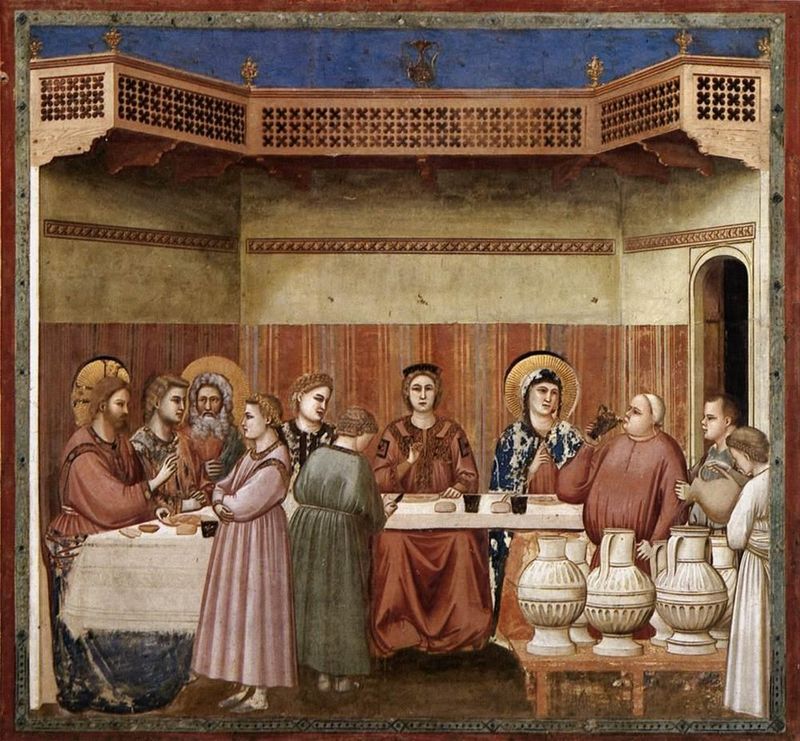
The scene is familiar. Jesus, his mother, and his disciples are guests at a wedding in the Galilean village of Cana. The wine runs out — a serious social embarrassment in first-century honor culture. Mary turns to Jesus and says, simply, “They have no wine” (John 2:3). Jesus responds: “Woman, what concern is that to you and to me? My hour has not yet come” (John 2:4, NRSV).
For centuries, interpreters have read this as a rebuke. The older translations reinforce that reading. The King James Version renders the line as “Woman, what have I to do with thee?” — which in seventeenth-century English sounds almost hostile. But the NRSV’s “What concern is that to you and to me?” is closer to the Greek (ti emoi kai soi), which is an idiomatic expression that can range in force from mild disengagement to a sharper expression of non-involvement, depending on context.6
And the context here argues powerfully for partnership. Look at what happens next. Mary does not retreat. She does not apologize. She does not behave like someone who has just been put in her place. Instead, she turns to the servants and says, “Do whatever he tells you” (John 2:5). This is not the response of a chastened mother. Mary’s confident response suggests she heard the disengagement as signaling the terms under which he would act, not as a refusal — a reading that preserves the idiomatic force of distancing while accounting for what actually happens next.
George R. Beasley-Murray notes that the idiom ti emoi kai soi does not inherently signal rejection; its meaning is determined by the relationship and the situation in which it is spoken.7 In this situation, Mary’s confident instruction to the servants only makes sense if she understood Jesus to be signaling cooperation. She pushes him toward his “hour,” and he responds by performing the first of the signs — transforming water into wine.
I explore the full narrative dynamics of this scene in my article on the mother of Jesus in John’s Gospel, and I have also written a companion piece on Cana and Calvary in John’s Gospel that traces the structural parallels between the wedding and the crucifixion. What I want to emphasize here is the specific function of the word “Woman.” By addressing Mary this way — respectfully but without the maternal title — Jesus signals that what is about to happen at Cana is not a family favor. It is a theological event. The first sign, which “revealed his glory” (John 2:11), is framed not as a son helping his mother with a social crisis but as the beginning of something cosmic.
The question “Why does Jesus say ‘What have I to do with thee’ at the wedding at Cana?” has a better answer than most readers expect. He is not dismissing Mary. He is inviting her into a different kind of relationship — one defined not by biological kinship but by participation in the unfolding revelation of God’s glory. And she accepts.
The Same Word from the Cross
The second occurrence of “Woman” as an address to Mary comes at the end of Jesus’ public ministry, from the cross itself:
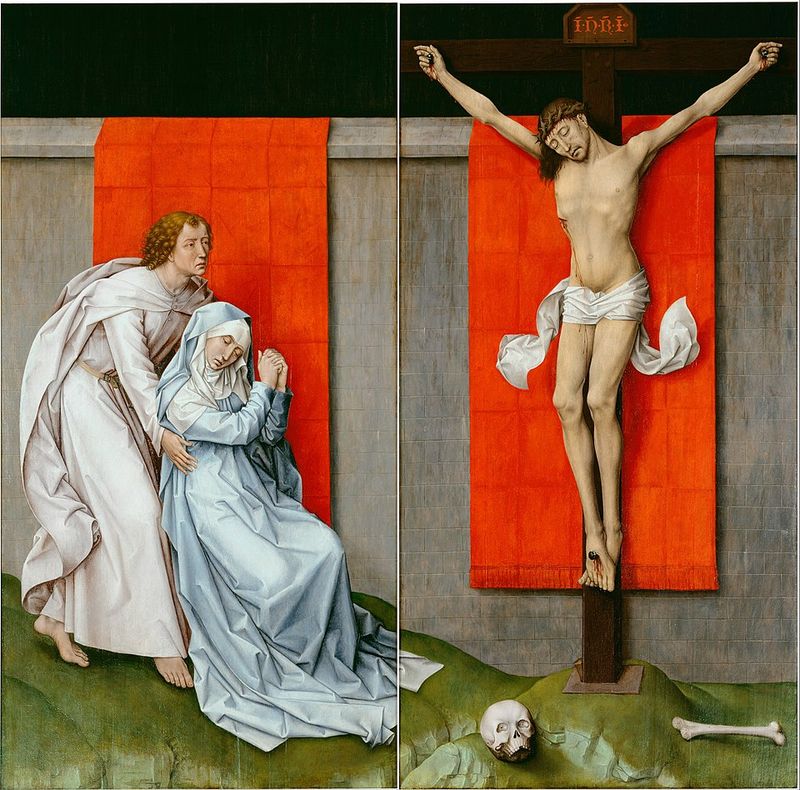
When Jesus saw his mother and the disciple whom he loved standing beside her, he said to his mother, “Woman, behold your son.” Then he said to the disciple, “Behold your mother.” And from that hour the disciple took her into his own home. (John 19:26-27)
Here the address “Woman, behold your son” carries an entirely different emotional weight. Jesus is dying. His mother is standing at the foot of the cross. And yet the same word — gynai — reappears, binding this scene to Cana with unmistakable intentionality.
The literary device at work is called an inclusio: a bracketing structure in which a motif or phrase appears at the beginning and end of a unit, signaling that everything between those markers should be read as a unified whole.8 John uses the address “Woman” at Cana (the first sign) and at Calvary (the final act), creating a frame around Jesus’ entire public ministry. The mother of Jesus appears at the opening and closing of the story, and both times she is addressed with the same unprecedented word.
C. Marvin Pate has argued that this inclusio is central to John’s narrative theology, linking the “hour” that had “not yet come” at Cana to the hour that has now arrived at the cross.9 The wine that Jesus provided at the wedding feast finds its ultimate expression in the blood and water that flow from his pierced side (John 19:34). And Mary, addressed as “Woman” at both moments, stands at the hinge of each scene.
But what does Jesus actually accomplish by saying “Woman, behold your son”? On the surface, he is providing for his mother’s care after his death — entrusting her to the Beloved Disciple. But John is rarely interested in surfaces. The scene also establishes a new community: the mother of Jesus and the disciple whom Jesus loved are bound together not by blood but by the word spoken from the cross. This new family, forged in the hour of Jesus’ glorification, is a microcosm of the believing community that John’s Gospel addresses.
For more on the Beloved Disciple’s role and identity in John’s narrative, see my discussion of women in the Gospel of John, which situates Mary within the broader pattern of female witnesses and disciples in the Fourth Gospel.
New Eve Typology (with Caveats)
No discussion of Jesus calling Mary “Woman” would be complete without addressing the New Eve interpretation — the idea that Jesus’ use of gynai deliberately echoes Genesis 3:15, where God says to the serpent: “I will put enmity between you and the woman, and between your offspring and hers.” On this reading, Mary is the “woman” whose offspring crushes the serpent’s head, and Jesus’ address identifies her as the New Eve, the mother of a redeemed humanity.
This reading has deep roots in Catholic and Orthodox theology. It finds further support in Revelation 12:1, where a “woman clothed with the sun” gives birth to a male child who is caught up to God — a passage that many interpreters read as a symbolic portrait of Mary. The logic is straightforward: if John’s Gospel begins with an echo of Genesis 1:1 — “In the beginning was the Word” (John 1:1) — then a deliberate echo of Genesis 3 would fit the pattern of Johannine creation theology.10 I have written about John’s prologue and its Genesis parallels elsewhere, and the connections are real.
Some serious scholars accept some version of this typology. Brown, for instance, was cautious but acknowledged that the Genesis echoes could not be entirely dismissed, particularly given the way John 2:1 introduces the Cana narrative with “On the third day” — a phrase loaded with resurrection connotations.11 Keener similarly notes the possibility but stops short of making it central to his interpretation.12
I want to be honest about where I come down on this. The New Eve reading is theologically elegant, and I understand its appeal. But my own analysis — shaped by the source-critical and narrative-critical methods I encountered at Yale Divinity School — focuses more on what the text demonstrably does at the literary level than on what it might symbolize at the typological level. The inclusio between Cana and Calvary is a structural feature of the text. The Genesis typology is an interpretive inference drawn from that structure. Both are worth taking seriously, but they operate at different levels of certainty.
What I can say with confidence is that the address “Woman” elevates Mary beyond the biographical. Whether that elevation reaches all the way to New Eve status or stops at the level of theological witness and narrative function is a question that Protestant and Catholic readers will answer differently — and that is fine. The text supports a range of readings, and intellectual honesty requires acknowledging that range.
The Christological dimensions of this question — what it means for the fully divine and fully human Jesus to redefine his relationship with his mother — also intersect with the conciliar debates about Christ’s nature. The Council of Chalcedon affirmed that Christ is one person in two natures, and the address “Woman” can be read as an expression of that Chalcedonian logic: the human son of Mary speaks to his mother not merely as her child but as the one whose “hour” encompasses the salvation of the world.
Why It Matters
So why does any of this matter? Why spend this many words on a single term of address?
Because how we read “Woman” determines how we read Mary — and how we read Mary determines, in significant part, how we read the Gospel of John. If “Woman” is a rebuke, then Mary is being put in her place, and her role in the narrative is primarily cautionary: even Jesus’ mother had to learn the limits of her influence. If “Woman” is merely polite, then Mary is a background figure — present but not theologically significant. But if “Woman” is a deliberately marked form of address that repositions Mary from biological mother to theological witness, source, and partner in the revelation of Jesus’ glory, then something far more interesting is happening.
On this third reading — which I believe the evidence supports — Mary stands at the intersection of the personal and the cosmic. She is the one who pushes Jesus toward his hour at Cana. She is the one who stands at the cross when that hour arrives. She is addressed not as “Mother” but as “Woman” because her role in the narrative transcends the maternal. She is, in John’s telling, a figure of the believing community itself: the one who sees the need, trusts the response, and remains present through the suffering.
This reading does not require Marian devotion. It does not require accepting the New Eve typology or the Marian dogmas of later centuries. It requires only that we take John’s literary art seriously — that we notice what the text does, how it does it, and what it asks of us as readers.
I return to this theme from multiple angles in my full study of the mother of Jesus in John’s Gospel, and I encourage readers who have found this discussion compelling to engage with that longer treatment. The word “Woman” is a thread, and when you pull it, the entire tapestry of John’s narrative theology comes into view.
Frequently Asked Questions
Is it disrespectful for Jesus to call Mary “woman”?
No. The Greek word gynai (γύναι) was a standard, respectful form of address in the first-century Mediterranean world, roughly equivalent to “ma’am” or “madam.” Jesus uses the same word to address the Samaritan woman (John 4:21), the woman caught in adultery (John 8:10), and Mary Magdalene (John 20:13, 15) — all in contexts of dignity and care. The strangeness lies not in the word itself but in the fact that no known parallel exists of a son addressing his mother this way. The address is respectful but deliberately marked, signaling that Mary’s role in John’s narrative is theological, not merely familial.
Why does Jesus say “What have I to do with thee” at the wedding at Cana?
The Greek phrase ti emoi kai soi (literally, “what to me and to you?”) is an idiom whose force depends on context. Older translations like the KJV render it as a sharp dismissal, but the NRSV’s “What concern is that to you and to me?” better captures the range of the expression. Mary’s immediate response — confidently instructing the servants to “do whatever he tells you” (John 2:5) — indicates that she heard partnership, not rejection. Jesus calls Mary “woman” at Cana (John 2:4) not to rebuke her but to signal that the miracle about to occur belongs to the realm of his messianic mission, not to a simple family request.
What does Jesus mean by “Woman, behold your son” in John 19:26?
From the cross, Jesus entrusts his mother to the Beloved Disciple and the Beloved Disciple to his mother, creating a new familial bond rooted not in blood but in the community of faith. The scene has both a practical dimension — providing for Mary’s care — and a theological one. It completes the inclusio begun at Cana: the same word, “Woman,” frames the opening and closing of Jesus’ public ministry. Many scholars, including Raymond E. Brown and C. Marvin Pate, read this moment as the founding of a new community at the foot of the cross, in which the mother of Jesus and the Beloved Disciple represent the believing church.
Does Jesus calling Mary “woman” support New Eve theology?
It can, but the case is not airtight. Some scholars argue that Jesus’ address echoes Genesis 3:15 (“I will put enmity between you and the woman”) and identifies Mary as the New Eve whose offspring defeats the serpent. This reading is strengthened by John’s broader pattern of Genesis allusions, beginning with the prologue’s echo of Genesis 1:1. However, other scholars — particularly in the Protestant tradition — emphasize the literary and narrative functions of the address without committing to the typological framework. The text supports both readings, and responsible interpretation requires acknowledging that the New Eve connection, while theologically significant for many Christian traditions, remains an interpretive inference rather than an explicit claim of the text.
Footnotes
-
See BDAG (Bauer, Danker, Arndt, and Gingrich), A Greek-English Lexicon of the New Testament and Other Early Christian Literature, 3rd ed. (Chicago: University of Chicago Press, 2000), s.v. γυνή. The vocative gynai is consistently glossed as a respectful form of address. ↩
-
Dio Cassius, Roman History 51.12.6. See also the discussion in Craig S. Keener, The Gospel of John: A Commentary, 2 vols. (Peabody, MA: Hendrickson, 2003), 1:503-504. ↩
-
Raymond E. Brown, The Gospel According to John I-XII, Anchor Bible 29 (New York: Doubleday, 1966), 99. ↩
-
Brown, John I-XII, 99. Brown’s survey remains the most comprehensive treatment of the question, and subsequent scholarship has not overturned his finding. ↩
-
Keener, The Gospel of John, 1:504. Keener notes that the address is “not disrespectful” but “is not the way a son would normally address his mother.” ↩
-
The idiom ti emoi kai soi appears in the LXX (e.g., Judg. 11:12; 2 Sam. 16:10; 1 Kgs. 17:18) with varying degrees of force. See Brown, John I-XII, 99-100, and George R. Beasley-Murray, John, Word Biblical Commentary 36 (Waco, TX: Word Books, 1987), 34-35. ↩
-
Beasley-Murray, John, 34-35. Beasley-Murray argues that the idiom in John 2:4 falls on the milder end of the spectrum, indicating that Jesus is not rejecting Mary’s implicit request but clarifying the terms under which he will act. ↩
-
On inclusio as a literary device in John, see R. Alan Culpepper, Anatomy of the Fourth Gospel: A Study in Literary Design (Philadelphia: Fortress Press, 1983), 77-79. ↩
-
C. Marvin Pate, The Writings of John: A Survey of the Gospel, Epistles, and Apocalypse (Grand Rapids: Zondervan, 2011), 120-124. ↩
-
For the Genesis framework of John’s Gospel, see Mark L. Appold, “The Structure of John 1,” in The Oneness Motif in the Fourth Gospel (Tubingen: Mohr Siebeck, 1976), and the broader discussion in Brown, The Gospel According to John XIII-XXI, Anchor Bible 29A (New York: Doubleday, 1970), 925-926. ↩
-
Brown, John I-XII, 107-109. Brown’s discussion is characteristically careful: he acknowledges the possibility of a New Eve allusion while insisting that the primary meaning of the passage is narrative and christological. ↩
-
Keener, The Gospel of John, 1:505-506. ↩

Garrett Ham
Garrett Ham is an attorney, military veteran, and holds a Master of Divinity from Yale Divinity School. He writes from Northwest Arkansas on theology, law, and service.
More about Garrett →Related Posts
The Mother of Jesus as a Named Source in John
An analysis of John 19:26-27 arguing that Mary, the mother of Jesus, served as a named source for the Gospel of John. Based on a paper from Yale Divinity School.
The Parallels Between Cana and Calvary in John's Gospel
The wedding at Cana and the crucifixion share extraordinary parallels — drink, thirst, the hour, and the mother of Jesus. These connections are the key to understanding John's Gospel.
Why Did Jesus Give Mary to John at the Cross?
Jesus bypassed his own brothers to commend his mother to the Beloved Disciple. This wasn't just filial care — it was a theological act that reshaped how we read John's Gospel.
Stay Informed
Get new writing on faith, law, and service delivered to your inbox.
No spam. Unsubscribe anytime.