Why Conservatives Should Read Their Opponents

On This Page
I enrolled at Yale Divinity School not by accident, not because my faith was in question, but because I wanted to test it. I had graduated from Ouachita Baptist University—a solidly Christian institution in small-town Arkansas—more than a decade earlier and had just completed twelve years in the Air Force. But I found myself asking a question that conservative evangelical parents rarely ask their children: What if the best case against what I believe is actually stronger than I’ve assumed? What if I owe it to my faith to discover whether my convictions could survive sustained contact with the strongest arguments the other side could produce?
So I went to New Haven. For three years, I sat in seminars where the intellectual framework I had inherited was not granted respect. It was questioned. It was challenged. And I left Yale Divinity more conservative than I arrived—but the testing mattered. That is not something you often hear a conservative say about progressive theological education. But it is precisely why I think more conservatives should undertake it.
Buckley’s Example
William F. Buckley Jr. understood something that has become unfashionable in American conservatism: intellectual engagement with your opponents is not a compromise with your principles. It is a vindication of them.
Buckley’s friendship with John Kenneth Galbraith is instructive.4 Galbraith was a Harvard man, an economic liberal, a relentless critic of capitalism’s inequalities. Buckley was a Yale man, a National Review editor, the intellectual godfather of American conservatism. They disagreed on nearly everything that mattered. Yet they maintained a genuine friendship across those decades of public disagreement—a friendship rooted in mutual intellectual respect and, importantly, in Buckley’s refusal to reduce Galbraith’s arguments to caricature.
Consider, too, his famous debates with Norman Mailer5—those two towering intellectual figures of the 1960s who argued vociferously and publicly about every major issue of their era: Vietnam, revolution, the meaning of America itself. They were genuinely opposed. They were also, by accounts of those close to them, close friends who shared a warm mutual admiration behind the scenes. Mailer understood that Buckley was engaging with his actual argument, not with a strawman version constructed for rhetorical convenience.
When Buckley hosted guests on Firing Line, his approach was almost courtly. He would ask his interlocutor to elaborate, to sharpen their position, to state their case more precisely—and only then would he offer his counterargument. The implicit premise of the show was that your opponent’s strongest argument deserves your strongest response. Anything less is not only intellectually dishonest; it is insulting. National Review’s founding mission statement spoke of “honest intellectual combat.” Notice the word “honest”—it is doing real work there. Combat it might be, but honest it must remain.
This is what has been lost.
Mill’s Logic
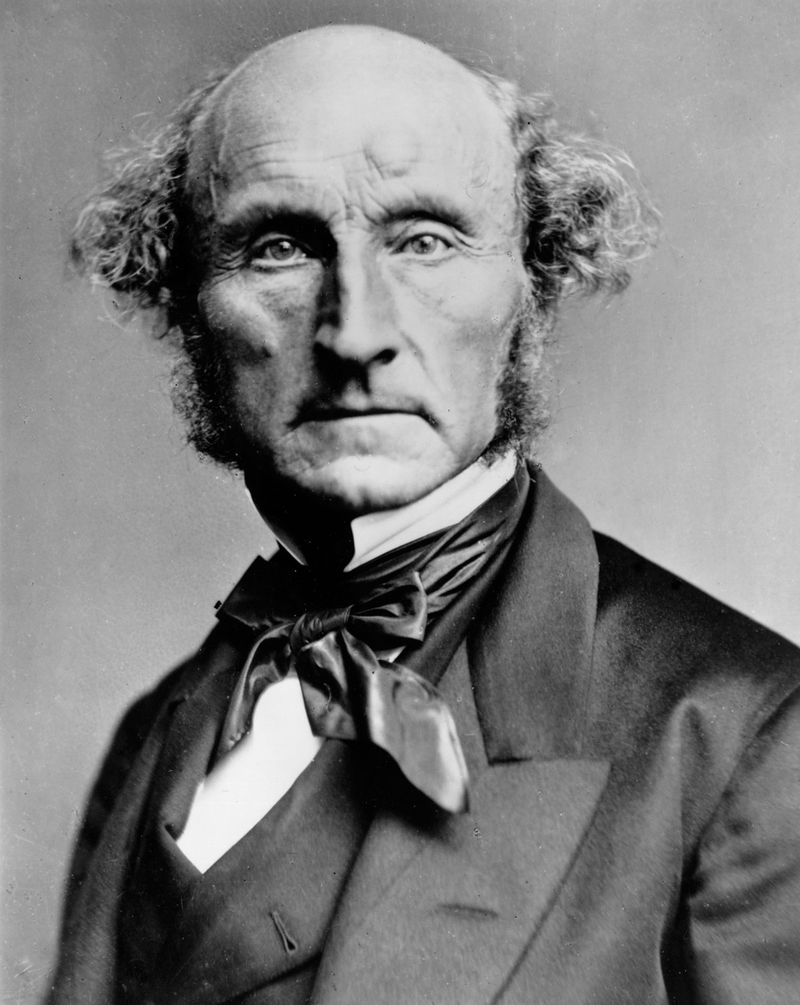
John Stuart Mill was not a conservative, though conservatives have learned to read him carefully. In On Liberty1, he makes an argument about intellectual engagement that cuts at the heart of why conservatives should read their opponents:
“He who knows only his own side of the case, knows little of that.”
This is not a plea for relativism. Mill is not saying your side might be wrong. He is saying that if you know only your own side, you have no rational ground for believing your side is right. You have merely inherited a position, or accepted it on authority, or chosen it for comfort. You have not tested it. You have not submitted it to the crucible of genuine opposition.
Mill extends the argument further, and here it becomes almost uncomfortable: “So essential is this discipline to a real understanding of moral and human subjects, that if opponents of all important truths do not exist, it is indispensable to imagine them, and supply them with the strongest arguments which the most skilful devil’s advocate can conjure up.”2 He is arguing that the health of an idea depends upon the existence of serious opposition to it. Without that friction, even true ideas decay into dogma.
This is not a progressive argument. This is a conservative argument. Conservative philosophy rests on the claim that certain truths have been tested across centuries and institutions, that they have survived sustained intellectual opposition, that they are not merely fashionable but structurally sound. But that claim only holds if the opposition has been genuine and has been seriously engaged. The moment conservatives retreat from that engagement, they lose the ground for their own argument. They become merely defenders of tradition rather than advocates for truth.
Aquinas’s Method
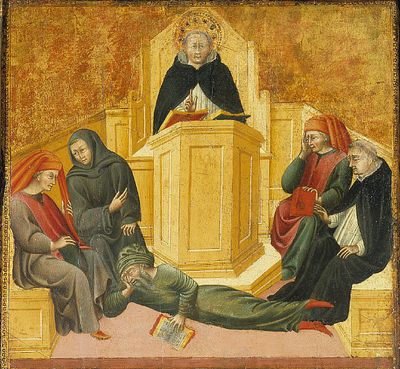
When Thomas Aquinas composed the Summa Theologiae3, he employed a method that few contemporary scholars—on either side of the political divide—seem to understand or appreciate. He would pose a question. He would then list objections to the answer he intended to give. Crucially, he stated those objections—as Bishop Robert Barron has observed—“in their most convincing form, often stating them better and more pithily than their advocates could.” He drew on pagan philosophers, Jewish scholars, Islamic thinkers—not because he agreed with them, but because he trusted that truth could survive the encounter with their best arguments.
This is the medieval Christian model of intellectual engagement. It is not cautious. It is not apologetic in the contemporary sense. It is confident—but a confidence rooted in something deeper than mere assertion. It is the confidence that comes from having said to your intellectual opponent: “State your case as strongly as you can. I will state mine. And we will see which one actually holds up under examination.”
Aquinas did not fear the other side’s arguments. He feared being caught in an argument with someone who had not bothered to understand them. He understood that to refute something poorly stated is not to refute it at all.
What Happens When You Don’t
Conservative intellectual culture has increasingly abandoned this method. In its place, we have substituted something else entirely: conservatism as performance. As outrage. As trolling. As the reflex reaction to progressive excess without the hard work of understanding what progressives actually believe and why they believe it.
This is not a new development—populism has always had a certain contempt for the intellectual life—but it has metastasized in recent years. We have created a conservative media ecosystem in which the opposition is never engaged with charitable precision but rather reduced to caricature, to the worst possible interpretation of what they might believe, to the arguments they would make if they were even stupider than they probably are. This makes conservative arguments weaker, not stronger. It makes them brittle.
Think about what happens when you spend months or years fighting a strawman version of progressive arguments. When you finally encounter the actual argument, made by someone who has thought about it, you are unprepared. You have no practice in the difficult work of distinguishing between what is actually problematic in progressive thought and what is merely different. You cannot separate the strong criticism from the weak one. You become a caricaturist fighting a caricature, never ascending to the level of actual intellectual engagement.
This is the cost of the conservative retreat from serious opposition. We have made our own arguments weaker by refusing to test them.
What I Found at Yale
Those three years at Yale Divinity School exposed me to progressive theological arguments at their strongest. Some of them were genuinely compelling—so much so that they forced me to think harder about what I actually believed and why I believed it. The encounter with a serious theological liberalism, articulated by scholars who had spent decades thinking about these questions, made my own conservatism more precise, more grounded, more defensible.
Some of the progressive arguments I encountered were, I came to believe, intellectually vacuous—rooted more in fashion than in logic, more in the desire to be thought modern than in rigorous theological reasoning. But I could only discover this by reading them closely, by sitting in seminars where they were treated seriously, by being forced to articulate why I found them insufficient.
The point is not that the other side is right. The point is not even that the other side sometimes makes good arguments, though that is true. The point is that you cannot know your own position is right until you have honestly engaged the strongest case against it. Until you have encountered an articulate defender of the opposing view who actually believes what they are saying and has thought about it carefully, you are skating on the surface of your own convictions.
I left Yale Divinity more conservative than I arrived—but a different kind of conservative. Not a reflexive one. Not a cultural conservative who has never examined why he believes what he believes. Not a conservative who fears the test. But a conservative who has subjected his convictions to scrutiny and found them—not perfect, not without tension, not without need for continued thought—but adequate to the reality of things.
The Intellectual Debt We Owe
In the years since Yale, I have had the privilege of knowing serious thinkers across the political spectrum—in the law, in the military, in various institutional contexts. The conservatives I respect most are invariably those who read their opponents. They are the ones who can articulate the progressive position better than many progressives can. They are the ones who know precisely where the disagreement lies and why it matters, rather than shouting past a caricature.
This is not a small thing. It is the difference between knowing your position and performing it. It is the difference between defending something because you believe it and defending it because it has been successfully defended. It is the difference between being a thinker and being a partisan.
Buckley understood this. Mill argued for it. Aquinas modeled it. And the conservative intellectual tradition from Russell Kirk to the editors of National Review—the tradition that actually built something, that actually shaped institutions, that actually won arguments—has rested on the assumption that honest engagement with the opposition is not a weakness but a strength.
The cost of abandoning that engagement is not immediately apparent. The cost accrues slowly. Conservative arguments become simpler, easier to make, more satisfying to believers. They also become less true, less persuasive to anyone who has actually thought about the matter, less capable of surviving contact with reality.
There is something to be said for the discomfort of reading your opponents carefully. There is something to be said for the intellectual humility that comes from discovering that someone you disagree with has made a point you had not considered, or has articulated an objection to your position that you cannot easily dismiss. That discomfort is not a sign that you are being softened or compromised. It is a sign that you are doing the work of thinking.
I think of those three years at Yale Divinity—the crowded seminars, the arguments that went nowhere, the moments when I was forced to articulate something I had always believed but never had to defend. I think of the dinner conversations where conservative ideas were simply not granted the respect I thought they deserved, and how that forced me to make a case rather than assert a position. I think, too, of the conversations where someone across the ideological divide actually engaged with what I was saying, and I felt the rarer pleasure of being genuinely heard.
That is what Buckley knew. That is what we seem to have forgotten. The other side is not an enemy to be vanquished so much as an opponent to be engaged—not because we might be wrong, but because we might learn something about why we are right.
Read your opponents. Not because you might agree with them. But because you might learn something about yourself.
- John Stuart Mill, On Liberty (1859), Book II, Chapter II. Mill's argument about the necessity of encountering opposing views forms the epistemological foundation for why intellectual engagement strengthens rather than weakens conviction. 1.
- Mill, On Liberty, Book II, Chapter II. This passage directly anticipates the Thomistic method: the deliberate construction of the strongest possible counterargument as a condition for intellectual health. 2.
- Thomas Aquinas, Summa Theologiae (c. 1265–1274), Part I, Question 1, Articles 1–10. The *Summa's* structure of objection-response-resolution became the standard template for scholastic theological method and remains the model for serious intellectual engagement with opposing positions. 3.
- The Buckley-Galbraith friendship is well-documented in John B. Judis's biography William F. Buckley Jr.: Patron Saint of Conservatives (2020) and in Buckley's own reflections in The Unmaking of Americans (1968) and Nearer, My God (1997). Their mutual respect across ideological lines became a model for serious conservative-progressive dialogue in mid-twentieth-century America. 4.
- Buckley and Mailer's debates are documented in numerous *Firing Line* episodes from the 1960s and 1970s, particularly their exchanges on American foreign policy and cultural revolution. See also Norman Mailer's Advertisements for Myself (1959) for his perspective on the relationship. 5.

Garrett Ham
Garrett Ham is an attorney, military veteran, and holds a Master of Divinity from Yale Divinity School. He writes from Northwest Arkansas on theology, law, and service.
More about Garrett →Related Posts

The Buckley Program at Yale: Intellectual Diversity on a Progressive Campus
A firsthand account of the William F. Buckley Jr. Program at Yale—what it does, why it matters, and what it's like to be a conservative Fellow on a campus that would rather you weren't.

Week 5: Conservatives at Yale Divinity
Is Yale Divinity liberal? Yes. But conservative students thrive. A candid account of being a conservative at Yale Divinity School and finding your place there.

Angry All the Time in the Ivy League
Campus activists at elite colleges like Yale often appear perpetually angry. But beneath the outrage lies a deeper psychological need: the search for heroic purpose and significance.
Stay Informed
Get new writing on faith, law, and service delivered to your inbox.
No spam. Unsubscribe anytime.