Who Were the Essenes? A Catholic Guide to the Dead Sea Scrolls Community
On This Page
“The Essenes are a group which follows a way of life taught to the Greeks by Pythagoras. They disdain pleasures as a vice, and regard temperance and the conquest of passions as a virtue. They despise marriage, but they adopt children from their infancy and instruct them in their doctrines.”
Josephus, Jewish War 2.8.2, adapted from Whiston
Key Takeaways
- The Essenes were a Jewish sect or movement of the Second Temple period (2nd century BC – 1st century AD) known for strict communal discipline, ritual purity, and apocalyptic beliefs
- The Qumran community, which preserved the Dead Sea Scrolls, is widely (though not universally) identified with the Essenes described by Josephus, Philo, and Pliny the Elder
- The Essenes practiced communal property, ritual immersion, elaborate purity laws, a hierarchical novitiate system, and ceremonial meals that may prefigure early Christian practice
- Essene theology was marked by determinism, cosmic dualism (two spirits), and messianic expectation, including belief in two messiahs: a priestly and a royal messiah
- The Teacher of Righteousness was a central figure in Essene religious life, and conflict with the “Wicked Priest” shaped their sectarian identity
- The Essenes and early Christians shared certain practices (communal living, baptism, eschatological urgency) but differed fundamentally on Christology and inclusivity
- Understanding the Essenes illuminates the diversity of Judaism in Jesus’s time and confirms the deep Jewishness of early Christian practice
Introduction: Who Were the Essenes?
The Essenes were a Jewish religious community or sect that flourished during the Second Temple period, particularly from the 2nd century BC until their apparent destruction during the Jewish War against Rome (66–70 AD). To many contemporary Jews, they were a marginal or eccentric group, but to scholars of Judaism and Christian origins, they are indispensable for understanding the religious landscape into which Jesus was born and in which the early Church emerged.
We know the Essenes primarily through three ancient sources: the writings of the Jewish historian Josephus (who lived in the first century AD), the philosophical works of Philo of Alexandria (also first century), and a brief reference by the Roman naturalist Pliny the Elder. Before the discovery of the Dead Sea Scrolls in 1947, these ancient texts were our only window into Essene life and belief. However, the Scrolls themselves—preserved by what scholars believe was the Essene community at Qumran—have given us direct access to Essene religious literature, allowing us to read their own words about their theology, practices, and community life.
For Catholics seeking to understand early Christianity, the Essenes matter deeply. They represent a form of Jewish piety and messianic expectation that was contemporaneous with Jesus. By studying the Essenes, we learn what it meant to be Jewish in the first century, what kinds of religious innovation and sectarian separation were possible within Judaism, and how the early Church’s own practices (communal living, ritual initiation, eschatological expectation) were rooted in Jewish precedent. The Essenes also illustrate the theological diversity within Judaism at the time of Christ, reminding us that there was no single “Judaism” but rather multiple movements, interpretations, and visions of Israel’s future.
Ancient Sources on the Essenes
Josephus: The Detailed Account
The most extensive ancient description of the Essenes comes from Josephus Flavius, a Jewish historian and military commander who lived from AD 37 to approximately 100. Josephus wrote two major works: the Jewish War (composed around AD 75–79) and the Antiquities of the Jews (completed around AD 94). In both works, Josephus devotes considerable space to describing the Essenes, their organization, beliefs, and practices.
Josephus presents the Essenes as one of three major philosophical schools or sects within Judaism, alongside the Pharisees and Sadducees. (Josephus also describes a “fourth philosophy” founded by Judas the Galilean [Antiquities 18.1.6], a revolutionary movement sometimes loosely equated with the Zealots, though the Zealots proper were a specific faction active during the revolt of 66–70 AD.) In his account, Josephus emphasizes several distinctive features of Essene life:
Communal Property: The Essenes held all property in common. When a person joined the sect, they surrendered their personal possessions to the community, and these goods were administered for the benefit of all members. Josephus notes that there was no buying and selling among the Essenes; instead, they relied on community resources.
Strict Observance: The Essenes observed the Law of Moses with exceptional rigor. They were known for their concern with ritual purity, their scrupulous observance of the Sabbath, and their fidelity to Jewish dietary laws. Josephus reports that they would not carry money on the Sabbath or travel outside their settlement on that day.
Celibacy and Simplicity: Josephus states that the Essenes disdained marriage and family life, viewing them as impediments to spiritual perfection. They lived simple, austere lives, avoiding luxury and sensual pleasure. (Though Josephus does mention some Essenes who did marry, he presents the celibate form as normative.)
Communal Meals: The Essenes gathered for formal, ritualistic meals together. Josephus describes how a priest would bless the food and drink, and members would eat in silence. These meals had a quasi-liturgical character, reflecting the community’s sense that ordinary activities were sacred and required purification and ritual propriety.
Secrecy and Initiation: Entry into the Essene community was not automatic but required a probationary period and initiation. Josephus describes a rigorous novitiate during which candidates progressively demonstrated their commitment and understanding of the community’s teachings. The Community Rule (1QS 6:13–23) specifies a two-year probationary period following initial examination.
Determinism and Providence: Josephus notes that the Essenes believed strongly in divine determination of all events. They held that God foreknows all things and that human free will operates within the bounds of God’s providential will.
Philo of Alexandria: The Philosophical Perspective
Philo of Alexandria (c. 20 BC – c. AD 50) was a Jewish philosopher and theologian who sought to harmonize Jewish law with Greek philosophical thought. Philo knew the Essenes and wrote about them in two texts: Every Good Man Is Free and Hypothetica (preserved partly in Eusebius’s Preparation for the Gospel).
Philo’s account largely corroborates Josephus, but Philo approaches the Essenes from a philosophical angle. He presents them as exemplars of virtue and wisdom, as Jews who have achieved what Stoic philosophers sought: freedom from passion (apatheia) and alignment with divine reason. Philo emphasizes their communal living, their rejection of slavery (Philo notes that Essenes refused to own slaves and regarded slavery as contrary to natural law), and their dedication to virtue.
Josephus also mentions a “second order” of Essenes who married (Jewish War 2.8.13), contradicting the general implication that the Essenes were exclusively male and celibate. This suggests that Essene practice may have been more diverse than the predominant accounts indicate, or that different Essene communities followed different disciplines.
Pliny the Elder: Brief Geographic Notice
Pliny the Elder (AD 23–79), the Roman naturalist and encyclopedist, provides a brief but significant reference to the Essenes in his Natural History. Writing about geography and peoples, Pliny describes the Essenes as living near the western shore of the Dead Sea, above En Gedi. He remarks on their austere lifestyle, their communal sharing of property, and notably, he states that new members continually joined their community, attracted by their way of life—“no one is born among them” (suggesting adoption and voluntary conversion rather than hereditary membership).
Pliny’s brief account is valuable because it places the Essenes geographically near Qumran, supporting the identification of the Qumran community (which produced the Dead Sea Scrolls) with the Essenes.
The Qumran-Essene Identification: Evidence and Debate
For many decades, scholars have identified the community that occupied Qumran and produced the Dead Sea Scrolls with the Essenes described by Josephus, Philo, and Pliny. This identification has been widely accepted, but recent scholarship has raised important questions about its certainty.
Evidence Supporting the Identification
Several factors support identifying the Qumran community with the Essenes:
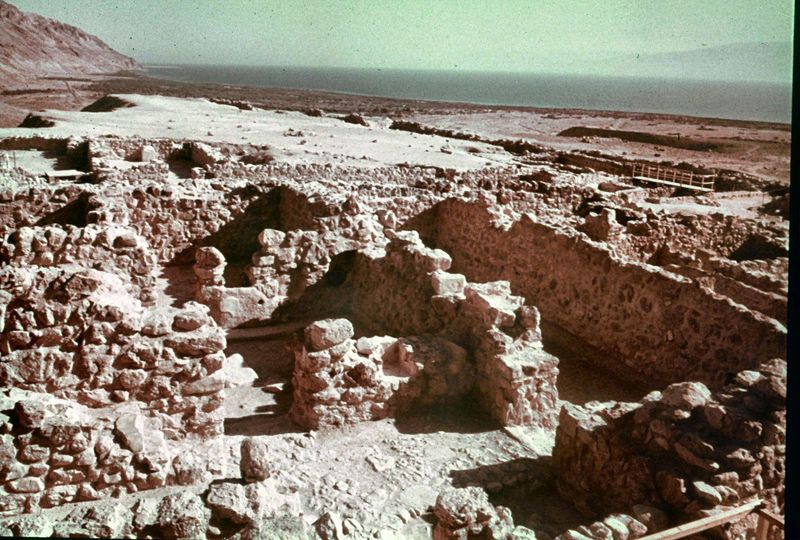
Geographic Location: Pliny places the Essenes on the western shore of the Dead Sea, above En Gedi. Qumran is precisely in this location. The proximity matches.
Chronological Overlap: The scrolls date from roughly the 3rd century BC to the mid-1st century AD, overlapping with the period when Josephus, Philo, and Pliny were writing about the Essenes.
Communal Organization: The Community Rule (1QS) describes a hierarchical, highly organized community with communal property, shared meals, and initiation procedures—features that align closely with Josephus’s account of the Essenes.
Ritual Purity Practices: Both the ancient sources and the Qumran texts emphasize elaborate ritual purity laws, ritual immersion, and concern with cleanliness. Archaeologists have indeed found the remains of numerous ritual baths (miqvaot) at Qumran.
Celibacy: Josephus emphasizes Essene celibacy, and the archaeological evidence from Qumran shows a disproportionate number of male burials and a conspicuous absence of children’s remains in certain areas, suggesting a largely male, celibate community (though this too is debated).
Apocalyptic Theology: Both Josephus and the Qumran texts reflect intense apocalyptic expectation and belief in divine determinism, suggesting a community preparing for God’s imminent intervention in history.
Recent Challenges to the Identification
However, recent scholars have raised important questions about whether the ancient sources represent all Essenes or only one branch of a more diverse movement. Key objections include:
Diversity at Qumran: Recent archaeological work suggests that Qumran may have housed multiple groups or that the community evolved significantly over time. The sectarian texts (like the Community Rule) represent one perspective, but not necessarily the universal practice of all inhabitants.
Gaps in the Sources: The ancient sources on the Essenes are selective and may not capture the full complexity of the movement. Josephus himself mentions a marrying order of Essenes (Jewish War 2.8.13), suggesting internal diversity.
The Name Question: Nowhere in the Dead Sea Scrolls does the community explicitly call itself “Essene.” The identification relies on comparing ancient descriptions with Qumran practices, but this is inferential rather than explicit.
Other Groups: Qumran may have housed other sectarian Jews, not exclusively Essenes. The movement was broader than a single settlement.
A Nuanced Approach
The safest scholarly position today is that the Qumran community practiced a form of Judaism consistent with what we know of Essenism from ancient sources, and that the identified community was likely Essene or closely related to Essene Judaism. However, scholars now acknowledge that:
- The Essenes were probably more diverse in practice and geography than previously thought.
- The Qumran settlement may have housed multiple communities or experienced significant internal changes.
- The identification is probable but not certain and should not be treated as dogmatic.
For the purposes of this study, we can confidently say that the Qumran community and the Essenes described by ancient writers represent kindred expressions of Second Temple Jewish piety, even if the precise relationship cannot be definitively established.
Essene Beliefs and Practices
Communal Property and Sharing
One of the most distinctive features of Essene life was the practice of communal property. According to Josephus, when a person joined the Essenes, they surrendered all personal possessions to a common fund managed by appointed officers of the community. The Community Rule from Qumran (1QS) specifies this practice: “All who freely devote themselves to His truth shall bring all their knowledge, powers, and possessions into the community of God.”
This communal arrangement served theological purposes beyond mere practicality. By renouncing private property, Essenes symbolically renounced attachment to the world and worldly concerns. They understood this practice as part of their preparation for the eschatological kingdom and as an embodiment of Torah’s imperative to love God and neighbor. The community provided for members’ material needs, allowing them to focus on spiritual discipline, study, and observance of the Law.
For students of early Christianity, this Essene practice illuminates passages in Acts describing the Jerusalem community: “All who believed were together and had all things in common; they would sell their possessions and goods and distribute the proceeds to all as any had need” (Acts 2:44–45). The early Church’s communal sharing had Jewish precedent in Essene practice, though the Christians understood their community in light of Christ’s resurrection and the gift of the Holy Spirit.
Ritual Immersion and Purity
The Essenes were obsessed with ritual purity in a way that exceeded even Pharisaic standards. The Community Rule prescribes ritual immersion (baptism) for nearly every aspect of communal life. Members would immerse themselves upon entering the assembly, before partaking of communal meals, and after various forms of contact that were considered defiling.
Archaeologists have excavated numerous ritual baths (miqvaot) at Qumran, many with steps leading down to water basins. These were used for frequent immersion as acts of purification. Unlike ordinary bathing, ritual immersion was a religious act performed to restore ritual purity and prepare oneself for sacred activities.
The Essene concern with purity was rooted in the biblical priestly code (particularly Leviticus), which prescribed purification from various forms of impurity: menstruation, childbirth, disease, contact with death, and other conditions. The Essenes extended and elaborated these biblical practices, seeing ritual purity as essential for approaching the holy and participating in communal worship.
Purity Laws and Dietary Observance
Beyond immersion, the Essenes followed strict dietary laws and elaborate rules about purity and contamination. The Community Rule specifies which foods are permitted, how hands must be washed before eating, and how the entire community must be maintained in a state of ritual purity.
The Essenes were known for their exceptional Sabbath observance. Josephus reports that they would not defecate on the Sabbath (Jewish War 2.8.9), not because they regarded the bodily function itself as sinful, but because of a chain of Sabbath restrictions: they could not carry the required digging tool (mattock), could not dig the necessary pit, and their designated latrine areas exceeded the permitted Sabbath walking distance. They avoided traveling, carrying money, or doing any work on the Sabbath. These practices represented an extreme interpretation of the Sabbath command, but they reflected the Essene commitment to perfect obedience to the Law.
The Question of Celibacy
Josephus and Philo both emphasize Essene rejection of marriage. Josephus states that the Essenes “despise pleasure as a vice” and avoid marriage, “as though women were a snare to chastity.” This celibacy was rooted in their conviction that sexual relations, even within marriage, incurred ritual impurity (as prescribed in the Torah; see Leviticus 15:16–18), and that such impurity was incompatible with their community’s sacred mission.
However, Josephus mentions a “second order” of Essenes who did marry (Jewish War 2.8.13), suggesting that celibacy was an ideal for the most rigorous members but not universally practiced. Recent scholarship has also questioned whether the Qumran community was entirely celibate, noting that women’s and children’s graves have been found at some Essene sites, though not at the central Qumran cemetery.
The Essene ideal of celibacy anticipates later Christian monasticism and may have influenced early Christian discussions of marriage and singleness (see Paul in 1 Corinthians 7). However, Jesus and the apostles rejected celibacy as a requirement for spiritual perfection, affirming the goodness of marriage while recognizing a celibate vocation as a charism for some.
Communal Meals and Hierarchy
The Essenes held formal, communal meals that were semi-liturgical in nature. According to Josephus, a priest would bless the bread and wine before the community ate in silence. These meals were not casual social events but sacred practices reflecting the community’s sense that daily life itself was to be sanctified and ordered according to Torah.
The Community Rule specifies precise procedures for communal meals, including a hierarchical seating arrangement. Members sat according to their rank or office within the community, reflecting the Essene commitment to strict order and discipline. A priest presided, and members participated according to their status and degree of initiation.
This hierarchical structure raises important questions about early Christian practice. Did early Christians adopt the Essene model of communal meals? The Eucharist in the early Church certainly had communal dimensions (see 1 Corinthians 11), but the early Christians rejected the rigid hierarchy and exclusivity that characterized Essene meals.
The Novitiate and Initiation Process
Entry into the Essene community was not immediate. Josephus describes a rigorous probationary period, and the Community Rule (1QS 6:13–23) specifies a two–year process following initial examination:
Initial Examination: A candidate was examined by an overseer and, if accepted, began instruction in the community’s way of life and beliefs. During this preliminary stage, they were not yet admitted to the community’s rituals or meals and their property was not shared.
First Year of Probation: If the candidate demonstrated genuine commitment and understanding, they advanced to participate in communal purification rites (immersion), but still did not join the sacred meals or merge their property with the community’s.
Second Year of Probation: Having proved their worthiness and understanding, the candidate was admitted to the communal meals and fully incorporated into the community. At this point, their property was merged with the common fund, and they took oaths binding them to the community’s discipline and teachings.
The Community Rule specifies that a candidate could be rejected at any stage if they were found to be insincere or incapable of living according to the community’s standards. Once admitted, members were bound by solemn oaths to maintain the community’s secrets and preserve its rules.
This initiation process reflects the Essene understanding of their community as sacred and set apart, requiring serious commitment and proven worthiness. It may have influenced early Christian practice of catechetical instruction and baptism as entry into the Church, though again, the early Church was radically more inclusive, baptizing Gentiles and those outside the Jewish people.
The Teacher of Righteousness and Community Leadership
Who Was the Teacher of Righteousness?
The Dead Sea Scrolls frequently mention a figure called the “Teacher of Righteousness” (moreh ha-tzedaqah in Hebrew). This figure was clearly a central authority in the Qumran community, but his precise identity remains uncertain. Several scholars have proposed candidates:
- An Early Essene Founder: Some scholars suggest the Teacher was the founder or early leader of the Essene movement, perhaps from the 2nd century BC.
- The Wicked Priest’s Opponent: The Teacher engaged in conflict with a figure called the “Wicked Priest,” suggesting a specific historical conflict over temple authority or interpretation of the Law.
- A Prophetic Interpreter: The Teacher may have been a visionary or prophet who revealed the true interpretation of the Torah and the prophets, understanding them as speaking directly to the community’s time.
The scrolls themselves do not identify the Teacher by a personal name, referring to him instead by this honorific title. This suggests either that his identity was so well known to the community that they needed no further identification, or that they deliberately preserved anonymity.
The Role of the Teacher
The Teacher of Righteousness held multiple roles in the community:
Interpreter of Scripture: The Teacher was regarded as the supreme interpreter of Torah and the Prophets. The Pesharim (biblical commentaries) claim to reveal the hidden meaning of scripture, and these interpretations reflect the Teacher’s authority. The community believed that God had revealed to the Teacher the true meaning of the prophets, meaning that remained hidden from the rest of Israel.
Spiritual Guide: The Teacher provided spiritual direction and moral instruction to the community. The Thanksgiving Hymns (Hodayot) may have been composed by or attributed to the Teacher, celebrating God’s work in preserving and guiding the faithful remnant.
Legal Authority: The Teacher clarified the application of Torah to the community’s circumstances, issuing rulings on purity, Sabbath observance, and communal discipline.
Eschatological Figure: Some scholars suggest that the community may have understood the Teacher in quasi-messianic terms, as a figure through whom God’s final revelation was being communicated. However, this interpretation is debated, and the scrolls do not explicitly present the Teacher as a messiah.
Conflict with the Wicked Priest
The scrolls repeatedly mention conflict between the Teacher of Righteousness and a figure called the “Wicked Priest.” The 1QpHabakkuk (pesher on Habakkuk) provides cryptic allusions to this conflict:
“The Wicked Priest pursued the Teacher of Righteousness to the house of his exile, that he might consume him with the venom of his wrath. And at the season appointed for rest, for the Day of Atonement, he appeared before them to consume them and to make them stumble on the Day of Fasting, their Sabbath of rest.”
Who was the Wicked Priest? Scholars have proposed various identifications:
- Jonathan or Simon Maccabeus: High priests of the Maccabean dynasty (mid-2nd century BC)
- Jason or Menelaus: Hellenizing high priests of the Seleucid period
- Ananus II: A first-century AD high priest
The precise identification remains uncertain, but the conflict likely centered on the Teacher’s interpretation of the Law and rejection of the Jerusalem temple priesthood as currently constituted. The Teacher and his community may have viewed the Jerusalem priesthood as corrupt and illegitimate, a conviction that led them to separate from the broader Jewish community and establish their own alternative sectarian structure.
Essene Theology
Determinism and Divine Providence
The Essenes held a distinctive theological conviction regarding divine providence and human free will. Both Josephus and the Dead Sea Scrolls emphasize that the Essenes believed God foreknows all things and has predetermined the course of history.
The Community Rule states: “From the God of knowledge comes all that is and shall be. Before ever they existed, He established their whole design. And when they come into being, they fulfill their work in accordance with His glorious design.”
This determinism was not fatalism. The Essenes believed that humans had genuine responsibility for their choices, but those choices and their outcomes were encompassed within God’s prior knowledge and providential will. This parallels later Christian theology and particularly anticipates Paul’s wrestling with predestination and human responsibility in Romans 9–11.
The Essene emphasis on divine determinism had practical consequences: it reinforced their conviction that they were chosen by God to form a faithful remnant, and it gave them confidence that God would ultimately vindicate their cause and bring about the apocalyptic transformation they anticipated.
Cosmic Dualism: The Two Spirits
As detailed in the previous post on Apocalypticism in the Dead Sea Scrolls, the Essenes held a dualistic theology centered on two cosmic spirits: the Angel of Truth (Prince of Lights) and the Angel of Darkness. Other Qumran texts (the War Scroll, the Damascus Document) identify this Angel of Darkness with Belial, a figure who appears elsewhere in the Community Rule as well (1QS 1:18, 1:24, 2:5, 2:19).
The Community Rule teaches that God created both spirits and assigned every human being to one or the other: “He created man to rule the world, and appointed for him two spirits in which to walk until the time of visitation: the spirits of truth and falsehood.”
The spirits are not equals. The Angel of Truth acts on behalf of God and leads the righteous toward light, truth, and eternal life. The Angel of Darkness is an adversary figure who leads humans into error, wickedness, and darkness. The spirits represent cosmic forces, but they are also internalized as spiritual dispositions within human hearts.
This dualistic theology distinguished the Essenes from mainstream Pharisaic Judaism, which did not typically employ such stark cosmic dualism. However, it shared features with other Jewish apocalyptic movements and with later Christian angelology and demonology.
Messianic Expectation: Two Messiahs
Most first-century Jewish movements anticipated the coming of a messiah or messiahs. The Essenes held a distinctive messianic doctrine: they expected two messiahs, not one.
-
The Messiah of Aaron (Priestly Messiah): The Essenes expected a righteous, priestly messiah who would cleanse and restore proper worship and sacrifice in the temple.
-
The Messiah of Israel (Royal Messiah): They also expected a royal, Davidic messiah who would restore Israel’s political independence and bring military victory.
The two messiahs would work in concert, with the priestly messiah taking precedence (reflecting the Essenes’ priestly orientation). Both would arise in the final days to establish God’s kingdom.
This expectation of two messiahs was not unique to the Essenes but was present in various forms throughout Second Temple Judaism. It represents a reading of the Hebrew scriptures that identified two eschatological figures: a priestly restorer and a royal warrior-king.
Early Christian theology reinterpreted this expectation, understanding Jesus as the single messiah who fulfilled both the priestly and royal roles. Jesus is both priest (Hebrews 4–10) and king (Revelation 19:16), combining what the Essenes understood as separate eschatological figures.
Israel, Purity, and the Remnant
The Essenes understood themselves as the true Israel, the righteous remnant chosen by God. They believed that the broader Jewish community, including the Jerusalem priesthood and temple authorities, had abandoned the proper interpretation of Torah and had become defiled through compromise and wickedness.
By separating themselves and establishing a pure, disciplined community, the Essenes understood themselves as preserving authentic Judaism and preparing for the eschaton. They viewed their community as prefiguring the eschatological kingdom: a society ordered perfectly according to God’s will, free from defilement and wickedness, and poised for divine vindication.
This sectarian self-understanding—the conviction that one’s community alone embodied true faith while the broader religious establishment had fallen away—would become a recurring pattern in Jewish and Christian history. It reflects a conviction that authentic faith requires separation and reformation.
The Essenes and Early Christianity
Parallels and Affinities
Scholars have long noted striking similarities between Essene practice and the practices described in the early Christian sources, particularly the Book of Acts. These parallels suggest that early Christianity emerged in a Jewish context already experimenting with communal living, initiation rites, eschatological expectation, and sectarian separation.
Communal Living: Acts 2:44–45 describes the Jerusalem community sharing possessions and distributing goods to all as any had need. This parallels Essene communal property practice.
Ritual Initiation: Both the Essenes and early Christians practiced ritual immersion as an initiation rite marking entry into the community. Essene initiation involved a multi-stage probationary period; Christian baptism was more rapid but fulfilled a similar function of marking a decisive break with the past and entry into the covenant community.
Eschatological Urgency: Both the Essenes and early Christians lived with intense conviction that the end was near. Paul wrote to the Thessalonians expecting Christ’s return within his own lifetime. This apocalyptic imminence characterized both movements.
Sacred Meals: The Essene communal meals and the early Christian Eucharist both combined practical sustenance with sacred meaning. Both meals were ordered and disciplined, reflecting the community’s understanding that ordinary activities must be sanctified.
Purity Concerns: Though less emphasized in early Christianity than in the Essene community, purity language and concerns persist in the New Testament (1 Corinthians 5:7–8, 2 Corinthians 6:14–18, 1 John 1:7–9).
Critical Differences
However, the differences between Essene Judaism and early Christianity are equally significant and ultimately more consequential:
Christological Center: The fundamental difference is Christological. The Essenes expected a messiah (or two messiahs) to arrive in the future. Early Christians proclaimed that the messiah had already arrived in Jesus, had died and risen, and would return. This Christological conviction transformed everything: communal living was now practiced in light of the resurrection; initiation was baptism into Christ; meals commemorated his self-sacrifice.
Universal Inclusivity: The Essene community was exclusive, comprising a righteous remnant separated from the broader Jewish people. Early Christianity, especially after the inclusion of Gentiles, moved toward radical universalism. Paul proclaimed that in Christ “there is no longer Jew or Greek, there is no longer slave or free, there is no longer male and female” (Galatians 3:28, NRSV). This contradicted the Essene vision of a pure, separated elect.
The Holy Spirit: Early Christian practice was animated by conviction in the gift of the Holy Spirit given to all believers at Pentecost. The Essenes did not articulate belief in the Spirit in this way. The Spirit’s empowerment and gifting transformed the early Church’s understanding of authority, healing, and prophecy in ways foreign to Essene practice.
The Role of Works vs. Grace: The Essenes emphasized precise observance of the Law and progression through their novitiate as means of spiritual advancement and assurance of salvation. Early Christian theology, particularly in Paul, emphasized that righteousness comes through faith in Christ and grace, not through works of the Law (Romans 3:21–26).
Cessation of Temple Sacrifice: The Essenes, despite their critique of the current priesthood, maintained hope for a restored and purified temple. Early Christians, following the destruction of the temple in 70 AD and the logic of Hebrews, understood Christ as the perfect sacrifice that fulfilled and superseded all temple offerings.
The Question of John the Baptist
Some scholars have speculated that John the Baptist, Jesus’s forerunner, may have had connections to the Essenes. The evidence, while suggestive, is not conclusive:
Similarities: John practiced baptism in the Jordan River as a rite of repentance and initiation into a renewed community. The Essenes emphasized ritual immersion. Both John and the Essenes were apocalyptic figures expecting God’s imminent judgment and kingdom.
Differences: John baptized in the open Jordan, not in the isolated settlement of Qumran. John called all Israel to repentance; the Essenes called only an elect remnant. John pointed to one coming after him; the Essenes expected two messiahs.
Conclusion: It is possible that John was influenced by Essene practice or moved in circles where such apocalyptic, baptismal piety was common. However, the sources do not allow us to conclude that John was an Essene or a direct student of the Qumran community. More likely, John and the Essenes represent parallel expressions of Jewish apocalyptic piety in the first century, both expecting God’s imminent intervention.
A Catholic Perspective on the Essenes
Confirmation of Jewish Diversity
For Catholics, the Essenes illustrate an crucial theological point: Judaism in the time of Jesus was theologically diverse. There was no monolithic Judaism but rather multiple movements, interpretations, and visions of Israel’s future. The Pharisees, Sadducees, Essenes, and other groups offered different answers to fundamental questions: How should the Torah be interpreted? Was there an afterlife? What does God require of Israel? How should Israel relate to Rome?
This diversity confirms that Jesus was not addressing a unified or univocal religious establishment but rather a complex, pluralistic Jewish world. Jesus’s critiques of the Pharisees and Sadducees, his teachings about the Law and its interpretation, and his proclamation of the kingdom made sense against this background of competing Jewish voices.
Understanding the Essenes deepens our appreciation of the Jewishness of Jesus and early Christianity. Jesus and the apostles were Jews navigating, critiquing, and reinterpreting their own Jewish tradition. The early Church did not emerge from Gentile Christianity but from Jewish Christianity, from Jews who believed that Jesus was the messiah and that his death and resurrection had transformed the meaning of Torah, temple, and covenant.
The Reliability of Scripture
The Dead Sea Scrolls, many of which are Essene in origin, provide extraordinary evidence for the reliability of the Hebrew Bible. The Great Isaiah Scroll (1QIsa), dated to approximately the 2nd century BC, is nearly identical to the medieval Masoretic text that underlies our English translations. This remarkable continuity across two millennia testifies to the care with which Jewish scribes transmitted the biblical text.
The Pontifical Biblical Commission’s 2001 document The Jewish People and Their Sacred Scriptures in the Christian Bible treats the Dead Sea Scrolls as important contextual evidence for understanding the Jewish roots of Christianity. The document compares Qumran exegetical methods with New Testament scriptural usage and notes the shared eschatological outlook of both communities, reinforcing the significance of the scrolls for illuminating the Jewish context of Christian origins.
Continuity and Innovation
The Essenes illustrate a principle vital to understanding Christian origins: authentic religious innovation emerges from rootedness in tradition. The Essenes were not inventing a new religion; they were Jews seeking to reform Judaism, to recover what they understood as the true interpretation of Torah, to prepare for God’s kingdom.
Similarly, early Christianity was not a alien imposition on Judaism but a Jewish movement that arose from within Judaism, claiming to fulfill the promises and hopes of Israel. The early Christians were Torah-observant Jews (initially) who believed that the messiah had come and that this belief required reinterpreting Torah, temple, and covenant in light of Jesus’s death and resurrection.
The Essene example reminds us that sectarian separation and theological innovation were possible within Judaism. The Essenes demonstrated that a Jewish group could separate from the temple, reinterpret scripture, establish alternative authority structures, and maintain that they alone possessed the true understanding of God’s will. Early Christianity would push this dynamic further, ultimately incorporating Gentiles and transcending the bounds of Jewish ethnic identity, but the pattern was already present in Jewish movements like the Essenes.
Frequently Asked Questions
Q: Was John the Baptist an Essene?
A: There is no definitive evidence that John was an Essene or a member of the Qumran community. However, John and the Essenes were both figures of the apocalyptic first-century Jewish world. John’s practice of baptism in the Jordan, his call to repentance, and his expectation of God’s imminent judgment share a spiritual affinity with Essene piety. More likely, John and the Essenes represent parallel expressions of Jewish apocalyptic expectation rather than direct organizational connection. John’s baptism, however, was more inclusive and public than Essene initiation, and John pointed to a single messiah figure, not two as the Essenes expected.
Q: Did Jesus know the Essenes?
A: The Gospels contain no explicit reference to Jesus meeting or teaching Essenes. However, Jesus lived in a world shaped by Essene and other sectarian Judaism. Jesus’s own teachings can be understood as responses to various Jewish movements: his critique of Pharisaic tradition, his debates with Sadducees about resurrection, and his kingdom proclamation all presuppose a complex Jewish landscape that included movements like the Essenes. Whether Jesus was directly acquainted with the Qumran community is unknowable from our sources, but Jesus was certainly addressing a Jewish world in which such apocalyptic, rigorous, separatist movements existed.
Q: Were the Essenes monks? Did they practice monasticism?
A: The Essenes are often described as proto-monks, and the comparison has merit. Like monks, Essenes lived in a separated community under strict discipline, devoted themselves to study and prayer, practiced communal property, and embraced celibacy (at least ideally). However, “monasticism” is a Christian term that emerged centuries later. The Essenes were a Jewish sect, not Christian monks. Their communal life was rooted in Torah and Jewish piety, not in Christian monastic tradition. That said, early Christian monasticism clearly drew on models of communal discipline and separation from the world that had Jewish precedent in the Essenes.
Q: What happened to the Essenes after 70 AD?
A: The Qumran settlement appears to have been destroyed during the Jewish War against Rome (66–70 AD). The Roman army swept through Judea, and the Qumran site shows evidence of destruction from this period. The scrolls were deliberately hidden in caves, likely by community members who foresaw the Roman assault. After 70 AD, there is no clear historical evidence for the continued existence of Essene communities. Some scholars have speculated that surviving Essenes may have merged with other Jewish movements or with early Christianity, but this remains speculative. The destruction of the temple and the reorganization of Judaism after 70 AD created a new context in which sectarian movements like the Essenes could no longer maintain their distinctive identity in the same way.
Q: Did the Essenes believe in resurrection of the dead?
A: The answer is more nuanced than a simple yes or no. Josephus describes the Essenes as believing in the immortality of the soul—the body as a “prison” from which the soul is released at death (Jewish War 2.8.11)—which is closer to Greek philosophical ideas than to Pharisaic bodily resurrection. However, certain Dead Sea Scrolls texts (notably 4Q521, which speaks of God making “the dead live,” and some Thanksgiving Hymns) contain language that sounds more like bodily resurrection. Some scholars, particularly Émile Puech, have argued that Josephus Hellenized the Essenes’ actual beliefs, suppressing resurrection language to make them palatable to a Greek-speaking audience. The question remains genuinely contested: the Essenes certainly believed in an afterlife and divine judgment, but whether they affirmed bodily resurrection in the Pharisaic sense or a more Platonic soul-immortality is debated among scholars.
Q: How do we know what the Essenes actually believed if we only have indirect sources?
A: We have multiple sources of evidence. The ancient writers (Josephus, Philo, Pliny) provide external descriptions. The Dead Sea Scrolls, particularly the Community Rule, give us the Essenes’ own words about their beliefs and practices. By comparing these sources and looking at the archaeological evidence from Qumran (ritual baths, settlement patterns, burial practices), we can construct a reasonably confident picture of Essene life and theology. Of course, no source is perfect or complete, and scholars continue to debate interpretations. But the convergence of evidence from multiple sources gives us considerable confidence in our understanding of the Essenes.
Study & Reflection Questions
-
How does the Essene practice of communal property and communal meals compare with the practices described in Acts 2–4? What are the similarities and differences in theological motivation and practical implementation?
-
The Essenes understood themselves as the righteous remnant, separated from broader Jewish society. How does this sectarian self-understanding relate to Jesus’s vision of the kingdom of God? How does the early Church’s universalism (Acts 10–15) represent a departure from the Essene model?
-
Read the Community Rule passages quoted in this post about the two spirits. How does this cosmic dualism compare to Christian theology regarding the Holy Spirit and demonic forces? What are the similarities and differences?
-
The Essenes expected two messiahs: a priestly and a royal messiah. How does early Christian understanding of Jesus as the single messiah who fulfills both roles represent a reinterpretation of messianic expectation?
-
The Teacher of Righteousness was the supreme interpreter of Torah for the Essenes. Reflect on the role of Jesus in the Gospels as an interpreter and reinterpreter of Torah. How does Jesus’s authority as teacher compare to and differ from the Teacher of Righteousness’s authority?
-
The Essenes held a doctrine of divine determinism: God foreknows all things and all events are predetermined. How does this compare with Christian theology regarding providence, predestination, and human free will? (Consider Ephesians 1:3–14 and Romans 8:28–30.)
Related Passages
- Genesis 2:3 – The Sabbath as holy rest
- Leviticus 15–16 – Laws of purity and ritual immersion
- Deuteronomy 23:12–14 – Purity laws for the Israelite camp
- Acts 2:44–45 – The Jerusalem community sharing possessions
- Acts 15:1–35 – The council at Jerusalem and inclusion of Gentiles
- 1 Corinthians 5:1–8 – Purity and church discipline
- 1 Corinthians 11:17–34 – The Lord’s Supper and communal order
- Hebrews 3:14–4:11 – Jesus as priest greater than Aaron
- Hebrews 7–10 – Jesus as the eternal high priest
- Revelation 12:7–12 – War in heaven: Michael vs. Satan
- 1 John 1:5–7 – God is light; walking in light and communion
- 1 Peter 2:9 – Called out of darkness into marvelous light
For Further Study
Primary Sources
-
Vermes, Geza (trans.). The Complete Dead Sea Scrolls in English. Revised edition. London: Penguin, 2004. [The most accessible English translation of the scrolls for general readers. Essential for reading the Community Rule, the Hodayot, and other Essene texts.]
-
Garcia Martinez, Florentino, and Eibert Tigchelaar (trans.). The Dead Sea Scrolls Study Edition. 2 vols. Leiden: Brill, 1997–1998. [The most comprehensive and scholarly translation, with Hebrew/Aramaic originals alongside English.]
-
Wise, Michael O., Martin G. Abegg Jr., and Edward M. Cook (trans.). The Dead Sea Scrolls: A New Translation. New York: HarperSanFrancisco, 1996.
Secondary Scholarly Sources on the Essenes
-
Collins, John J. The Apocalyptic Imagination: An Introduction to Jewish Apocalyptic Literature. 2nd ed. Grand Rapids: Eerdmans, 1998. [Places Essene theology within the broader context of Jewish apocalypticism.]
-
Collins, John J. Apocalypticism in the Dead Sea Scrolls. London: Routledge, 1997. [Focused study of Essene eschatology.]
-
Magness, Jodi. The Archaeology of Qumran and the Dead Sea Scrolls. Grand Rapids: Eerdmans, 2002. [Authoritative on the archaeological evidence and the complex history of Qumran settlement.]
-
Schiffman, Lawrence H. Reclaiming the Dead Sea Scrolls: The History of Judaism, the Background of Christianity, the Lost Library of Qumran. Philadelphia: Jewish Publication Society, 1994. [Excellent treatment of Essene law and theology.]
-
Stegemann, Hartmut. The Library of Qumran: On the Essenes, Qumran, John the Baptist, and Jesus. Grand Rapids: Eerdmans, 1998. [Scholarly but accessible; explores connections between the Qumran community and early Christian figures.]
-
VanderKam, James C. The Dead Sea Scrolls Today. Grand Rapids: Eerdmans, 1994. [Accessible overview of the scrolls and their significance for understanding the Essenes.]
-
Vermes, Geza. An Introduction to the Complete Dead Sea Scrolls. Revised edition. Minneapolis: Fortress Press, 1999. [By the leading Qumran scholar; comprehensive and readable.]
-
Vermes, Geza. The Essenes and the History of Their Interpretation. In The Complete Dead Sea Scrolls in English. Revised edition. London: Penguin, 2004. [Accessible historical overview of who the Essenes were.]
On Essenes and Early Christianity
-
Bauckham, Richard. The Testimony of the Beloved Disciple: Narrative, History, and Theology in the Gospel of John. Grand Rapids: Baker Academic, 2007. [Treats John’s relationship to Jewish sectarian contexts, including the Essenes.]
-
Charlesworth, James H. (ed.). John and the Dead Sea Scrolls. New York: Crossroad, 1990. [Essays on connections between the Qumran community and the Gospel of John.]
-
Charlesworth, James H. (ed.). Jesus and the Dead Sea Scrolls. New York: Doubleday, 1992. [Written for general readers; explores connections between Jesus and the Qumran community.]
-
Dunn, James D. G. The Partings of the Ways Between Christianity and Judaism and Their Significance for the Character of Christianity. London: SCM Press, 1991. [Historical account of how Christianity separated from Judaism; provides context for understanding the Essenes as a Jewish movement.]
Catholic Teaching
-
Pontifical Biblical Commission. The Jewish People and Their Sacred Scriptures in the Christian Bible. Vatican City: Libreria Editrice Vaticana, 2001. [Official Catholic teaching on the Dead Sea Scrolls and the Jewish context of Scripture. Available at https://www.vatican.va/roman_curia/congregations/cfaith/pcb_documents/rc_con_cfaith_doc_20020212_popolo-ebraico_en.html]
-
Second Vatican Council. Dei Verbum (Dogmatic Constitution on Divine Revelation), § 11–13, 19–20. [On Scripture’s composition, inspiration, and interpretation.]
Reference Works
-
Encyclopædia Britannica. Article on the Essenes. [Accessible overview for general readers.]
-
Dead Sea Scrolls Digital Library. https://www.deadseascrolls.org.il/ [The Leon Levy Dead Sea Scrolls Digital Library, operated by the Israel Antiquities Authority; contains images and translations of thousands of scroll fragments.]
Footnotes
- Josephus provides his most detailed account of the Essenes in *Jewish War* 2.8.2–13 and *Antiquities* 18.1.2–5. Both accounts emphasize their communal property, ritual purity practices, and rejection of marriage, though Josephus acknowledges some variation in Essene practice. ↑
- The Community Rule (1QS) is our most important direct source for Essene theology and practice. The document likely dates to the 2nd or 1st century BC and was copied multiple times, attesting to its importance in the community. The phrase quoted here appears in 1QS 1:11–12. ↑
- The identification of the Qumran community with the Essenes remains probable but not certain. Scholars like Jodi Magness have provided strong archaeological support for identifying Qumran as a sectarian Essene settlement, while also exploring nuances such as the presence of women in the cemetery and the site’s evolving chronology. Other scholars have raised questions about whether the Essenes were more diverse than ancient sources suggest. However, the convergence of evidence (geographic location, communal practices, apocalyptic theology, ritual purity) makes the identification more likely than not. ↑
- Philo, *Every Good Man Is Free* 12 (75–91), and *Hypothetica* 11.1–18, preserved in Eusebius, *Preparation for the Gospel* 8.11. Philo describes the Essenes as exemplars of virtue and freedom from passion, arguing that their communal living and rejection of slavery represent the philosophical ideal more fully than even the Greek schools. ↑
- The Community Rule specifies the admission process in 1QS 6:13–23. After initial examination, the candidate entered a two-year probationary period. In the first year, they participated in purification rites but not in the sacred meals or communal property. In the second year, further access was granted but property was still held in reserve. Full admission to the communal meals, oaths, and property-sharing marked final incorporation. ↑
- The 1QpHabakkuk (pesher or interpretation of Habakkuk) contains the cryptic references to the Teacher of Righteousness and the Wicked Priest. These commentaries claim to reveal the hidden meaning of scripture, meanings that remained concealed from others but were revealed to the community through the Teacher’s interpretation. ↑
- The Two Spirits teaching appears in 1QS 3:13–4:26. The text assigns every human being to one of the two spirits “until the final inquisition.” This determinism coexists with moral exhortation: the community is called to choose the way of truth and to obey God’s commandments, suggesting that human choice operates within the bounds of divine determination. ↑
- The expectation of two messiahs appears in the Community Rule and other texts (e.g., 1QS 9:11, 1QSa [Messianic Rule] 2:11–21). The Messiah of Aaron was expected to precede and have authority over the Messiah of Israel. Some scholars debate whether these were understood as separate individuals or as two roles filled by a single eschatological figure, but the dualism of priestly and royal messiahs is clear in the texts. ↑
- Acts 2:44–45 describes the Jerusalem community’s communal property practice: “All who believed were together and had all things in common; they would sell their possessions and goods and distribute the proceeds to all as any had need.” This parallels the Essene practice described by Josephus, though the theological motivation differs: the early Christians understood their sharing in light of the resurrection and the gift of the Holy Spirit, whereas the Essenes rooted their practice in Torah and preparation for the eschaton. ↑
- The proposal that John the Baptist had connections to the Essenes was notably made by W.H. Brownlee in the 1950s and subsequently explored by other scholars including J.A.T. Robinson, but it remains speculative. The Gospels place John in the Jordan region (not Qumran), and John’s message of repentance and baptism, while apocalyptic, differs from what we know of Essene practice. More likely, John and the Essenes represent parallel expressions of Jewish apocalyptic piety without direct organizational connection. ↑
- The Pontifical Biblical Commission’s *The Jewish People and Their Sacred Scriptures in the Christian Bible* (2001) treats the Dead Sea Scrolls as important contextual evidence for understanding the Jewish roots of Christianity, comparing Qumran exegetical methods with New Testament scriptural usage. The document is available in full at https://www.vatican.va/roman_curia/congregations/cfaith/pcb_documents/rc_con_cfaith_doc_20020212_popolo-ebraico_en.html ↑
This post is part of the Catholic theology blog’s ongoing exploration of Scripture, Second Temple Judaism, and the historical context of early Christianity. For related reading, see “Apocalypticism in the Dead Sea Scrolls: Sons of Light and Sons of Darkness” and other posts on the Dead Sea Scrolls and Jewish history.

Garrett Ham
Garrett Ham is an attorney, military veteran, and holds a Master of Divinity from Yale Divinity School. He writes from Northwest Arkansas on theology, law, and service.
More about Garrett →Related Posts

Apocalypticism in the Dead Sea Scrolls: Sons of Light and Sons of Darkness
What do the Dead Sea Scrolls reveal about Jewish apocalypticism? A study of the Community Rule, the War Scroll, the light-darkness dualism of Qumran, and how it connects to the New Testament.
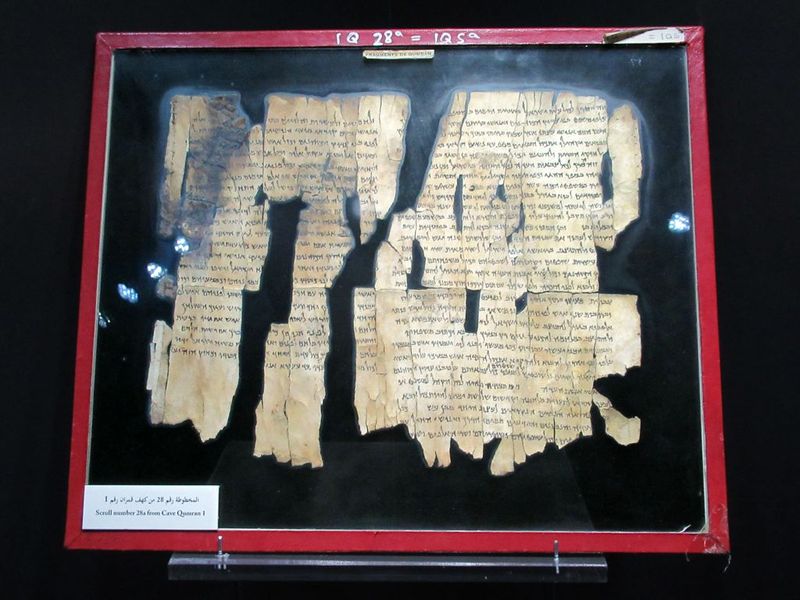
The War Scroll Explained: A Catholic Guide to the Final Battle
A comprehensive guide to the War Scroll (1QM) from the Dead Sea Scrolls: the 40-year eschatological battle, angelic warfare, priestly liturgy, and what this reveals about Jesus's rejection of violent messianism.
John 1:5 Meaning Explained: The Light Shines in the Darkness
What does John 1:5 mean? A study of the Greek—the present tense of φαίνει, the double meaning of κατέλαβεν, and the already/not yet of eschatology.
Stay Informed
Get new writing on faith, law, and service delivered to your inbox.
No spam. Unsubscribe anytime.