What Happened to the Jesuits? A Catholic Lament for a Great Order
On This Page
There is a particular kind of grief reserved for watching something great become a shadow of itself. A gifted athlete whose talent curdles into arrogance. A statesman whose genuine courage eventually serves only ambition. And, in the case before us, a religious order whose founding genius — razor-sharp intellectual formation married to absolute apostolic availability — has, in many of its most public expressions, turned against the very tradition it was built to defend.
I say this as a Catholic who loves the Church, who believes that her teachings are not a set of negotiable positions subject to revision by each generation’s cultural fashions, but the deposit of faith handed down from the apostles. I say it with no pleasure. And I say it because silence in the face of public scandal is its own kind of failure.
This is not a screed. The history of the Jesuits is too long, too complicated, and too genuinely glorious in significant portions to reduce to a simple villain narrative. But the history also explains — far better than partisan talking points from either direction — why so many faithful Catholics today look at the Society of Jesus and feel a profound sense of loss.
The Founding Genius
To understand what went wrong with the Jesuits, you have to first appreciate what was right.
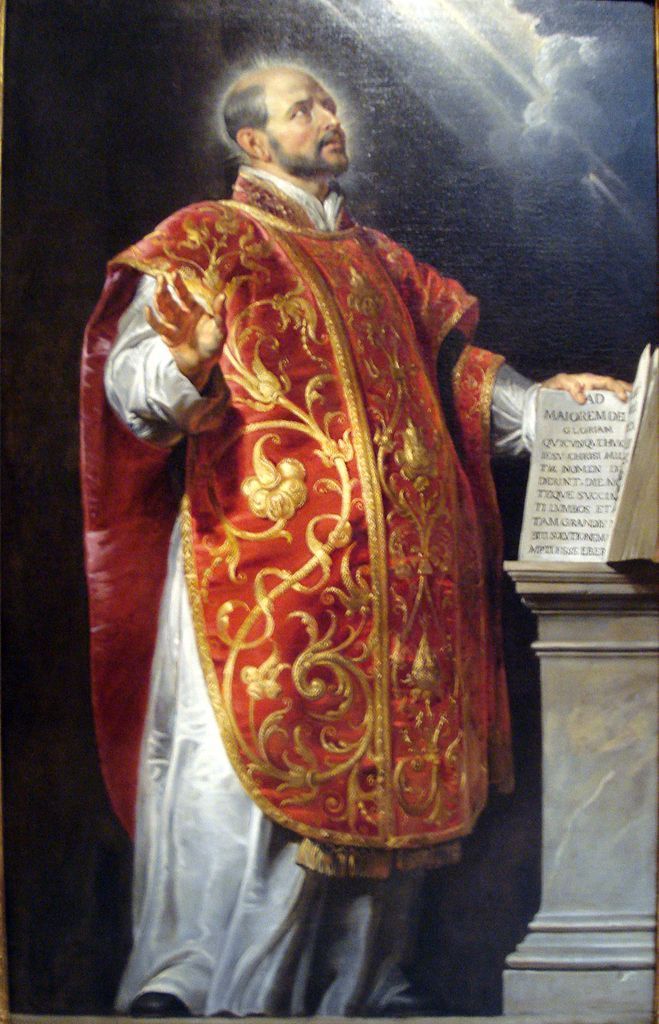
Ignatius of Loyola did not found a religious order in the conventional medieval sense. He did not envision a community of monks chanting the Divine Office in a cloister. What emerged from his conversion experience — a soldier’s pride shattered at Pamplona in 1521, a long convalescence, an encounter with God at Manresa that he never quite finished describing — was something structurally different: a mobile strike force for the Church, ready to go where the need was greatest, formed with unusual depth, and bound by a fourth vow of special obedience to the Roman Pontiff specifically regarding missions.
The Formula of the Institute (1540, confirmed 1550) is the founding charter, and it rewards careful reading. The Society exists for “the defense and propagation of the faith,” deploying itself through preaching, teaching, the sacraments, and mission. The fourth vow is not, as it is sometimes caricatured, merely an expression of papalist loyalism. It is a concrete missioning mechanism: certain fully professed Jesuits bound themselves to go — rapidly, without condition — wherever the pope judged the Church’s need greatest. The genius of it was mobility in the service of truth.
The early Society’s intellectual record was extraordinary. Francisco Suárez gave Catholic metaphysics and political theory their most rigorous early-modern form. Robert Bellarmine defended the faith against the Protestant Reformation with a precision that forced Protestant controversialists to raise their game. Peter Canisius catechized German-speaking Christendom when it seemed about to collapse into confessional chaos. The Ratio Studiorum (1599) established a model of humanistic Catholic education that shaped Western pedagogy for generations. These men were not retreating from the intellectual challenges of their era — they were meeting them head-on, in fidelity to the Church.
This matters because the most common caricature of traditional Catholicism is that it is intellectually timid, afraid of hard questions, content to retreat behind authority rather than engage with rigor. The founding Jesuits give the lie to that caricature. You can hold the deposit of faith and still be a first-rate intellectual. In fact, if you really believe the faith is true, you have every reason to be.
A Long History of Controversy — But Not Like This
It would be unfair not to note that the Jesuits have been controversial before — sometimes for reasons that actually reflect well on them in retrospect, and sometimes for reasons that are more complicated.
Blaise Pascal’s Provincial Letters (1656–57) — one of the great polemical works of French literature — cemented a cultural association between the Jesuits and “lax” casuistry, the practice of finding loopholes in moral reasoning to accommodate the powerful. The casuistry controversy was real, and Pascal was not inventing things wholesale, but the full story of Catholic moral theology in this period is far more complex than the polemic suggests. The Jesuits had serious defenders and the opposing Jansenists had serious problems of their own — a heretical anthropology, as the Church eventually ruled.
The Chinese Rites controversy is similarly double-edged. Matteo Ricci’s genius for inculturation — learning Mandarin, dressing as a Confucian scholar, presenting Christianity in terms the Chinese intellectual class could engage — was genuinely apostolically creative. But it shaded, in the judgment of Rome (confirmed under Clement XI in 1715 and Benedict XIV in 1742), into an accommodation that compromised the integrity of Christian worship. Where the line between legitimate inculturation and syncretism falls is a real theological question, not a simple one. The Jesuits found themselves on the wrong side of Rome’s answer.
And then there was the suppression itself. Pope Clement XIV’s Dominus ac Redemptor (1773) dissolved the Society — not primarily because of doctrinal failure, but because of transnational political pressure from Catholic monarchies (Portugal, France, Spain) who regarded the Jesuits as an international institution that complicated their sovereignty. The Marquis of Pombal in Portugal, the Bourbon courts elsewhere — these were the real architects of suppression. The irony is profound: an order founded to serve the pope was dissolved at the demand of Catholic kings who found them inconvenient.
The Society survived, improbably, in the domains of Frederick the Great and Catherine the Great — neither of them Catholic sympathizers, both of them simply unwilling to dissolve a useful educational apparatus. Pius VII restored the Society in 1814.
The lesson from this long history is important: controversy, even severe controversy, is not itself evidence of guilt. The Jesuits have been accused of being too papalist and not papalist enough, too rigid and too lax, too politically engaged and too politically passive — often by the same critics in the same era. A measure of skepticism about the particular accusations of any given moment is warranted.
But — and this is crucial — not all controversies are equal. The pre-modern controversies, as serious as some of them were, generally involved the Jesuits being accused of deviating from Catholic teaching. The post-Vatican II controversies involve, in documented cases, the Church actually confirming that deviation occurred — and it is this distinction that makes the modern Jesuit decline fundamentally different from anything that came before.
The 19th Century: Rome’s Intellectual Soldiers
Before coming to the hinge, it is important to note something that is often forgotten in contemporary Catholic culture wars: for much of the 19th and early 20th centuries, the Jesuits were perceived as the most reliably orthodox, most aggressively anti-modernist intellectual force in the Catholic world.
Pope Leo XIII’s Aeterni Patris (1879) launched the neo-Scholastic revival — the project of restoring Thomistic philosophy as the backbone of Catholic intellectual life against the encroachments of modern post-Kantian thought. Jesuits were deeply involved in this project. Pope Pius X’s Pascendi Dominici Gregis (1907) — the great anti-Modernist synthesis — named Modernism as a systemic doctrinal threat and mandated institutional defenses against it. In that environment, Jesuits were generally perceived as reliable allies of Rome’s doctrinal project.
The Pontifical Biblical Institute, founded by Pius X in 1909 and entrusted specifically to the Jesuits, is a concrete indicator of papal confidence: Rome wanted rigorous Catholic biblical scholarship conducted under doctrinal supervision, and it chose the Society of Jesus to do it. La Civiltà Cattolica, founded in 1850 at the behest of Pius IX, functioned for long periods as an authoritative voice accompanying Holy See positions on political and cultural questions.
Whatever the Jesuits became later, they were not always this. They were not, by historical nature, the progressivist vanguard. That transformation requires explanation.
The Hinge: Vatican II, Arrupe, and General Congregation 32
The critical inflection point is the decade from 1965 to 1975. Understanding it requires distinguishing three things that are often conflated: the Second Vatican Council itself, the way certain Jesuit leaders chose to interpret the Council, and the way those interpretations were then institutionalized through governance and formation.
Arrupe and “Men for Others”
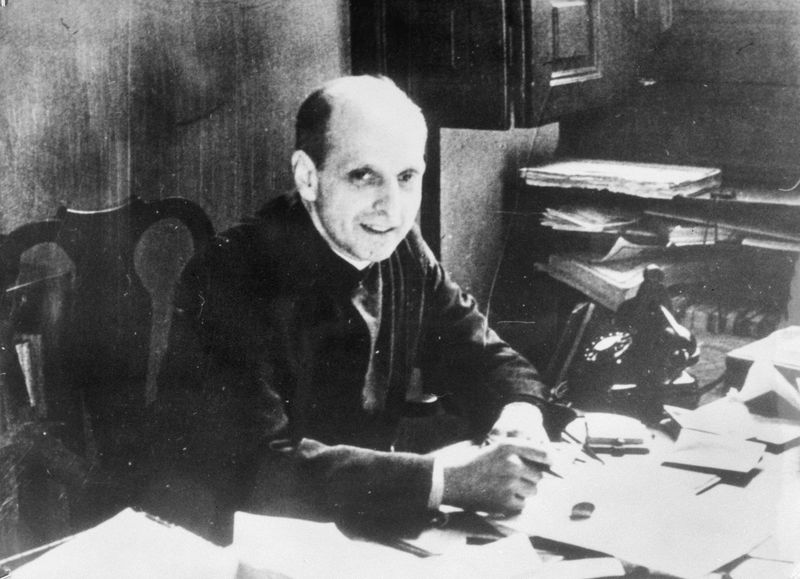
Pedro Arrupe was elected Superior General in 1965, immediately as the Council closed. He is a genuinely compelling figure — a man of deep faith who had been a medical student in Japan and had witnessed the aftermath of the Hiroshima bombing from the city’s outskirts. His personal credibility was real.
His 1973 address at Valencia, “Men for Others,” became programmatic in Jesuit educational culture: Jesuit formation and education should orient students toward justice and social responsibility, not toward personal success or cultural prestige. Taken on its face, that is a defensible Christian conviction.
General Congregation 32 and “Faith and Justice”
The problem came with the 32nd General Congregation in 1975, which produced its defining decree: “Our Mission Today: The Service of Faith and the Promotion of Justice.” The decree formally integrated the “promotion of justice” into the Society’s mission as a co-defining element rather than a consequence of evangelization.
The decree’s authors would insist — and the text does support this reading — that they were not replacing evangelization with political action. The theological claim is that faith demands justice, a claim with serious scriptural warrant. The problem was in implementation.
In Western universities and in parts of Latin America, “faith and justice” in practice often meant what its critics charged: the substitution of progressive political engagement for the proclamation of the Gospel. The difference between what the text said and what the institutions did is the root of the conservative critique, and it is a legitimate one.
Liberation Theology and the CDF’s Response
The engagement with liberation theology in Latin America made this concrete and acute. Many Jesuits worked in conditions of extreme poverty and political repression, and their pastoral response drew on liberation theology’s categories. The Church’s most authoritative response came from the CDF: the 1984 instruction Libertatis Nuntius explicitly warned that integrating Marxist analysis — with its atheistic anthropology and class-struggle framework — into theological method risks “terrible contradictions” with Christian doctrine. A follow-up instruction, Libertatis Conscientia (1986), affirmed liberation as a legitimate Christian concern while clarifying its proper theological parameters.
This is not a merely political accusation invented by reactionaries. The Magisterium treated this as a doctrinal question. The CDF said, formally, that certain intellectual tools being used by some Jesuits (and others) were incompatible with Catholic faith when adopted as interpretive norms.
Pope John Paul II’s 1981 intervention, in which he appointed Paolo Dezza as his personal delegate to govern the Society following Arrupe’s debilitating stroke, has been interpreted variously. From a sympathetic perspective, it can be read primarily as a response to a governance crisis following a medical catastrophe. From a more critical perspective — and the weight of evidence supports taking this reading seriously — it was a signal that Rome had significant concerns about the direction of the Society and was not content to let those concerns resolve themselves through internal mechanisms.
The Theological Record: What Rome Actually Said
The conservative complaint about Jesuit theology is sometimes stated in terms of vague cultural anxiety. But in the most important cases, we do not have to rely on cultural anxiety. We have formal magisterial documents.
The Teilhard de Chardin Monitum
The Holy Office issued a monitum — a formal warning — about the works of Pierre Teilhard de Chardin in 1962, stating that his writings “abound in ambiguities and even serious errors” offensive to Catholic doctrine. This warning was reaffirmed in 1981. Teilhard’s attempt to synthesize evolutionary cosmology with Christology was intellectually ambitious and has attracted serious admirers across the Catholic spectrum. But Rome judged that the synthesis, as executed, crossed doctrinal lines. That judgment stands.
Karl Rahner and Anonymous Christianity
Karl Rahner’s concept of “anonymous Christianity” — the proposal that non-Christians who respond to grace without explicit knowledge of Christ may be “anonymous Christians” — was enormously influential in postconciliar theology and far beyond the Jesuits. The orthodox critique is serious: the concept risks weakening the urgency of evangelization, blurring the unique mediation of Christ and the Church, and functioning as a conceptual universalism that sidesteps the New Testament’s clear imperatives toward conversion and baptism. These are not fringe complaints. Vatican II itself holds in tension the affirmation of God’s universal salvific will with the insistence on Christ and the Church’s unique mediation — a tension Rahner’s framework, critics argue, resolves too easily in one direction.
CDF Notifications: Sobrino and Haight
The strongest evidence of all lies in two CDF notifications against Jesuit theologians:
In 2006, the CDF issued its Notification on the works of Jon Sobrino, SJ, stating explicitly that his Christological works contain “notable discrepancies with the faith of the Church.” The specific concerns included methodological reduction of Christology, issues regarding the divinity of Christ, the Incarnation, and the relationship between Jesus and the Kingdom of God. The CDF’s explanatory note framed this as protecting the poor and the faithful from doctrinal harm — a powerful inversion of Sobrino’s own claimed pastoral motivation.
In 2004, the CDF issued its Notification regarding the book Jesus: Symbol of God by Father Roger Haight, SJ, identifying “serious doctrinal errors” and restricting his teaching as a Catholic theologian. The concerns touched on theological method and substantive claims about Christ’s self-understanding.
These are not cultural conservatives complaining about politics. These are the Church’s doctrinal authority formally identifying serious problems in the published work of Jesuit theologians. That record deserves to be stated plainly.
The James Martin Question
Father James Martin, SJ, is a useful case study not because he is the worst example — he is not a theologian of the stature of Sobrino or Haight, and no CDF notification has been issued against him — but because he illustrates how Jesuit pastoral and media influence can become a proxy battleground in the broader war over Catholic identity.
Martin’s project, articulated in Building a Bridge and through his “Outreach” initiative, is framed as a call for pastoral accompaniment of LGBT Catholics — reducing hostility, increasing personal encounter, building dialogue. That framing is not self-evidently wrong; the Church does call for welcoming those who struggle. The question is what accompaniment means and whether Martin’s rhetoric creates confusion about what the Church actually teaches.
The orthodox Catholic critique — articulated by bishops including Archbishop Charles Chaput and Bishop Thomas Paprocki — focuses on precisely this: that Martin’s framing, by prioritizing affective welcome without corresponding clarity about chastity, and by using identity language that defines persons by their sexual inclinations, creates doctrinal confusion rather than pastoral clarity. The critique has real force, and Martin’s defenders have not adequately answered it — though the debate is ongoing and the pastoral questions are real. What is not in dispute is that Martin has navigated his visibility with Vatican-facing credibility — Pope Francis appointed him a consultor to the Vatican’s communications office, and supportive letters from the Pope have been publicly reported — alongside sustained episcopal criticism.
The pattern is telling. Not formal censure, but also not the unambiguous magisterial endorsement that Martin’s defenders sometimes imply. The controversy continues, and the Church deserves clarity it has not received.
What This Has to Do with Being Catholic
Here is the nub of my concern, stated as directly as I can manage.
The Catholic Church’s claim on the world is not that she offers a better progressive vision, a more socially engaged non-profit, or a more sophisticated form of therapeutic community. Her claim is that she is the Bride of Christ, that her teachings on faith and morals are not the opinions of her current leadership but the deposit entrusted to her by the apostles and protected by the Holy Spirit. She is, in the words of the First Vatican Council, the pillar and ground of truth.
That claim is inseparable from what Pope Benedict XVI called, in his essential 2005 Christmas address to the Roman Curia, the “hermeneutic of reform” in continuity — as opposed to the “hermeneutic of discontinuity and rupture” that treats the Church before and after Vatican II as two fundamentally different institutions. The rupture reading, Benedict warned, risks splitting pre-conciliar and post-conciliar Catholicism into irreconcilable halves. And yet the rupture reading is exactly what some postconciliar Jesuit sectors have been most comfortable articulating, especially in pastoral theology and social ethics, where appeals to “the spirit of Vatican II” have routinely been used to claim permissions not found in the Council’s actual texts.
What troubles me most about the most vocal progressive Jesuit voices is not their compassion — that impulse is often genuine, and it has genuine Christian roots. What troubles me is the implied premise: that the problem with the Catholic Church is that she is too Catholic. That if she would simply update her moral theology, accommodate contemporary sexual ethics, soften her insistence on the unique mediation of Christ, approach doctrine with something closer to Protestant hermeneutical flexibility — then she would be more credible, more welcoming, more relevant.
But a Church that followed that path would have ceased to be recognizably Catholic. It would be a denomination. There are many fine Christian denominations, and I do not speak dismissively of them. But they are not what Rome claims to be and what the faithful believe her to be. The moment you treat the tradition not as a deposit received but as a proposal open to revision by each successive generation’s sensibilities, you have ceased to be Catholic in any meaningful sense. You have, as Chesterton might have said, simply let the world tell you what to think — just with more sophisticated theological vocabulary.
The moment you treat the tradition not as a deposit received but as a proposal open to revision by each successive generation’s sensibilities, you have ceased to be Catholic in any meaningful sense.
The Jesuits, at their founding, understood this with crystalline clarity. Ignatius’s whole project — the Spiritual Exercises, the fourth vow, the Formula — was predicated on the conviction that the truth had been revealed, that the Church was its custodian, and that the task of the Jesuit was to serve that Church with every intellectual and apostolic resource at his disposal. The men who founded the Society were not retreaters from the modern world; they were warriors for the truth within it. That is why they were so feared by those who wished the Church would simply go away.
Some of today’s most vocal Jesuit voices seem to want the Church to go away too — or at least to become unrecognizable. That is the scandal. And it is made worse by the fact that these men are priests, that their collars convey an authority that their heterodoxy does not deserve, and that the faithful who look to them for guidance are misled.
A Word to the Holy Father
The current Holy Father, Pope Leo XIV, inherits a situation shaped by decades of controversy within the Society. I address him with the highest respect and the deference owed to the Vicar of Christ, precisely because I am convinced that this concern deserves to be heard at that level.
The Society of Jesus possesses a founding charism that is, at its core, magnificent. A fourth vow of special obedience to the Roman Pontiff regarding missions is not the heritage of a dissident order — it is the heritage of men who were willing to go anywhere, do anything, learn any language, master any discipline, endure any hardship, in service of the Church that Christ founded. That charism is not lost. Orthodox Jesuits exist. Joseph Fessio’s Ignatius Press has been one of the most important orthodox Catholic publishing houses in the English-speaking world. Robert Spitzer’s apologetics work has brought serious philosophical formation to a wide audience. James Schall was a voice of genuine Catholic intellectual culture in political philosophy for decades.
But the institution as a whole, particularly in its North American and Western European expressions, has been in a state of documented crisis — doctrinal, vocational, and institutional. The membership has fallen from a peak of roughly 36,000 in 1965 to under 14,000 as of 2024 — a decline of more than 60 percent in six decades, as documented by Fr. Julio Fernández Techera, SJ, rector of the Catholic University of Uruguay, in his widely circulated 2024 assessment of the Society’s “profound decline.” The demographic center of gravity is shifting toward Asia and Africa, which may reshape the Society’s theological profile over time in salutary ways.
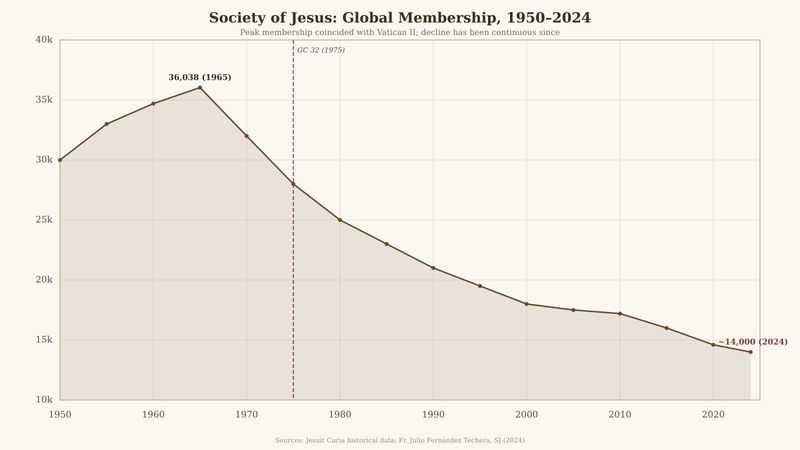
In the meantime, the faithful deserve to have their pastors and teachers speak with a single voice on the matters the Church has definitively settled. When priests bearing the clerical collar — and bearing the reputation, however attenuated, of the Society’s intellectual prestige — publicly sow confusion about the Church’s settled teachings on sexuality, Christology, or the uniqueness of Christian salvation, that is a scandal in the precise theological sense of the word: a stumbling block placed before the souls of the faithful.
The Holy Father has the authority and, I respectfully submit, the pastoral obligation to address this. Not with rancor — the Jesuits have given the Church too much that is genuinely beautiful for rancor to be the appropriate response. But with clarity. The fourth vow, after all, was supposed to make the Society uniquely responsive to papal direction. If that vow still means something, this is a moment that calls for it to mean something.
An Honest Assessment
I want to be careful not to caricature. The Jesuits are a global institution across dozens of countries and thousands of men, and the story of Jesuit decline is not uniform across every province and continent. The “Jesuit = liberal” association is strongest in the North American and Western European academic and media contexts; it is less accurate as a description of Jesuits in parts of Africa, Asia, and South America, where different theological and pastoral emphases prevail. The assumption that the next generation of the Society will look like the current one may be mistaken.
But in the United States, and in the institutions and media platforms that have the most reach, the pattern is real and documented. It is not paranoia, and it is not anti-intellectualism, to notice that formal magisterial warnings have been issued against Jesuit theologians, that the Society’s governance required extraordinary papal intervention, and that some of its most prominent public voices have made a practice of suggesting that the Church’s problem is the Church.
The Catholic faith is not a problem. The tradition dating from the apostles through the Fathers, the Councils, the great scholastics, the martyrs, and the saints of every century — that tradition is not an embarrassment to be managed or a burden to be lightened. It is the inheritance of every Catholic, and its custodians bear a solemn responsibility.
The Jesuits, at their best, have known this. Bellarmine knew it. Canisius knew it. Ignatius himself knew it.
The question is whether the Society, in the years ahead, will recover that knowledge — or whether it will complete its transformation into something its founder would not recognize.
I pray for the former. And I believe the Church, and the Holy Father, should make clear which path they expect the Society to walk.
Primary Sources Referenced
- Formula of the Institute (1540/1550)
- Ignatius of Loyola, Spiritual Exercises
- Clement XIV, Dominus ac Redemptor (1773)
- Pius VII, Sollicitudo omnium ecclesiarum (1814)
- Leo XIII, Aeterni Patris (1879)
- Pius X, Pascendi Dominici Gregis (1907)
- General Congregation 32, Decree 4: “Our Mission Today” (1975)
- CDF, Libertatis Nuntius (1984)
- CDF, Libertatis Conscientia (1986)
- Holy Office, Monitum on Teilhard de Chardin (1962, reaffirmed 1981)
- CDF, Notification on the works of Jon Sobrino, SJ (2006)
- CDF, Notification regarding Jesus: Symbol of God by Roger Haight, SJ (2004)
- Benedict XVI, Address to the Roman Curia (December 22, 2005)
Key Secondary Works
- John W. O’Malley, SJ, The First Jesuits (Harvard University Press, 1993)
- Markus Friedrich, The Jesuits: A History (Princeton University Press, 2022)
- Jeffrey D. Burson & Jonathan Wright (eds.), The Jesuit Suppression in Global Context (Cambridge University Press, 2015)
- James Tunstead Burtchaell, The Dying of the Light: The Disengagement of Colleges and Universities from Their Christian Churches (Eerdmans, 1998)
- Peter McDonough & Eugene C. Bianchi, Passionate Uncertainty: Inside the American Jesuits (University of California Press, 2002)
- John W. Padberg, SJ, ed., Jesuit Life & Mission Today: The Decrees & Accompanying Documents of the 31st–35th General Congregations of the Society of Jesus (Institute of Jesuit Sources, 2009)

Garrett Ham
Garrett Ham is an attorney, military veteran, and holds a Master of Divinity from Yale Divinity School. He writes from Northwest Arkansas on theology, law, and service.
More about Garrett →Related Posts

Evangelical to Catholic: The Intellectual Journey
A comprehensive guide to the intellectual journey from evangelical Protestantism to Roman Catholicism — from sola scriptura to the Church Fathers, from faith alone to the fullness of Catholic tradition.
The Counter-Reformation: Catholic Reform in the Wake of Luther
A comprehensive examination of the Catholic Counter-Reformation: the Council of Trent, the founding of the Jesuits, and the Church's response to the Protestant Reformation.

Anti-Catholic Evangelicals
During this time of quarantine, I have had the opportunity to dialogue with some old-school anti-Catholic evangelicals, and it has left me wondering how...
Stay Informed
Get new writing on faith, law, and service delivered to your inbox.
No spam. Unsubscribe anytime.