The War Scroll Explained: A Catholic Guide to the Final Battle
On This Page
“You appointed the Prince of Light from of old to assist us, for in His lot are all sons of righteousness and all spirits of truth are in his dominion. You yourself made Belial for the pit, an angel of malevolence, his dominion is in darkness and his counsel is to condemn and convict.”
1QM (War Scroll) 13:10–11 (trans. Wise, Abegg, and Cook)
Key Takeaways
- The War Scroll (1QM) is a remarkable ancient Jewish text describing a prophetic 40–year eschatological battle between the Sons of Light and Sons of Darkness
- The scroll provides extraordinary detail about military formations, battle tactics, priestly blessings, and angelic participation in cosmic warfare
- The text reflects a dualistic apocalyptic worldview where good and evil forces clash in preparation for God’s final triumph
- The War Scroll illuminates what Jews of the Second Temple period expected of the messiah: a divine warrior who would lead Israel to military victory
- Jesus’s rejection of violent messianism becomes more striking when understood against expectations depicted in texts like the War Scroll
- The scroll’s theology of spiritual warfare influenced New Testament imagery, particularly in Ephesians and Revelation
- For Catholics, the War Scroll reveals the diversity of Jewish messianic hope and deepens our appreciation for how radically the Gospel transforms apocalyptic expectation into Christological reality
What Is the War Scroll?
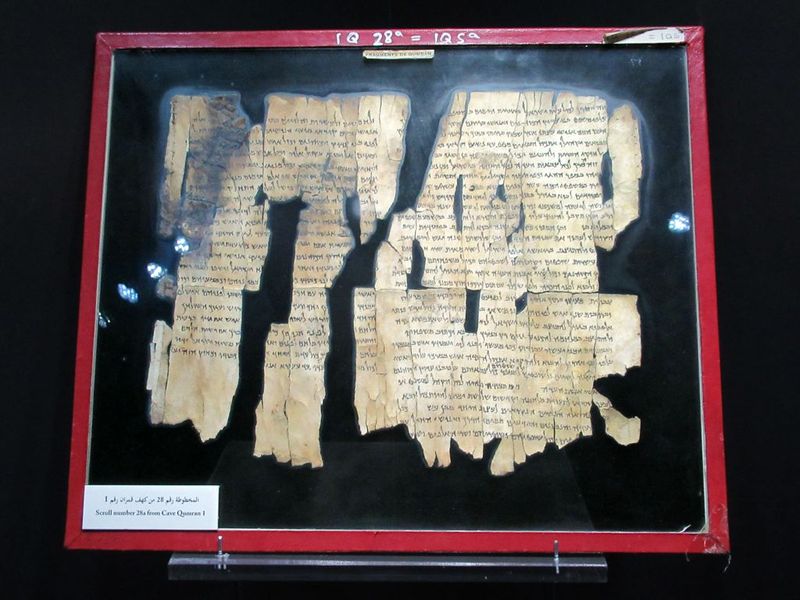
The War Scroll, formally designated 1QM (meaning “War Rule” from Cave 1 at Qumran), is one of the most extraordinary documents recovered from the Dead Sea. Discovered among the Qumran manuscripts in the late 1940s, this ancient text survives in fragmentary condition but remains coherent enough to reconstruct its theology and content with considerable confidence.
Discovery and Physical Description
Like the other Dead Sea Scrolls, the War Scroll was discovered by Bedouin shepherds in 1947, hidden in clay jars in caves near Qumran on the northwestern shore of the Dead Sea. The surviving manuscript dates to approximately the late 1st century BC or early 1st century CE, making it roughly contemporary with Jesus’s birth, though the composition may draw on earlier sources from the Maccabean period. The surviving manuscript consists of nineteen columns of Hebrew text, though scholars believe the original document may have been longer.
The text is written in formal scribal hand on parchment, indicating that it was a carefully prepared, important document for the Qumran community. The fact that it was preserved alongside the Community Rule (1QS) and other sectarian texts suggests that the War Scroll held significant theological and liturgical importance for the community’s self–understanding.
Purpose and Function
The War Scroll is not a straightforward prediction or historical account. Rather, it functions as a liturgical and devotional text for the Qumran community. Its purpose appears to be twofold: first, to provide detailed theological instruction about the anticipated final war; second, to allow the community to participate imaginatively and spiritually in the eschatological victory through its reading and possibly through ritual recitation.
The text was not merely intellectual speculation about the future. It was a document that shaped how the Qumran community understood their present moment, their corporate identity as the “sons of light,” and their spiritual preparations for the imminent end times. By studying the War Scroll, we gain insight into how an ancient Jewish community prepared themselves, in both body and spirit, for what they believed would be the final cosmic conflict.
The 40-Year Eschatological War: Structure and Phases
The War Scroll’s most distinctive feature is its detailed description of a cosmic warfare spanning forty years. This is not casual apocalyptic speculation but an elaborate theological vision of how the final conflict would unfold.
The Overall Framework
According to the War Scroll, at the end of the present age, God will raise up the Sons of Light to engage in direct, physical warfare against the Sons of Darkness. This war will last exactly forty years—a biblically significant number evoking Israel’s wilderness wandering and redemptive time periods. The entire cosmos participates: not only human warriors but also angelic beings, heavenly forces, and divine intervention.
The war is conceived as a structured, divinely ordered process. It is not chaos or chance but a predetermined sequence of events, each with theological significance and spiritual meaning.
The Campaign Structure and the Seven Lots
The War Scroll describes a 40–year war unfolding in phases: six years of initial conquest, a sabbatical year of rest, and then 29 more years of campaigns against various nations (1QM cols. 1–2). This extended campaign structure follows a divinely ordered sequence in which Israel systematically engages the enemies of God.
Distinct from the overall campaign structure, the War Scroll also describes the climactic final battle as a dramatic contest of seven lots or engagements (1QM 1:13–15, detailed in cols. 15–18). These seven lots unfold on the decisive day of battle itself:
Lots 1–3: Initial Victories of the Sons of Light
In the first three engagements, the Sons of Light gain decisive military advantage. These early victories demonstrate the righteousness of God’s chosen and establish their superiority on the battlefield. The text emphasizes that these victories are achieved through adherence to divine law, ritual purity, and the guidance of the Prince of Light.
Lots 4–6: The Sons of Darkness Strike Back
In the next three engagements, the fortunes of battle reverse. The Sons of Darkness, empowered by Belial, gain the upper hand. Warriors fall; the outcome becomes uncertain. This reversal functions theologically as a trial of faith. The text does not explain these setbacks as evidence that God has abandoned the righteous, but rather as a testing period in which the Sons of Light must demonstrate unwavering commitment to divine law and trust in God’s ultimate vindication.
This corresponds to Jewish apocalyptic theology more broadly: the righteous may suffer in the present age, may appear to be losing, may face seemingly insurmountable odds. Yet their trust in God’s justice and ultimate intervention must remain firm.
Lot 7: Final Victory and Divine Intervention
In the seventh and decisive engagement, God directly intervenes. The text describes the opening of the heavens, the appearance of angelic armies, and the decisive overthrow of Belial and the Sons of Darkness. This is not a victory earned through human military prowess alone, but a climactic divine action in which human warriors participate in God’s triumph.
The Named Enemies
The War Scroll does not leave abstract the identity of the Sons of Darkness. The text names specific enemies that will be defeated:
- The Kittim (widely identified with the Romans, though some scholars argue for the Seleucids or other Hellenistic powers)
- The Edomites
- The Moabites
- The Ammonites
- Various Arabian tribes and gentile peoples
These enemy designations suggest that the War Scroll’s author(s) understood the conflict as having both a cosmic and a historical dimension. The final war would involve real military conflict against Israel’s historical enemies, yet this conflict would also reflect and be directed by cosmic forces of good and evil.
Military Formations and Tactics
The War Scroll provides remarkably specific details about military organization:
- Arrangement by age and physical capability: Warriors are organized into units of varying ages and strengths, with younger, stronger men positioned for the most intense combat
- Trumpet signals and banners: The text describes trumpet calls for military maneuvers (1QM 2:15–3:11) and inscriptions on banners and standards (1QM 3:12–5:2)
- Cavalry and infantry coordination: The scroll addresses both mounted warriors and foot soldiers, describing how they work together
- Priestly blessing formations: Before battle, priests arrange themselves to pronounce blessings over the warriors
This level of tactical detail is remarkable and suggests that the War Scroll served both theological and practical functions. Whether this was intended as an actual military manual for the Qumran community or remained purely eschatological speculation, it reveals the seriousness with which the community contemplated their anticipated role in the final war.
The Role of Angels and Heavenly Warfare
One of the most distinctive features of the War Scroll is its integration of angelic participation in the final battle. This is not merely a human military conflict but a cosmic warfare involving heavenly beings.
Michael, Prince of Light
The supreme commander of the Sons of Light is widely identified by scholars as Michael, the archangel associated in Jewish tradition with God’s protection of Israel. The War Scroll refers to a “Prince of Light” appointed to assist the righteous (1QM 13:10) and separately mentions “the majestic angel of the authority of Michael” (1QM 17:6–7). Although these two names never appear together in a single passage of 1QM, most scholars (and the Israel Museum’s own description) identify them as the same figure.
Michael does not appear in the scroll as a distant celestial being but as an active commander who leads the armies of heaven into battle. The scroll describes the moments when Michael and his heavenly forces directly engage the forces of darkness, bringing about the decisive final victory.
Belial and the Forces of Darkness
Opposing Michael is Belial, whom the War Scroll describes as “an angel of malevolence” whose “dominion is in darkness” (1QM 13:11). (The specific title “Angel of Darkness” appears in the Community Rule at 1QS 3:20–21, rather than in 1QM itself.) Belial is not merely a symbol but a real angelic being with armies and power. The War Scroll depicts Belial as ruling over various demonic spirits, each with authority over particular nations or peoples.
The conflict between Michael and Belial is the heavenly counterpart to the earthly military conflict. As the Sons of Light fight the Sons of Darkness on earth, Michael and heavenly forces combat Belial and demonic powers in the heavens.
Angelic Hosts and Their Roles
The War Scroll mentions various categories of heavenly beings:
- The Prince of Lights (Michael’s rank and title)
- Angels of Light or angels of truth who assist Michael
- Heavenly warriors who appear when God directly intervenes
- Demonic forces aligned with Belial, assigned to particular terrestrial enemies
The text suggests that each nation or people has an associated angelic power. When Israel defeats these nations militarily, they are also, in the heavenly dimension, participating in the defeat of these demonic powers.
Theophanic Moments
Particularly striking are the moments in the War Scroll when God directly intervenes in the battle. These are described using theophanic language—the appearance or manifestation of God’s presence and power. The heavens open, cosmic upheaval occurs, and God’s transcendent power becomes visible and effective. These moments mark the transition from the period of struggle to the final, decisive victory.
The Liturgical Character: Priestly Blessings, Trumpets, and Ritual Purity
What distinguishes the War Scroll from a straightforward military text is its profound liturgical character. Throughout the document, ritual, priestly blessing, and ceremonial language predominate.
Priestly Blessings and Liturgical Functions
Priests hold a central place in the War Scroll’s vision of the final war. The text prescribes detailed priestly blessings to be pronounced before, during, and after battle:
- Pre-battle blessings: Priests pronounce blessings over the warriors, sanctifying them for combat and invoking God’s protection and strength
- Blessings during campaign: As the forty–year war progresses, priests continue to offer blessings, maintaining the spiritual sanctification of the community
- Liturgical processions: The War Scroll describes ceremonial arrangements of priests and warriors, suggesting that warfare itself was conceived as a sacred act requiring priestly mediation
The specific blessings are theologically rich, invoking God’s names, recalling divine acts of salvation in Israel’s history, and petitioning for strength and victory.
Trumpet Calls and Banners
The scroll is remarkably detailed about the use of trumpets for communication and spiritual purposes:
- Different trumpet signals for various military maneuvers and phases of battle
- Banners and standards inscribed with sacred inscriptions and divine names
- Trumpet blasts at key moments to invoke heavenly assistance and encourage the warriors
For instance, the War Scroll specifies that when the Prince of Light enters the battle, particular trumpet calls are to be sounded. These are not merely military signals but sacred invocations, connecting the terrestrial battle to heavenly realities.
Ritual Purity Requirements
Central to the War Scroll’s vision is the requirement of ritual purity. Warriors must maintain ceremonial purity as preparation for battle. The text specifies:
- Purification rituals before engaging in warfare
- Restrictions on those who are ritually impure or afflicted
- Separation of menstruating women and others considered ritually impure
- Ritual washing and other purification practices
This emphasis on purity reflects the conviction that warfare against the Sons of Darkness is fundamentally a sacred act. Just as priests must be ritually pure to approach God’s sanctuary, warriors must be ritually pure to participate in God’s eschatological battle. Physical combat is not separated from spiritual reality but integrated into a unified vision of cosmic, ritual, and military action.
The War as Sacred Performance
When read holistically, the War Scroll presents the final war not as secular military conflict but as a sacred liturgical performance in which the Qumran community participates through their present discipline and purity practices. By living according to the Community Rule, maintaining ritual purity, and preparing themselves spiritually, the members of Qumran were, in a sense, rehearsing their role in the anticipated final battle. The War Scroll allowed them to envision themselves not as a marginal sect but as the center of God’s purpose for history, playing a crucial role in the cosmic triumph of good over evil.
The Kittim Identification Debate
One of the most debated questions in War Scroll scholarship concerns the identity of the Kittim (“Chittim” in English Bible translations). This designation appears frequently in the War Scroll and in other Qumran texts as a primary enemy of the Sons of Light.
The Romans Identification
The dominant modern scholarly view identifies the Kittim with the Romans. Supporting this interpretation:
- The Kittim are described as a powerful foreign power with advanced military technology and discipline
- They are depicted as the supreme military force of the age
- Historical context: By the time the War Scroll was composed (likely 1st century BC), Rome had become the dominant power in the Mediterranean, and Romans had established their control over the Levant
- The Pesharim (other Qumran texts) are generally understood by scholars to identify the Kittim with Rome based on contextual clues in commentary on prophetic texts
This interpretation makes historical sense and aligns with the crisis atmosphere reflected in many Qumran texts as Roman power became increasingly apparent.
Alternative Identifications
Some scholars propose different identifications:
- The Seleucids: An earlier Hellenistic power that ruled the Levant before Rome. This identification would place the War Scroll’s composition earlier, during the Maccabean period or shortly after
- Hellenistic powers generally: Some scholars argue that “Kittim” functions as a generic designation for any foreign, powerful, militarily advanced civilization
The Seleucid identification has declined in favor as most scholars now date the War Scroll to the 1st century BC, when Rome was the dominant threat.
The Eschatological Dimension
Importantly, even if the Kittim are identified with Rome, the War Scroll’s primary concern is eschatological rather than historical. The text is not predicting a specific, imminent military conflict with Rome in this-worldly terms. Rather, Rome functions as the representative of the Sons of Darkness in the final cosmic conflict. Rome is not merely a political or military opponent but the earthly embodiment of demonic spiritual forces.
This distinction helps clarify the War Scroll’s peculiar character: it is neither pure fantasy nor straightforward historical prediction, but theological interpretation of current events through an apocalyptic lens.
Connection to Other Qumran Texts
The War Scroll cannot be understood in isolation. It forms part of an interconnected web of theological texts from the Qumran community, each reinforcing and illuminating the others.
The Community Rule (1QS)
As discussed in our earlier post, the Community Rule (1QS) provides the theological foundation for the War Scroll. The Community Rule establishes the two spirits doctrine and identifies the Qumran community as the “sons of light” under the Angel of Truth. The War Scroll takes this theological framework and projects it into the future, envisioning how the cosmic struggle between these two spirits will culminate in the final war.
The Community Rule is thus the present reality and spiritual preparation, while the War Scroll is the anticipated eschatological fulfillment.
The Pesharim (Interpretive Commentaries)
The Pesharim (commentaries on biblical prophets like Habakkuk, Nahum, and Isaiah) function as interpretive keys to understanding how the Qumran community related apocalyptic expectation to their present historical circumstances. In 1QpHabakkuk, the Chaldeans of Habakkuk are interpreted as the Kittim, and Pesher Nahum (4Q169) places the Kittim after the Greek kings—from which scholars generally identify the Kittim as Romans. The Teacher of Righteousness is portrayed as the community’s eschatological leader.
The War Scroll should be read against this interpretive backdrop: the events of the present age (Roman occupation, conflict with Jerusalem authorities) are understood through the lens of apocalyptic expectation.
The Hodayot (Thanksgiving Hymns)
The Hodayot (1QH) are liturgical poems expressing thanksgiving for divine protection and wisdom. Many hymns reflect the apocalyptic consciousness of the Qumran community and their expectation of imminent divine intervention. They celebrate the community’s election as the righteous remnant and anticipate their vindication in the final judgment.
The War Scroll gives military and tactical expression to the spiritual triumph anticipated in the Hodayot.
The Temple Scroll (11Q19)
The Temple Scroll (11Q19, also known as 11QTemplea) describes an idealized vision of the future temple in Jerusalem, suggesting that the Qumran community held hopes for a restored and purified temple in the eschatological age. This connects to the War Scroll’s vision: the military victory of the Sons of Light would result not only in the defeat of their enemies but also in the restoration of proper temple worship and priestly service.
War Scroll and the New Testament
The War Scroll predates the New Testament, yet it provides crucial context for understanding how the earliest Christians understood spiritual warfare, cosmic conflict, and the nature of Jesus as messiah.
Ephesians 6 and the Armor of God
Paul’s famous passage on spiritual armor in Ephesians 6:10–18 reflects a worldview strikingly similar to that of the War Scroll:
“Put on the whole armor of God, so that you may be able to stand against the wiles of the devil. For our struggle is not against blood and flesh, but against the rulers, against the authorities, against the cosmic powers of this present darkness, against the spiritual forces of evil in the heavenly places.” (Ephesians 6:11–12, NRSVUE)
Paul describes cosmic spiritual warfare involving heavenly forces and earthly struggle. The similarities to the War Scroll are notable:
- Both texts understand the present age as a conflict between good and evil forces
- Both affirm that the struggle is not merely physical but fundamentally spiritual
- Both employ military metaphors and call for disciplined preparation
- Both anticipate God’s ultimate victory through divine intervention
However, Paul reinterprets the broader Second Temple apocalyptic tradition—of which the War Scroll is one important witness—through Christological and ecclesiological frameworks. For Paul, the armor is not physical but spiritual (faith, righteousness, gospel, salvation, Scripture). The warfare is not military but consists of prayer and proclamation. The victory has not been deferred to a future 40–year campaign but is already achieved through Christ’s resurrection and the Church’s participation in his victory.
Revelation and the Final Battle
The Book of Revelation, composed near the end of the 1st century AD, describes the eschatological war in language and imagery remarkably similar to the War Scroll:
- Heavenly warfare: Revelation 12:7 depicts Michael and his angels fighting against the dragon and his angels
- The defeat of Satan: Like the War Scroll’s vision of Belial’s defeat, Revelation describes Satan’s ultimate overthrow
- Armies and conflict: Revelation 19 describes Christ as a warrior leading heavenly armies against the earthly powers arrayed against God
- The victory of the righteous: Like the War Scroll’s Sons of Light, Revelation’s faithful are vindicated and triumphant
Yet again, Revelation Christianizes the apocalyptic vision: Christ, not Michael, is the supreme leader; the victory is achieved through Christ’s sacrificial death and resurrection, not through 40 years of warfare; the enemy is not merely Rome but all forces opposing God’s reign.
1 Thessalonians 5 and the “Sons of Light”
Paul uses the language of “sons of light&rdquo directly in 1 Thessalonians 5:4–5:
“But you, brothers and sisters, are not in darkness, for that day to surprise you like a thief; for you are all children of light and children of the day.”
This language echoes the Qumran texts’ use of “sons of light.” Paul applies this terminology not to an elect sectarian community but to all believers in Christ. The boundary between “light” and “darkness” has shifted: it is no longer membership in the Qumran sect versus the broader Jewish people, but rather faith in Christ versus rejection of the gospel.
A Catholic Perspective: Jesus’s Rejection of Violent Messianism
Understanding the War Scroll is essential for appreciating one of the most distinctive and shocking features of Jesus’s ministry: his radical rejection of violent messianism.
The Messianic Expectations of the War Scroll
The War Scroll articulates one expression of Jewish messianic expectation: the coming of a divine warrior-messiah who would lead Israel in military victory against Israel’s enemies. The messiah would be the supreme military commander, the “Prince of Light” under whose leadership the Sons of Light would defeat the Kittim and all enemies of Israel.
This was not fringe speculation. It represented a widespread hope among many Jews in the Second Temple period. The Roman occupation intensified this longing: perhaps God would soon send a warrior-messiah to liberate Israel as in the days of David and Joshua.
Jesus’s Messianic Self-Understanding
When Jesus proclaimed that “the kingdom of God has come near” (Mark 1:15), his Jewish hearers would have understood this in light of apocalyptic expectation. But Jesus’s kingdom was radically different from what the War Scroll envisioned:
- No military campaign: Jesus established no army, gathered no warriors, performed no military victories
- No political liberation: He did not attempt to overthrow Roman rule or establish an independent Jewish state
- Universal inclusivity: Rather than a sectarian “sons of light” community, Jesus proclaimed good news to tax collectors, Samaritans, gentiles, and all outcasts
- Redemptive suffering: Most shockingly, Jesus’s path to messianic fulfillment led through crucifixion, not military triumph
The Crucifixion as Messianic Refusal
The crucifixion must be understood partly as the rejection of Jesus by those expecting a military messiah. The inscription on the cross, “King of the Jews,” was meant as mockery: Here is your messiah, executed as a criminal, unable to defend himself or his people. It did not look like victory.
Yet the early Church proclaimed that precisely in the cross and resurrection, Jesus had achieved the true eschatological victory. Not through military conquest but through redemptive suffering, Jesus had defeated the forces of evil, achieved salvation for all humanity, and established God’s kingdom.
Spiritual Warfare vs. Physical Warfare
The War Scroll’s vision of 40 years of military conflict gives way, in Christian understanding, to the Church’s engagement in spiritual warfare. As Paul affirms in 2 Corinthians 10:4, “the weapons of our warfare are not merely human” (NRSVUE). The Church fights not with swords and spears but with prayer, sacrament, the proclamation of the gospel, and the power of the Holy Spirit.
This represents a fundamental reorientation: the cosmic struggle between good and evil continues, the battle is intensely real, but its character has been transformed by Christ’s incarnation and redemptive work.
Catholic Theology and Spiritual Warfare
The Catholic tradition, particularly through the writings of figures like St. Ignatius of Loyola and contemporary spiritual theologians, has maintained a robust understanding of spiritual warfare. The War Scroll illuminates why this doctrine is so important: the struggle against evil is not merely personal or psychological but cosmic and deeply real.
Yet Catholic spirituality, like New Testament theology, emphasizes that this warfare is waged through prayer, sacraments, virtue, and union with Christ—not through military force or physical violence. The “armor of God” mentioned in Ephesians consists of faith, righteousness, the gospel, and prayer, not weapons of war.
Understanding the War Scroll helps Catholics appreciate both the reality of spiritual struggle and the distinctive Christian conviction that this struggle has been decisively won through Christ, even as its final consummation awaits his return.
The War Scroll in Historical Context
To fully appreciate the War Scroll, we must understand the historical circumstances of the Qumran community.
The Maccabean Period and Beyond
The Qumran community emerged during or shortly after the Maccabean period (2nd century BC), when Jewish resistance to Seleucid rule had achieved initial successes under the Maccabees. However, the Maccabean state itself soon became corrupt in the eyes of the Essene community. By the 1st century BC, when the War Scroll was likely composed, Rome had become the dominant power.
The Qumran community, faced with a world seemingly dominated by the forces of evil (Rome, corrupt Jewish authorities, and the powers behind them), sustained themselves through apocalyptic hope. The War Scroll articulated their conviction that God would not permit this state of affairs to continue indefinitely. Divine intervention was imminent.
The Community’s Self-Understanding
The Qumran community understood itself as the righteous remnant prepared for the end times. They did not merely predict the final war; they understood themselves as the principal human actors in it. The War Scroll’s detailed military prescriptions suggest that the community may have understood its present practices as actual preparation for imminent warfare.
However, by the late 1st century AD, as the Roman siege of Jerusalem (66–70 AD) loomed and then devastated, it became clear that the anticipated 40–year eschatological war had not begun. The Qumran community was destroyed during the Roman siege, and the War Scroll remained unfinished, a powerful witness to hopes unfulfilled in the way they were imagined.
The Significance of Unfulfilled Eschatology
The War Scroll is a sobering document in some respects: it represents sincere apocalyptic hope that was not fulfilled as anticipated. Yet its preservation and transmission tells us something important about Jewish faith: even when apocalyptic predictions did not materialize in the expected form, the fundamental conviction that God would ultimately vindicate the righteous and establish his kingdom persisted and was reinterpreted through new theological lenses (particularly, in Christianity, through Christology).
Frequently Asked Questions
Q: Is the War Scroll actually describing a real war, or is it purely mythical?
A: This is debated among scholars. The War Scroll employs the language of military description and tactical prescription, yet it is thoroughly suffused with liturgical and theological language, suggesting it is not a straightforward historical prophecy. It likely represents a blend: it responds to the real historical threat posed by Rome and the real hopes of the Qumran community for divine intervention, yet it expresses these hopes in apocalyptic-theological rather than literal historical terms. Some scholars have suggested that the War Scroll may have been intended as a kind of “military manual” for use in the anticipated eschatological conflict, while others view it primarily as a visionary text with devotional and theological significance. The text itself blurs the boundaries between literal and symbolic.
Q: Who were the Sons of Light and Sons of Darkness?
A: According to the War Scroll and the Community Rule, the Sons of Light were members of the Qumran community who had entered the covenant and aligned themselves with the Spirit of Truth under the command of the Prince of Light. The Sons of Darkness were all those outside the community, under the dominion of Belial. This included not only Romans and other gentiles but also Jews who rejected the Qumran community’s understanding of covenant and purity. The designation was both cosmic and communal: it reflected both a theological understanding of spiritual reality and a sociological division within the Jewish world of the time.
Q: Did the Qumran community actually intend to fight a war, or was the War Scroll purely theoretical?
A: We do not know with certainty. The War Scroll’s level of tactical detail suggests that the community took the prospect of literal warfare seriously. However, it is also possible that the text served primarily as a visionary and devotional document, allowing the community to participate imaginatively in the anticipated eschatological triumph while their actual “warfare” consisted of strict adherence to the Community Rule, ritual purity, and spiritual discipline. Archaeological evidence does not suggest that Qumran was a military fortress or training ground, which may support the more devotional interpretation. Most likely, the community held both perspectives: they anticipated literal eschatological warfare in the end times, but their present expression of this hope was through spiritual and communal discipline.
Q: How does the War Scroll compare to apocalyptic literature in other religions?
A: The War Scroll shares features with apocalyptic literature from various traditions: detailed descriptions of cosmic conflict, divine intervention, and the triumph of good over evil. However, the War Scroll is distinctively Jewish in its emphasis on the restoration of Israel, the role of the temple and priesthood, and the authority of the Torah. It also stands out for its remarkable level of tactical military detail, which makes it unique even within the corpus of Jewish apocalyptic literature. Some scholars have compared its structure to Zoroastrian apocalyptic literature, which also describes a final conflict between good and evil, though direct influence is difficult to establish.
Q: What happened to the Qumran community and the War Scroll after 70 AD?
A: The Qumran community was destroyed during the Jewish War against Rome (66–70 AD). When Roman legions approached, the community members apparently decided to hide their precious manuscripts in the caves, sealing them in clay jars. Many texts, including the War Scroll, were never retrieved. The Roman destruction brought an end to the community’s lived anticipation of the eschatological war. The manuscripts remained hidden for nearly 2,000 years until their discovery in 1947, making them one of history’s most remarkable archaeological finds.
Q: How does Catholic theology relate to the War Scroll’s vision of spiritual warfare?
A: Catholic theology affirms the reality of spiritual warfare and recognizes the cosmic conflict between good and evil forces. The War Scroll helps illuminate why this doctrine matters: the struggle against evil is not merely personal or psychological but reflects a genuine cosmic battle. However, Catholic theology, following New Testament teaching, understands that Christ has already achieved the decisive victory through his passion, death, and resurrection. The Church’s role is to participate in Christ’s victory through prayer, sacramental life, moral witness, and proclamation of the gospel. The weapons of spiritual warfare are faith, hope, charity, and the sacraments—not physical force. The War Scroll’s vision is thus reinterpreted and elevated in light of Christ’s redemptive work.
Study & Reflection Questions
-
The War Scroll describes an elaborate 40–year military conflict with detailed tactical descriptions. How does this compare to Jesus’s vision of God’s kingdom? What does the difference reveal about Jesus’s messianic self-understanding?
-
The War Scroll emphasizes ritual purity, priestly blessings, and liturgical observance as essential preparation for eschatological warfare. How does this reflect the Qumran community’s understanding of their present moment and their anticipation of the future?
-
The War Scroll identifies Michael as the Prince of Light commanding the Sons of Light against Belial and the Sons of Darkness. How does this compare to the role of Jesus in New Testament theology? What similarities and differences do you observe?
-
Read Ephesians 6:10–18 carefully. How does Paul’s vision of spiritual warfare relate to the War Scroll’s vision? What has changed, and what remains similar?
-
The War Scroll represents sincere apocalyptic hope that was not fulfilled as anticipated. What does this tell us about how God’s people grapple with unfulfilled expectations? How did the early Church reinterpret these expectations through Christology?
-
The War Scroll names specific historical enemies (Kittim/Romans) as embodying cosmic evil forces. How does this illustrate the apocalyptic interpreter’s way of reading current historical events as expressing deeper spiritual realities? What cautions does this approach suggest about our own apocalyptic thinking?
-
Meditate on the War Scroll’s declaration that God “appointed the Prince of Light from of old to assist us” and that “in His lot are all sons of righteousness” (1QM 13:10). How does this compare to Jesus’s teaching about following him as the “way, the truth, and the life” (John 14:6)?
-
The War Scroll emphasizes communal identity and collective preparation for the anticipated final battle. How does this contrast with Jesus’s call to individual repentance and faith, yet also relate to the Church’s corporate identity as the Body of Christ?
For Further Study
Primary Sources
-
Vermes, Geza (trans.). The Complete Dead Sea Scrolls in English. Revised edition. London: Penguin, 2004. [Includes full translation of 1QM (War Scroll); most accessible for general readers.]
-
Garcia Martinez, Florentino, and Eibert Tigchelaar (trans.). The Dead Sea Scrolls Study Edition. 2 vols. Leiden: Brill, 1997–1998. [Comprehensive scholarly translation with original Hebrew/Aramaic texts; includes 1QM.]
-
Wise, Michael O., Martin G. Abegg Jr., and Edward M. Cook (trans.). The Dead Sea Scrolls: A New Translation. San Francisco: HarperSanFrancisco, 1996. [Readable translation; includes War Scroll.]
-
Leon Levy Dead Sea Scrolls Digital Library. https://www.deadseascrolls.org.il/ [Digital collection from the Israel Antiquities Authority in partnership with Google; includes high-quality images of 1QM manuscripts.]
Specialized Studies on the War Scroll
-
Davies, Philip R. 1QM, The War Scroll from Qumran: Its Structure and History. Rome: Biblical Institute Press, 1977. [Detailed technical analysis of the War Scroll’s composition and meaning.]
-
Duhaime, Jean. “The War Scroll.” In Encyclopedia of the Dead Sea Scrolls. Edited by Lawrence H. Schiffman and James C. VanderKam. Oxford: Oxford University Press, 2000. [Scholarly overview in accessible format.]
-
Yadin, Yigael. The Scroll of the War of the Sons of Light against the Sons of Darkness. London: Oxford University Press, 1962. [Foundational technical study by a leading Dead Sea Scrolls scholar; remains essential for serious study.]
The War Scroll and the New Testament
-
Bauckham, Richard. The Theology of the Book of Revelation. Cambridge: Cambridge University Press, 1993. [Discusses Revelation’s apocalyptic theology in light of Jewish apocalyptic texts like the War Scroll.]
-
Beale, Gregory K. The Book of Revelation: A Commentary on the Greek Text. Grand Rapids: Eerdmans, 1999. [Extensive commentary treating Revelation’s use of Jewish apocalyptic traditions.]
-
Collins, John J. Apocalypticism in the Dead Sea Scrolls. London: Routledge, 1997. [Focused treatment of apocalyptic themes in the Qumran corpus.]
-
Collins, John J. The Apocalyptic Imagination: An Introduction to Jewish Apocalyptic Literature. 2nd ed. Grand Rapids: Eerdmans, 1998. [Comprehensive treatment of Jewish apocalyptic, including War Scroll, and its relationship to early Christian apocalypticism.]
-
Fitzmyer, Joseph A. The Dead Sea Scrolls and Christian Origins. Grand Rapids: Eerdmans, 2000. [Scholarly treatment of how Dead Sea Scrolls illuminate New Testament backgrounds; includes discussion of apocalyptic theology.]
Catholic Interpretation and Spiritual Theology
-
Pontifical Biblical Commission. The Jewish People and Their Sacred Scriptures in the Christian Bible. Vatican City: Libreria Editrice Vaticana, 2001. [Official Catholic statement on Jewish scriptures and Dead Sea Scrolls; available at https://www.vatican.va/roman_curia/congregations/cfaith/pcb_documents/rc_con_cfaith_doc_20020212_popolo-ebraico_en.html]
-
Kittel, Bonnie Pedrotti. The Hymns of Qumran: Translation and Commentary. Chico, CA: Scholars Press, 1985. [Study of liturgical texts from Qumran, contextualizing the War Scroll within liturgical traditions.]
-
Vermes, Geza. An Introduction to the Complete Dead Sea Scrolls. Revised edition. Minneapolis: Fortress Press, 1999. [Accessible introduction by the leading Qumran scholar; includes War Scroll.]
The Messiah and Messianic Expectation
-
Charlesworth, James H. (ed.). The Messiah: Developments in Earliest Judaism and Christianity. Minneapolis: Fortress Press, 1992. [Collection of essays on messianic expectation in Judaism and early Christianity.]
-
Schürer, Emil. The History of the Jewish People in the Age of Jesus Christ. Revised edition. 3 vols. Edinburgh: T&T Clark, 1973–1987. [Comprehensive historical background on messianic expectation in the Second Temple period.]
Footnotes
- The designation **1QM** follows the standard scholarly nomenclature for Dead Sea Scroll texts: the first digit indicates the cave number (Cave 1), and the following letters represent an abbreviated title. In this case, “M” stands for the War Rule or War Scroll (sometimes also called “Serekh Hamilhamot” in Hebrew). ↑
- The 40–year timespan is both a military structure (divided into lots or cycles of warfare) and a theological gesture: the number 40 carries biblical resonance with Israel’s wilderness wandering (Exodus, Numbers) and redemptive temporal frameworks. See Yigael Yadin, The Scroll of the War of the Sons of Light against the Sons of Darkness (London: Oxford University Press, 1962), 8–15. ↑
- The identity of the Kittim has been extensively debated. While scholars historically identified them with Greeks, the dominant modern consensus places the Kittim as Romans based on the War Scroll’s description of a dominant military power in the late Second Temple period and contextual clues in Qumran pesharim that scholars generally interpret as referring to Rome. See John J. Collins, Apocalypticism in the Dead Sea Scrolls (London: Routledge, 1997), 78–92. ↑
- The War Scroll specifies detailed trumpet calls for different military maneuvers and spiritual purposes. 1QM 3:1–11 prescribes seven trumpet signals with specific inscriptions and purposes. This reflects the integration of military signaling with liturgical practice—each trumpet blast carries theological meaning. ↑
- The requirement of ritual purity in the War Scroll (1QM 7:3–5) specifies that those with certain afflictions, discharges, or ritual impurities may not participate in the war. This reflects a conviction that cosmic warfare against demonic forces requires spiritual preparation and ceremonial purity comparable to priestly temple service. ↑
- Paul’s use of military metaphor in Ephesians 6:10–18 and 2 Corinthians 10:3–6 operates within the apocalyptic worldview common to Second Temple Judaism, yet Christianizes it by emphasizing that the battle’s outcome has already been determined through Christ’s resurrection. The Church’s warfare is participation in a victory already won, not a struggle whose outcome remains uncertain. ↑
- The Roman siege of Qumran (66–70 AD) resulted in the destruction of the community. Archaeological evidence suggests that members deliberately sealed the scrolls in caves, perhaps hoping to recover them after the anticipated Roman defeat. The anticipated eschatological war did not materialize, yet the hidden manuscripts survived to testify to the community’s hopes and theological vision. ↑
This post is part of the Catholic theology blog’s ongoing exploration of Scripture, tradition, and the historical context of Christian faith. For related reflections on apocalypticism, the Dead Sea Scrolls, and early Christianity, see “Apocalypticism in the Dead Sea Scrolls” and “John 1:5 and the Meaning of Light in Scripture.”

Garrett Ham
Garrett Ham is an attorney, military veteran, and holds a Master of Divinity from Yale Divinity School. He writes from Northwest Arkansas on theology, law, and service.
More about Garrett →Related Posts

Apocalypticism in the Dead Sea Scrolls: Sons of Light and Sons of Darkness
What do the Dead Sea Scrolls reveal about Jewish apocalypticism? A study of the Community Rule, the War Scroll, the light-darkness dualism of Qumran, and how it connects to the New Testament.
John 1:5 Meaning Explained: The Light Shines in the Darkness
What does John 1:5 mean? A study of the Greek—the present tense of φαίνει, the double meaning of κατέλαβεν, and the already/not yet of eschatology.
Stay Informed
Get new writing on faith, law, and service delivered to your inbox.
No spam. Unsubscribe anytime.