The Lost World of Genesis One: A Review of John Walton's Classic

On This Page
What follows is a review of [The Lost World of Genesis One] by John Walton.
The Lost World of Genesis One by John Walton is an ingenious and innovative take on the first chapter of Genesis. Eschewing technical exposition, Walton presents his interpretive theory of the creation account in a simple, easy-to-understand manner.
Written from an evangelical perspective, the book offers an interpretive scheme that is both consistent with ancient understandings of creation accounts and the doctrine of biblical infallibility.1 A side benefit—though not the theory’s main thrust—is that it removes Scripture from the toolbox of those who oppose scientific discovery.
I highly recommend The Lost World of Genesis One. It is not a mere effort to reconcile Scripture with the theory of evolution. Instead, Walton attempts to interpret Scripture on its own terms. He seeks to remain faithful to the text without pushing it into some box or jamming it into a part of a puzzle where it does not fit.
Reading Genesis in Its Ancient Context
The book approaches the text with the view that the Bible was written for us but not to us. Therefore, we must seek to understand what the biblical author of Genesis meant. We must also ask, What would the original audience—without our modern understanding of science—have understood the author to be saying?
That is the starting point for all biblical interpretation. It is particularly apt when dealing with the creation account, and it is, therefore, the foundational question of The Lost World of Genesis One.
Walton’s 18 Propositions
The book is structured around eighteen propositions, each forming a chapter. Here is a summary of each:
| # | Proposition | Core Argument |
|---|---|---|
| 1 | Genesis 1 is ancient cosmology | The text must be understood in its ancient Near Eastern context, not through modern scientific categories. |
| 2 | Ancient cosmology is function oriented | Ancient peoples defined existence by function and role within an ordered system, not by material properties. |
| 3 | ”Create” (bārā’) concerns functions | The Hebrew word bārā’ used in Genesis 1 refers to assigning functions, not producing material objects. |
| 4 | The beginning state is nonfunctional | Genesis 1:2 describes a state lacking function (tōhû and bōhû), not a material void. |
| 5 | Days 1–3 establish functions | Light/darkness (time), weather/water (life support), and vegetation/land (food) are functional installations. |
| 6 | Days 4–6 install functionaries | Celestial bodies, sea/sky creatures, and land animals/humans are assigned to carry out the functions of days 1–3. |
| 7 | Divine rest is in a temple | In the ancient world, a deity rested in a temple—Genesis 1’s seventh day marks God taking up residence in the cosmos as his temple. |
| 8 | The cosmos is a temple | The cosmos itself functions as God’s temple, with humanity serving as his image-bearing vice-regents. |
| 9 | The seven days are not about material origins | The seven-day structure concerns the inauguration of cosmic functions, not the material creation of the universe. |
| 10 | The seven days do not concern the age of the earth | Since the account is functional, it makes no claims about the material age of the earth. |
| 11 | Functional cosmic temple offers a literal reading | This interpretation is literal in the sense that it reads the text according to the author’s intended meaning in its original context. |
| 12 | Other theories of Genesis 1 are flawed | Young Earth, Old Earth, Framework, and Gap theories each impose modern questions the text was never designed to answer. |
| 13 | The difference between origin and purpose | Science addresses material origins (the how); Genesis addresses teleological purpose (the why). |
| 14 | God is the one responsible for all origins | Affirming functional creation does not deny God’s role in material creation—it simply recognizes that Genesis 1 addresses a different question. |
| 15 | Current scientific models are not the enemy | Scientific theories about material origins do not inherently conflict with the theological claims of Genesis 1. |
| 16 | Science cannot offer a purpose | Science, by definition, cannot adjudicate metaphysical questions about meaning, purpose, or design. |
| 17 | Resulting theology is not diminished | A functional reading does not weaken the doctrine of creation; it strengthens it by recovering the original theological message. |
| 18 | Public science education should be neutral on purpose | Schools should teach science (material processes) without making metaphysical claims for or against purpose and design. |
Ancient Cosmology: Why Genesis 1 Is About Functional Origins
In the opening chapters of the book, Walton argues that Genesis 1 is ancient cosmology.2 Ancient cosmology, he explains, is function, rather than material, oriented.
Walton points to the creation accounts of other cultures that were contemporaries of the ancient Israelites—including the Babylonian Enuma Elish, the Atrahasis epic, and Egyptian cosmogonies.3 By comparing the creation account in Genesis 1 with these other accounts, we can see striking similarities between Genesis 1 and the creation myths of Israel’s neighbors.
This is not to say, of course, that there aren’t significant differences. There are. Walton, however, argues that to understand a text we must understand the worldview into which it was written.
Understanding the worldview of Israel’s neighbors will help us better understand the worldview of Israel itself. Even where Israel did not share the view of her neighbors, there would have been an apparent contrast. Even in that contrast, there is much to learn.
At the heart of the book is the argument that ancient creation accounts were function oriented. That is, they conveyed creation in terms of function, not material.
When we think of creation, we think of material origins. That is, how did what we see come into being? This, Walton argues, is not how the ancients saw things.
When the ancients thought of creation, they thought of functional origins. That is, how did what we see come to perform their assigned roles?
I discuss this point further below. But, first, we must turn to the cultural presuppositions we often ignore.
Ancient Cultural Presuppositions
Walton makes a point that should be obvious but unfortunately is not. Genesis 1 does not teach scientific truths or an understanding of the universe that is inconsistent with the worldview of the audience to whom the Bible was written. Genesis 1 does not displace or contradict the ancients’ general understanding of nature itself.
This is true throughout Scripture. The point of Scripture—as I discuss in my post on the inspiration of Scripture—is not to provide new scientific insight.
This is not a radical, unorthodox statement. Rather, it merely teaches that, in attempting to communicate truth, God spoke in terms that his people could understand. The Catholic Church affirms something similar. The Second Vatican Council’s Dei Verbum teaches that the books of Scripture “firmly, faithfully, and without error teach that truth which God, for the sake of our salvation, wished to see confided to the Sacred Scriptures.”4 The focus, in other words, is on salvific truth—not on providing a scientific textbook.
God did not feel the need to correct ancient misunderstandings of peripheral matters. To do so would have distracted from the primary message of Scripture. New teachings on cosmology would have overshadowed lessons about God’s character and purpose.
So, for example, the Genesis 1 account discusses the firmament. The ancients believed that the sky was solid and that mountains or other physical objects held this solid sky high above the earth. Genesis 1’s depiction of the atmosphere is consistent with this belief.
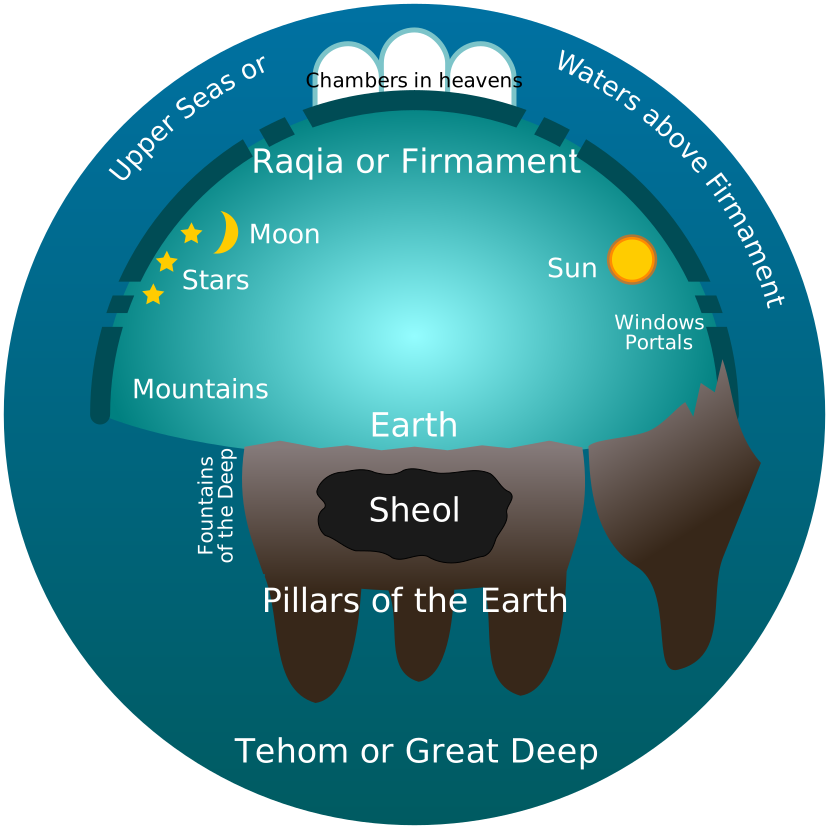 Ancient Hebrew conception of the universe. The firmament (rāqîaʿ) separates the waters above from the waters below, illustrating the cosmological assumptions Walton argues are embedded in Genesis 1. Image: Wikimedia Commons, public domain.
God did not feel the need to dispel this ancient understanding. (Similarly, he elsewhere does not correct the notion that the sun revolves around the earth.)
Walton argues that God allowed his people to maintain their misunderstanding of the world. He accommodated their presuppositions so that they could better understand him.
Ancient Language
Understanding this, how are we to view the creation account in Genesis 1? How does Walton address this question?
He argues that we must avoid the temptation to take the English translation of Scripture at face value. Faithfulness to Scripture does not mean faithfulness to a translation.5 Indeed, we cannot take Scripture seriously without looking at the original languages.
Walton argues forcefully for what should be obvious: words matter.
The words of each language come with their own unique nuances. They are packed with cultural significance. We, therefore, need to remember that the author of Genesis did not write to Americans in twenty-first-century American English. He (or they) wrote in ancient Hebrew to ancient Israelites.
So, what significance do the Hebrew words have here? What cultural nuances would they have conveyed to ancient Israelites?
This is where The Lost World of Genesis One really shines.
”Create” (Hebrew בָּרָא / bārā’) Concerns Function
Here the book earns its title.6 Walton argues that in the ancient world, creation accounts concerned installation of function. Giving purpose, rather than bringing something into material existence, is what matters.
“[P]eople in the ancient world believed that something existed not by virtue of its material properties, but by virtue of its having a function in an ordered system.”7
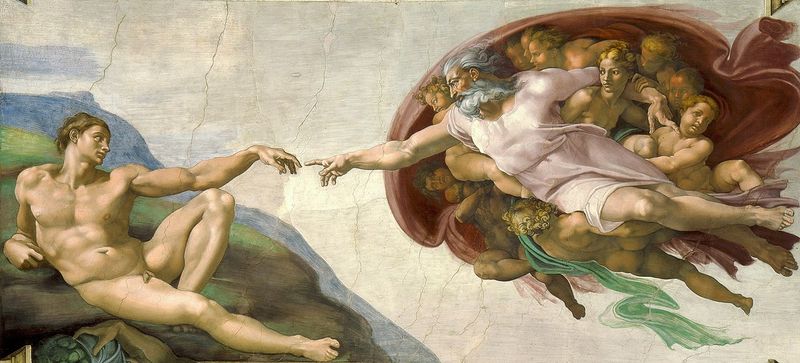
The ancients were concerned about function rather than material creation. Their creation accounts, therefore, addressed the gods providing function and order to things. They (generally) did not discuss the gods’ bringing things into existence in the material sense.
Consequently, in the ancient mind, God could create something that already existed.
Modern Parallels
Walton points out that we often use the word create in the same manner. So, for example, when we say we’re creating a committee to look at an issue, we do not mean that we are bringing a committee into material existence. After all, the members of the committee already exist.
We are, instead, giving human beings who already exist a new purpose. That is what we mean by creation in that sense.
The book also discusses creating a university. When a group of people wants to create a university, they don’t talk about building buildings or facilities. The buildings are not the university.
Instead, they talk about bringing a new purpose into being. They refer to turning buildings or faculty into a functioning, ordered system existing for the education of individuals.
Similarly, given my military background, I think of the term “making soldiers.” When drill sergeants say they are making soldiers, they do not mean they are creating new human beings. Rather, they mean they are taking a human being that already exists and instilling him or her with new purpose.
This is the type of paradigm shift in understanding that The Lost World of Genesis One provides.
בָּרָא (Bārā’)
Walton argues that this is what the ancients meant when they discussed “creation.” When we speak of the origins of man, we mean his material origin. The theory of evolution seeks to answer this creation question. That, however, is not how the ancients thought of creation at all.
The ancients were asking a different question than we are attempting to answer. We must understand what question the ancients were asking before trying to determine the answer Genesis 1 seeks to provide.
Walton argues, in particular, that we must attempt to understand the original meaning of Genesis 1 before trying to utilize it as an explanation for the origin of species.
The book focuses on the Hebrew word בָּרָא (bārā’, translated “created” in Genesis 1). Walton studies the word and its appearance throughout Scripture. He then concludes that the word generally requires a functional understanding of creation. That is, examples of the word’s use elsewhere in Scripture, “offer support that existence is viewed in functional rather than material terms, as is true throughout the rest of the ancient world.”8
In light of this, Walton translates Genesis 1:1 as, “In the initial period, God created by assigning functions throughout the heavens and the earth, and this is how he did it.”9
The Beginning State in Genesis 1 Is Nonfunctional
In this section, Walton explores the beginning state of the earth.10 Specifically, Genesis 1:2 describes the earth as תֹּהוּ (tōhû) and בֹּהוּ (bōhû). Various versions translate these words to set up a material creation account. (E.g., “formless and void” (KJV, NASV), “without form and void” (ESV, NKJV), “formless and empty” (NIV, NLT), “a formless wasteland” (NABRE), etc.).
Conducting a semantical analysis, however, Walton concludes that “unproductive” is a better translation. This is consistent with other Near Eastern creation accounts. In these accounts, creation, while existing in the material sense at the accounts’ beginnings, was unproductive.
So, Walton argues, “in the beginning,” before the initiation of the seven days found in Genesis, the earth existed. God had simply not yet provided it with the purpose that it was to have.
Genesis 1 is the description of God’s instilling creation with his purpose for it. The culminating purpose in this account, Walton argues, is that of man. The purpose God gives man is of the most significance. Human beings were to serve as God’s viceroys to subdue creation. That was their purpose and consequently the overall purpose of God’s creative work.
It is important to note—though Walton, writing from an evangelical perspective, does not emphasize this—that his functional-origins reading does not deny creatio ex nihilo, the doctrine that God created all things from nothing. The Catholic Church has defined this as a matter of faith since the Fourth Lateran Council in 1215, and the Catechism reaffirms it clearly.11 Walton’s argument is simply that Genesis 1 is not about material creation. It does not follow that material creation by God did not happen; only that this particular text addresses a different question.
The Purpose of the Six Days
Walton argues that we should divide the six-day period of creation into two. Days one through three establish function. The last three days install functionaries.12
That is to say, on days one through three, God established the functions of the cosmos.
- Light (day one).
- The place for living things to live and the source of rain (day two).
- Space for food to grow and terrestrial animals and man to live (day three).
In days four through six, God installed the functionaries to carry out the functions he had established in the previous three days.
- Cosmic bodies to ensure the continued separation of day and night established on day one (day four).
- The animals to fill the space provided on day two (day five).
- Animals and man to fill the dry land God established on day three (day six).
Walton points out the neat, poetic correspondence between the first three and last three days. (Day one corresponds to day four, day two to day five, etc.) God instilled creation with purpose and then assigned functionaries to carry out those purposes.
The material things and functionaries already existed. The story is of God’s moving to establish order and give material objects purpose.
All of this takes on more significant meaning when the book moves onto day seven.
Why Did God Have to Rest?
As Walton points out, to modern readers, day seven seems like an afterthought. It appears to be a tack-on that makes little sense to us.
It also provokes superficial Sunday School questions. (For example, “Why did God have to rest? Was he tired?”)
Further reflection, however, suggests that such questions are not all that superficial. Why would the text say that God rested? Why would that require another day? (And what, as Walton asks, did God do on the eighth day?)
The book argues, however, that this would not have confused the ancients. They understood the significance of divine rest.
First, our understanding of rest is different than that of the ancient readers. We think of it as mere relaxation. “But in the ancient world rest is what results when a crisis has been resolved or when stability has been achieved, when things have ‘settled down.‘“14 After the passing of a crisis, things return to “normal.” That is, regular routines can be established and resumed without the threat of interference from chaotic forces.
“For deity this means that the normal operations of the cosmos can be undertaken.”15
God as Ruler
Walton here explains the dynamics of ancient temple theology. The ancients believed that a god rested in his temple. In light of this, day seven takes on greater significance.
On this day, God, having defeated the chaotic forces and brought order and purpose to the earth, takes up residence on earth as his temple. That is, the God of Israel is not limited to a temple built by man. The whole earth is his temple (see Isa 66:1).
This is a substantial theological point, particularly in the ancient polytheistic world.
Day seven is when God takes up residence in his temple. A god was the ruler of his temple. The point, therefore, is that the earth is God’s temple. In taking up residence in it, God assumes his role as the ruler of the whole earth.
He takes the levers of control of the universe and rules. Now that “creation” is complete, God assumes control as its rightful ruler. Humanity serves as his viceroy.
This is the lost world of The Lost World of Genesis One. And it is this lost world that provides the context for a proper understanding of the creation account.
Competing Theories
The book also addresses various other views of creation.
Young Earth Creationism
First, Walton discusses young earth creationism. This is the belief that God created the physical universe out of nothing in a literal six-day period. Advocates of this position believe the world to be a mere six thousand to twenty thousand years old.
Proponents of this position like to claim that they are taking the Bible at its word. Walton, however, argues that they are forcing Genesis to say things that it never meant to say.
Instead, they are instilling the ancient Hebrew text with the meaning of its twenty-first-century English translation. The English words “create” and “made” as twenty-first-century Americans use them do not necessarily correspond to the ancient Hebrew words בָּרָא (bārā’) and עָשָׂה (‘āśâ).
To take the Bible at face value, Walton argues, we must understand its ancient Hebrew meaning. We cannot merely assume an American English one.
Old Earth Creationism
Next, Walton addresses Old Earth Creationism. He faults proponents of this theory for attempting to reconcile Scripture with modern scientific understandings of the world.
Science changes. The predominant theories of today may not be the prevailing theories of tomorrow. Attempting to reconcile the events of the six days with various scientific theories instills the text with a meaning that the author never intended.
We must allow Scripture to speak for itself without subjecting it to the ever-changing scientific theories of material origin. Otherwise, the Bible is just another secular book with some religious messages. There is little special about it if we must reconcile it with the theories du jour.
Framework Hypothesis
Walton next addresses the framework hypothesis. Here, he argues against those who see Genesis 1 as a mere literary tool meant to teach theological truths. Proponents of this position often view Genesis 1 as allegory, not history.
The book agrees with many of the theological points proponents of this theory make. Walton nonetheless faults them for arguing that that’s all there is. The author of Genesis 1, he argues, is saying more than that.
Walton seems to advocate some historicity of the creation account, though it is not clear on this point.
Less Popular Views
The book also briefly mentions other less popular views.
For example, there is a theory that the earth functioned and existed before the creation account in Genesis 1. A fallen Satan, however, destroyed the earth before the book’s beginning. Genesis 1 is, therefore, an account of the recreation of a ruined planet. The Scofield Reference Bible helped make this theory famous.
Walton, however, argues that the Hebrew does not allow for such a reading. He is not the first one to point this out. This is why the theory has already fallen out of favor. The book, therefore, does not spend much time addressing it.
Walton then turns to the argument that millions of years separate the accounts of Genesis 1:1–2:3 and 2:4–25. He dismisses this argument almost out of hand.
Walton raises brief theological objections to this theory for its failure to account for non-human hominid species and their relationship to God and man. I’m not sure what his point is here, though. The book does not develop this argument. Rather, it seems to cut it short with little explanation.
The Evolution Debate
Walton argues that Genesis 1 is a story of God’s instilling the universe with purpose and function consistent with the divine plan. Purpose, he argues, is a metaphysical matter. Genesis 1, therefore, is primarily about the why not the how.
Therefore, as long as believers accept that God is responsible for creation—the fundamental claim of divine revelation—it does not matter how they believe he accomplished it. The book argues that the theory of evolution does not contradict the story of Genesis because Genesis simply does not comment on the material origins of the universe.
Walton, however, argues that both science and religion should understand their unique purpose. Christians should not take the why of Genesis 1 and impose it on science as the how. Conversely, science must not take the how of science and insist it to be the answer to the metaphysical why. That is, science must remain neutral on the matter of purpose.
Science is simply not equipped to answer metaphysical questions. It is, therefore, inappropriate for science to say that, since evolution explains the material origins of creation, there is no God or God was not involved.
It is these inappropriate metaphysical statements made in the name of science that Christians should oppose, rather than science itself. In Walton’s words, “Public Science Education Should be Neutral Regarding Purpose.”16
The Catholic Church has navigated this territory with care. Pope Pius XII’s 1950 encyclical Humani Generis permitted Catholics to explore the possibility that the human body developed from pre-existing living matter, provided they hold that the soul is immediately created by God.17 Pope John Paul II went further in his 1996 address to the Pontifical Academy of Sciences, acknowledging that evolution is “more than a hypothesis” while insisting on the spiritual discontinuity that marks the emergence of the human person.18 Walton’s framework—distinguishing the metaphysical why from the scientific how—aligns well with this Catholic distinction, even though he does not write from a Catholic perspective.
Intelligent Design
The discussion of intelligent design within The Lost World of Genesis One may be the book’s most controversial section.
Walton concedes that intelligent design is not a scientific theory. He, therefore, argues that it has no place alongside evolution in public schools. The book does not present intelligent design as an alternative scientific theory of creation. Quite the opposite.
Scientists cannot subject the theory of intelligent design to experimentation. Intelligent design is consequently not conducive to the scientific method. Therefore, it is not a scientific theory.
Public schools should only teach scientific theories. Walton has no qualms with this conclusion.
Review: Strengths and Weaknesses of Walton’s Argument
I found The Lost World of Genesis One to be a compelling yet accessible read. Walton demonstrates an intense love of Scripture and an evident desire to discover the biblical author’s intent. His arguments are very persuasive. I also found them to be consistent with evangelical presuppositions.
I never got the impression that Walton was attempting to force Scripture into an interpretation that he desired. The book was also lacking in exegetical gymnastics. Walton never appeared to be trying for its own sake to reconcile the creation account with modern scientific theory.
Admittedly, I had never before heard of an interpretation of Genesis 1 like the one the book proposes. I am always skeptical whenever an author offers a novel interpretation of Scripture, particularly one as prominent as the creation account.
I generally find it hard to believe that throughout millennia, no one has proposed an explanation like the one an author suddenly discovers. The Lost World of Genesis One is essentially claiming to find a meaning in the creation account that such greats as Athanasius, Augustine, Aquinas, and Calvin all somehow missed.
Novelty of the Interpretation
Yet, Walton provides a reasonable explanation for the novelty of his position. After delivering a compelling exegetical analysis of the Scripture, he explains why no one has proposed a similar interpretation.
He does not argue that he found something heretofore hidden within the text. Instead, he argues that we have only recently discovered the cultural context into which Genesis 1 was written. That is to say, the interpretation is not novel.
Walton argues that his interpretation would have been the natural understanding of the original audience. That is the whole point of the book. Only recently have archaeological and literary discoveries—particularly the decipherment of cuneiform tablets in the nineteenth and twentieth centuries—allowed us to access and begin to understand the original cultural context of the ancient Israelites. This information was lost by the time of Christ. Time, war, and exile have a way of obscuring history.
The Church Fathers, looking at the Hebrew text from their own late-antique Greco-Roman culture, would not have had the point of reference to interpret the creation account according to its original intent. This remained true throughout the centuries. The great scholars of the Church simply did not understand ancient Hebrew culture.
In short, Walton does not argue that his interpretation is new. He argues only that it had long been forgotten.
Shortcomings
There are some areas, however, where The Lost World of Genesis One leaves much to be desired. For example, Walton fails to address the allegory argument adequately.
He acknowledges that there are those who believe that the creation account is a mere literary work meant to teach us about God and man. Proponents of this theory argue that Genesis 1 demonstrates God’s use of allegory to teach theological truth. (Allegory and parables were, after all, a favorite tool of God incarnate.)
Walton seems to dismiss this position out of hand. He appears insistent on holding onto the traditional evangelical view that the creation account must be an historical account—at least somewhat in the way modern Westerners understand history.
He fails, however, in my opinion, to argue adequately why this is necessary. He seems to assume that taking the Bible seriously requires understanding the creation account as history. Yet, the book fails to provide much justification for this position.
I tend to agree with Walton that Genesis 1 is more than allegory. Still, I don’t believe he adequately explains why or to what extent it is more. The Catechism of the Catholic Church, for its part, acknowledges that the creation account uses “symbolic language” while affirming the fundamental truths it conveys about God, creation, and the human person.19
The Evolution of Man?
In addition, Walton fails to address the origins of man adequately. The book seems to suggest that Genesis 1 provides an account of the actual material creation of man. That is, God does more in Genesis 1 than give man purpose. Walton, however, does not flesh this out. (And the book seems to contradict itself somewhat on this point.)
I was, therefore, left wondering whether Walton rejects the evolution of man from pre-human ancestors. He seems to suggest that Genesis 1 has nothing to say about material origins. He then implies that there is something different about man. That is, man could not have evolved in the same way that everything else did.
Again, I’m not sure if this is his position. I simply find some passages of the book ambiguous and confusing.
What is notably absent from this discussion is any treatment of the soul. The Catholic tradition offers a helpful framework here. Even if the human body developed through evolutionary processes, each human soul is an immediate creation of God—not a product of biology. As the Catechism states, “Every spiritual soul is created immediately by God—it is not ‘produced’ by the parents.”20 This distinction, rooted in Pope Pius XII’s Humani Generis, preserves both the dignity of the human person and the legitimacy of scientific inquiry into our material origins. Walton’s silence on this point is understandable—he writes as an evangelical, not a Catholic—but the omission leaves a significant question unanswered for readers who want a complete theological account of human origins.
What Is History?
I am also left wondering if Walton thinks Genesis 1 is an historical account in the modern sense. As I stated above, the book seems to imply that it is. Still, I am not sure.
This confusion leads me to the inevitable question the book raises but then fails to answer. How would the ancient audience have understood history?
It is unlikely that the ancients would have understood it the way that we do. Even in the first century, the Gospels appear willing to rearrange stories to prove a point without anyone’s necessarily questioning the reliability of the accounts as a result.
Would it not stand to reason then that the author of Genesis could have told a story in a manner modern historians would find unacceptable but would not have concerned the original audience? If so, would that not be important for interpretation? The Pontifical Biblical Commission’s 1993 document The Interpretation of the Bible in the Church affirms that responsible exegesis must attend to the literary genres, conventions, and cultural contexts in which biblical texts were composed—precisely the kind of work Walton attempts here.
A discussion on this point would have been helpful.
Conclusion
The Lost World of Genesis One is an ingenious work that offers a faithful interpretation of the text—one that simultaneously rescues Scripture from those who claim to take it seriously but then force it to say things it never meant to say.
I highly recommend this work. For those interested in how Scripture’s inspiration relates to its interpretation, or how God’s progressive revelation unfolds across the biblical narrative, this book provides an important piece of the puzzle.
Readers looking for a Catholic complement to Walton’s thesis will find a natural companion in Joseph Ratzinger’s In the Beginning…: A Catholic Understanding of the Story of Creation and the Fall (Eerdmans, 1995), which explores Genesis 1–3 with similar attentiveness to literary form and theological meaning.
If you’ve read Walton’s book, I’d welcome your perspective—feel free to reach out via the contact page.
The Words of Saint Augustine
Given the controversy surrounding scientific theory within the Christian Church, I think it is appropriate to end this discussion with a quote from Saint Augustine of Hippo (A.D. 354–430).

Usually, even a non-Christian knows something about the earth, the heavens, and the other elements of this world…Now, it is a disgraceful and dangerous thing for an infidel to hear a Christian, presumably giving the meaning of Holy Scripture, talking nonsense on these topics; and we should take all means to prevent such an embarrassing situation, in which people show up vast ignorance in a Christian and laugh it to scorn…
If they find a Christian mistaken in a field which they themselves know well and hear him maintaining his foolish opinions about our books, how are they going to believe those books in matters concerning the resurrection of the dead, the hope of eternal life, and the kingdom of heaven, when they think their pages are full of falsehoods and on facts which they themselves have learnt from experience and the light of reason?…
For then, to defend their utterly foolish and obviously untrue statements, they will try to call upon Holy Scripture for proof and even recite from memory many passages which they think support their position, although they understand neither what they say nor the things about which they make assertion. [1 Timothy 1.7]21
Frequently Asked Questions
Does Walton believe Genesis 1 is literal?
Yes—but not in the way most people mean. Walton argues that a truly literal reading requires understanding the text as its original audience would have. He contends that the original audience understood creation in terms of function, not material origins. His reading is literal in the sense that it takes the ancient Hebrew text on its own terms rather than imposing modern English meanings.
Is the cosmic temple view compatible with biblical inerrancy?
Walton explicitly affirms biblical inerrancy and argues that his functional-origins reading is more faithful to the text than material-origins readings. He maintains that Genesis 1 is completely true in everything it affirms—it’s simply affirming something different than what many modern readers assume. The text is inerrant in its claims about God’s establishment of cosmic functions and his rule over creation as his temple.
Does Walton’s view mean God did not create the material world?
No. Walton is careful to distinguish between what Genesis 1 addresses and what is true. He believes God is the creator of all material things. His argument is only that Genesis 1 is not about material creation—it addresses functional origins. The doctrine of creatio ex nihilo (creation from nothing) is affirmed on other grounds, including other biblical texts and the Church’s longstanding teaching.
Does John Walton accept the theory of evolution?
Walton does not take a firm public position on evolution in this book. His argument is that Genesis 1, properly understood, simply does not speak to the question of material origins at all—and therefore cannot be used either to support or to refute evolutionary theory. He urges Christians to oppose not science itself, but scientism—the inappropriate use of science to make metaphysical claims about purpose.
What is the difference between functional and material origins?
Material origins concern how something came into physical existence—the atoms, molecules, and processes that produced it. Functional origins concern how something received its purpose and role within an ordered system. Walton argues that ancient peoples, including the Israelites, thought of creation primarily in functional terms: something existed when it had a role, not merely when it was physically present.
How does the cosmic temple reading change the meaning of the Sabbath?
In Walton’s reading, the Sabbath takes on profound theological significance. In the ancient world, divine rest meant a deity had taken up residence in a temple to rule. Day seven is not an afterthought—it is the climax of the entire account. God’s rest signals that the cosmos is now functioning as his temple, and he has assumed his rightful place as its sovereign ruler. The Sabbath, then, is an invitation to participate in the reality of God’s sovereign rule over all creation.
How does The Lost World of Genesis One relate to Walton’s later books?
The Lost World of Genesis One (2009) was the first volume in what became Walton’s “Lost World” series from InterVarsity Press, which now includes volumes on Adam and Eve, the Israelites, the Flood, and more. In 2025, InterVarsity Press published New Explorations in the Lost World of Genesis by John Walton and J. Harvey Walton, which extends and updates the original thesis. For a complete guide, see John Walton’s Lost World Series: A Reading Guide.
Notes
1. It is always difficult to decide which word to use to describe the evangelical understanding of Scripture. So much debate has swirled around the Bible and its reliability in a variety of different fields that words such as "inerrancy" and "infallibility" have become loaded terms. In attempting to avoid the nuances of an unrelated debate, I use the word "infallibility" to mean the Bible's complete reliability in the matters of faith and practice.
2. Walton divides The Lost World of Genesis One into several propositions, which double as chapter titles. I borrow these propositions as subheadings in this review. I do so to focus on various aspects of Walton's theory. "Ancient Cosmology is Function Oriented" is proposition two in the book.
3. For English translations of these and other ancient Near Eastern creation texts, see William W. Hallo and K. Lawson Younger Jr., eds., The Context of Scripture, 3 vols. (Leiden: Brill, 1997–2002). Walton discusses these parallels in chapters 1–3 of The Lost World of Genesis One.
4. Second Vatican Council, Dei Verbum (Dogmatic Constitution on Divine Revelation), §11 (1965).
5. Regardless of what the King James Only folks—or their intellectual predecessors within the Catholic Church who insisted on the Vulgate only—may say.
6. This is the third proposition in The Lost World of Genesis One.
7. John H. Walton, The Lost World of Genesis One: Ancient Cosmology and the Origins Debate (Downers Grove, IL: InterVarsity Press, 2009), 24.
8. Walton, 41.
9. Walton, 44–45.
10. This is proposition 4 in The Lost World of Genesis One.
11. See Catechism of the Catholic Church, §296–298; Fourth Lateran Council, Firmiter credimus (1215). See also Joseph Ratzinger, In the Beginning…: A Catholic Understanding of the Story of Creation and the Fall (Grand Rapids, MI: Eerdmans, 1995), 9–27.
12. Propositions 5 and 6 in The Lost World of Genesis One.
13. Walton, 71.
14. Walton, 72.
15. Walton, 72.
16. Proposition 18 in The Lost World of Genesis One.
17. Pope Pius XII, Humani Generis, §36 (1950).
18. Pope John Paul II, "Message to the Pontifical Academy of Sciences: On Evolution" (October 22, 1996).
19. Catechism of the Catholic Church, §337, §362.
20. Catechism of the Catholic Church, §366; see also Humani Generis, §36.
21. Augustine, The Literal Meaning of Genesis (De Genesi ad litteram libri duodecim), trans. J. H. Taylor, in Ancient Christian Writers, volume 41 (Newman Press, 1982).

Garrett Ham
Garrett Ham is an attorney, military veteran, and holds a Master of Divinity from Yale Divinity School. He writes from Northwest Arkansas on theology, law, and service.
More about Garrett →Related Posts
John 1:5 Meaning Explained: The Light Shines in the Darkness
What does John 1:5 mean? A study of the Greek—the present tense of φαίνει, the double meaning of κατέλαβεν, and the already/not yet of eschatology.

What Happened to the Jesuits? A Catholic Lament for a Great Order
From 36,000 members to under 14,000 — what happened to the Jesuits? A historically grounded Catholic assessment of the Society of Jesus's decline.

Evangelical to Catholic: The Intellectual Journey
A comprehensive guide to the intellectual journey from evangelical Protestantism to Roman Catholicism — from sola scriptura to the Church Fathers, from faith alone to the fullness of Catholic tradition.
Stay Informed
Get new writing on faith, law, and service delivered to your inbox.
No spam. Unsubscribe anytime.