2 Peter — The Most Contested Letter in the Canon
On This Page
Part of the series: The New Testament Canon — How 27 Books Survived the Ancient Gauntlet
No book in the New Testament took a harder road to the canon than 2 Peter. It was absent from the Muratorian Fragment. It was unknown to the Peshitta. Eusebius classified it among the antilegomena—the disputed books—and acknowledged bluntly that “the ancient presbyters” had not quoted it.1 Ernst Käsemann, in a landmark 1952 essay, called it “perhaps the most dubious writing in the canon.”2 Raymond Brown judged its pseudonymity “more certain than that of any other NT work.”3
And yet this same letter supplies the Catholic Church with its primary biblical text for the doctrine of deification, a foundational warrant for the doctrine of inspiration, and the earliest explicit recognition of Paul’s letters as Scripture. The Catechism of the Catholic Church cites 2 Peter 1:4 in at least seven paragraphs.4 Dei Verbum explicitly invokes both 2 Peter 1:19–20 and 3:15–16.5 A letter that spent centuries on the margins of the canon now sits at the heart of Catholic doctrinal teaching.
Understanding how that happened—and what it means for how Catholics read the Bible—requires engaging every dimension of the evidence: the patristic testimony, the critical scholarship, the theological questions, and the Church’s own evolving engagement with all of it.
A letter that claims to be by Peter
The author identifies himself as “Simeon Peter, a servant and apostle of Jesus Christ” (1:1), using the archaic Semitic form Symeōn (Συμεών) rather than the standard Greek Simōn. This form appears elsewhere in the New Testament only in Acts 15:14, where James uses it at the Jerusalem Council—a Palestinian setting. The author claims to have been an eyewitness of the Transfiguration, hearing the divine voice from the “Majestic Glory” (1:16–18). He refers to an earlier letter he has written (3:1), almost certainly meaning 1 Peter. He anticipates his imminent death as foretold by Christ (1:14), a passage widely read as echoing the Johannine tradition of Jesus’s prophecy about Peter’s martyrdom (John 21:18–19). And he speaks of “our beloved brother Paul” and his letters (3:15–16) with the casual intimacy of apostolic collegiality.
How one reads these features depends entirely on one’s conclusions about authorship. And the authorship of 2 Peter is, by any measure, the most disputed question of its kind in New Testament studies.
The case against Petrine authorship
The critical consensus runs firmly against Petrine authorship, and the arguments deserve honest engagement. Five converging lines of evidence are typically cited.
Style and vocabulary
The Greek of 2 Peter is dramatically different from 1 Peter. Where 1 Peter is steeped in Septuagintal language with approximately 46 Old Testament allusions, 2 Peter alludes to the Old Testament perhaps only five times and employs what Richard Bauckham calls “Asiatic Greek”—a florid, ornate rhetorical style with Gorgianic figures characteristic of Hellenistic Asia Minor.6 The letter contains approximately 57 hapax legomena—words found nowhere else in the New Testament—the highest proportion of any canonical book relative to its roughly 1,100 words.7 Drawing on U. Holzmeister’s 1949 study, Bauckham found that only 38.6 percent of words are common to both 1 and 2 Peter, while 61.4 percent of 2 Peter’s vocabulary is peculiar to it alone.8 Nearly two-thirds of those unique terms appear only in non-Jewish Greco-Roman literature. Jerome Neyrey described the style as characteristic of epideictic rhetoric—a writer consciously performing in a Hellenistic literary register.9
The stylistic gap between the two letters is not subtle. It is not the kind of variation one might attribute to different moods or different occasions. It reads like a different author.
Dependence on Jude
2 Peter 2:1–18 closely parallels Jude 4–16, with as many as 19 of Jude’s 25 verses finding full or partial echoes in 2 Peter.10 The majority scholarly view holds that 2 Peter used Jude rather than the reverse, based on a pattern of systematic adaptation. Where Jude freely quotes 1 Enoch 1:9 and alludes to the Assumption of Moses, 2 Peter drops both citations entirely—consistent with a later author increasingly uncomfortable with non-canonical references.11 Where Jude describes false teachers as a present reality, 2 Peter reframes the same material as future prophecy—consistent with a pseudepigraphal author casting Jude’s descriptions as Petrine “predictions.” And 2 Peter adds the positive examples of Noah and Lot absent from Jude, reorders the Old Testament examples into chronological sequence, and smooths Jude’s rougher grammar.12
The question this raises for authorship is straightforward: why would an apostle borrow so extensively from a much shorter, less prominent letter attributed to Jude, the brother of James? The question is less acute if Peter himself wrote first and Jude later condensed his material—but most scholars find the evidence of literary direction runs the other way.
Paul’s letters as a collection
The reference to “all his letters” (pasais tais epistolais) in 3:15–16, classifying them alongside “the other Scriptures” (tas loipas graphas), presupposes both a collected Pauline corpus and its recognition as authoritative Scripture. The definite article with graphas carries the technical sense—sacred Scripture—in every one of its 51 New Testament uses.13 David Trobisch traced the early formation of the Pauline corpus, while Harry Gamble demonstrated that collection activity began very early but the equation of Paul’s letters with “Scripture” reflects a development most scholars place after Peter’s lifetime.14
The distance from the apostolic generation
2 Peter 3:2 speaks of “the commandment of the Lord and Savior through your apostles.” Critical scholars read this as indicating distance from the apostolic generation—if Peter were writing, we would expect “us apostles” or some first-person identification.15 The scoffers of 3:3–4 ask, “Where is the promise of his coming? For ever since the fathers fell asleep, all things continue as they were.” Most critical scholars read “the fathers” as first-generation Christian leaders whose death without the Parousia’s occurrence creates the theological crisis the letter addresses—a crisis that makes better sense in a post-apostolic setting.
The delayed Parousia as the letter’s driving concern
The entire structure of chapter 3 presupposes that enough time has passed since the apostolic proclamation of Christ’s return that the delay itself has become a pastoral problem requiring theological explanation. Ernst Käsemann delivered the landmark critical treatment in his 1952 essay “An Apologia for Primitive Christian Eschatology,” arguing that 2 Peter represents “early Catholicism” (Frühkatholizismus)—a church sheltering behind apostolic authority to suppress opponents.16 Käsemann placed the letter in the mid-second century, though Bauckham later systematically refuted his criteria and chronology.
The testament genre
Bauckham’s most influential contribution was classifying 2 Peter as a “testament letter”—a hybrid genre combining the Hellenistic epistle with the Jewish farewell discourse.17 In this genre, a patriarch facing death gathers followers to deliver final ethical instruction and prophecy about future threats. Parallels include the Testament of Moses, the Testaments of the Twelve Patriarchs, Deuteronomy 31–34, John 13–17, and 2 Timothy. Bauckham argued that “in Jewish usage the testament was a fictional literary genre” and that 2 Peter’s testamentary features would have been transparent to ancient readers—making the pseudepigraphal device “not a fraudulent means of claiming apostolic authority, but [embodying] a claim to be a faithful mediator of the apostolic message.”18
This argument has been genuinely influential across confessional lines, because it addresses the moral objection to pseudepigraphy—the worry that a letter falsely claiming to be by Peter is simply a forgery. If 2 Peter was composed within a recognized literary convention, ancient readers would have understood the attribution as a formal literary device rather than a factual claim.
Not everyone has found this convincing. Peter Davids concluded that 2 Peter fits “only loosely into the testamentary category.”19 Donald Guthrie, in an influential appendix on pseudepigraphy, argued more sharply that “pseudonymity and canonicity are mutually exclusive”—that the early Church consistently rejected known pseudepigrapha and would have done so here had the attribution been recognized as fictional.20
The case for Petrine authorship
Conservative defenders mount a serious counter-argument, and it deserves the same honest engagement.
The vocabulary objection reconsidered
Michael Green—whose 1960 Tyndale monograph 2 Peter Reconsidered has been called “the ablest defence of Petrine authorship”—demonstrated that 1 and 2 Peter share 153 words in common, comparable to the 161 shared by 1 Timothy and Titus, where common authorship is generally maintained.21 Michael Kruger pushed the statistical argument further, demonstrating that vocabulary statistics are unreliable with sample sizes under 10,000 words, citing statistician G.U. Yule, and that 2 Peter’s mere 1,100 words make any statistical comparison with 1 Peter’s roughly 1,700 words methodologically suspect.22
The Semitic Symeōn
Thomas Schreiner emphasized that the archaic Symeōn “is never used in the Apostolic Fathers or pseudepigraphic Petrine literature.”23 A forger would more likely copy the opening of 1 Peter or use the standard Greek Simōn. The presence of this rare form—attested in the New Testament only here and in James’s speech at the Jerusalem Council—suggests either genuine Palestinian provenance or an unusually sophisticated forger.
The amanuensis hypothesis
Jerome himself proposed the solution in De Viris Illustribus: since 1 Peter 5:12 identifies Silvanus as secretary, a different amanuensis for 2 Peter could explain the stylistic divergence.24 The hypothesis has real explanatory power—Roman-era literary composition routinely involved secretaries who exercised varying degrees of stylistic freedom. Bauckham countered that the differences “go beyond what secretarial variation can explain,” but this judgment involves a degree of subjectivity about just how much freedom an ancient secretary could exercise.25
Verbal links to the Petrine speeches in Acts
Guthrie noted strong verbal similarities between 2 Peter and Peter’s speeches in Acts, including shared terms such as “received” (1:1; Acts 1:17), “godliness” (1:6; Acts 3:12), and “day of the Lord” (3:10; Acts 2:20).26 The significance of these parallels depends on how much weight one gives to Acts’ reliability in recording Peter’s actual vocabulary—a contested question in its own right—but the connections are real.
The early Church’s track record on pseudepigraphy
Kruger mounted the sharpest version of this argument: the early Church consistently rejected known pseudepigrapha. When the Asian elders discovered that the author of the Acts of Paul and Thecla had written it “out of love for Paul,” they defrocked him despite his good intentions—a story preserved by Tertullian in De Baptismo 17.27 If the Church was this vigilant, the argument runs, 2 Peter’s eventual acceptance is evidence that it was not widely perceived as pseudepigraphal.
The pre-70 dating argument
Bo Reicke dated all three Catholic Epistles to the 60s AD, arguing the social and political problems they address reflect the pre-70 situation.28 John A.T. Robinson—a liberal Anglican bishop best known for Honest to God (1963), which makes his conservative dating conclusions especially striking—argued that every New Testament book was written before AD 70, reasoning that the absence of any reference to the Fall of Jerusalem makes post-70 dating implausible.29 Douglas Moo similarly favored Petrine authorship with a mid-60s date.30
The choice, as Guthrie framed it, ultimately lies between genuine Petrine authorship with the problem of delayed reception, or pseudepigraphy with the problem of lacking adequate motive and the letter’s eventual acceptance by a Church that demonstrably rejected pseudepigrapha when it identified them.31 Neither option is without difficulty.
How the Catholic Church navigates the tension
The trajectory of Catholic teaching on 2 Peter’s authorship traces the same arc visible across Catholic biblical scholarship in the twentieth century: from strict affirmation of traditional attributions to critical openness.
The Pontifical Biblical Commission, functioning between 1905 and 1915 as an instrument of Pius X’s anti-Modernist campaign, issued Responsa generally upholding traditional authorship attributions of biblical books. In 1955, PBC secretaries Athanasius Miller, O.S.B. and Arduin Kleinhans published articles clarifying that Catholic scholars now had plena libertate—“full freedom”—regarding the earlier PBC decrees insofar as they did not touch on matters of faith and morals.32 Raymond Brown and Thomas Aquinas Collins held that “many of these decrees now have little more than historic interest.”33 After the PBC’s reconstitution in 1971 under the Congregation for the Doctrine of the Faith, it no longer issues binding decrees but produces advisory documents.
Dei Verbum, the Second Vatican Council’s 1965 constitution on divine revelation, affirmed that God “chose men” who “as true authors” committed to writing what God wanted—without specifying the mechanism of authorship or requiring that a named author be the literal writer.34 The PBC’s 2014 document The Inspiration and Truth of Sacred Scripture explicitly notes that 2 Peter is pseudepigraphical and observes this has no implications for whether the text is inspired.35
Inspiration and canonical authority attach to the text we have, not to the resolution of the authorship question.
The navigating principle is the same one that applies to every authorship question in Catholic biblical studies: inspiration and canonical authority attach to the text we have, not to the resolution of the authorship question. The Gospel of Matthew does not become less authoritative if it was composed by an anonymous Jewish-Christian scribe rather than by the apostle. And 2 Peter does not become less inspired if it was written by a member of the Petrine circle rather than by Peter himself.
The result is that the leading Catholic scholars of the last half-century—Brown, Perkins, Harrington, Neyrey—have openly accepted pseudepigraphy while affirming the letter’s canonical authority without magisterial censure. Conservative Catholics continue to defend Petrine authorship. The Church has not dogmatically defined the question and is unlikely to do so.
When and where was 2 Peter written?
The dating of 2 Peter spans nearly a century of possibility, and where one lands depends largely on one’s authorship conclusions.
If Peter himself wrote the letter, it must date to the mid-60s AD, before his martyrdom under Nero. This is the position of Reicke, Green, Moo, and Robinson, who argue that the false teachers reflect incipient heresy rather than developed Gnosticism, that “the fathers” in 3:4 refers to Old Testament patriarchs rather than first-generation Christians, and that “all” Paul’s letters need not presuppose a complete corpus.36
Bauckham’s preferred date of c. AD 80–90 positions 2 Peter as a pseudonymous testament from the Petrine circle in Rome—early enough to draw on genuine Petrine traditions, late enough to account for the developed features critics identify.37 Jeremy Duff of the Oxford Bible Commentary concurred that “various strands of evidence point towards 60–130 CE, with some reason to favour 80–90 CE.”38
Neyrey, Perkins, and Brown favor a range of AD 100–130, citing the Paul collection evidence, the developed Parousia-delay crisis, and the thoroughly Hellenistic philosophical vocabulary. Brown called 2 Peter the latest New Testament document.39
Käsemann’s mid-second-century date is now generally considered too late. Bauckham systematically refuted the Frühkatholizismus criteria on which it rested, and the manuscript evidence does not support so late a composition.
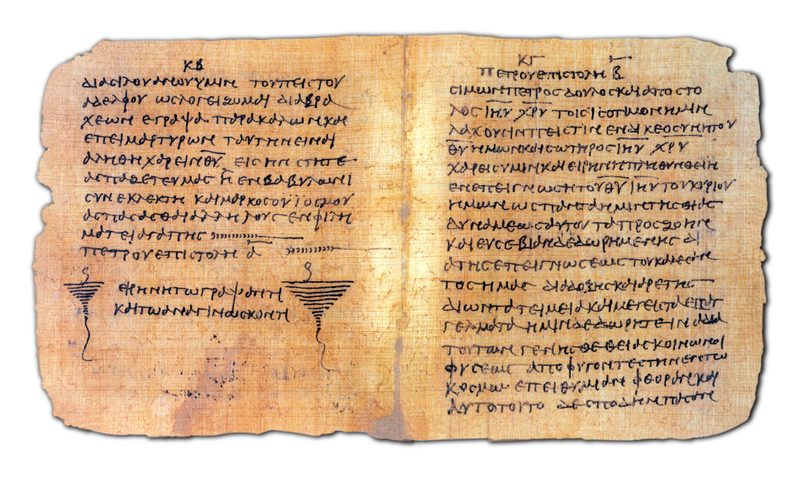
The terminus ad quem is established by P72 (Papyrus Bodmer VII–VIII), the earliest manuscript of 1–2 Peter, paleographically dated to the third century by Kurt and Barbara Aland, or as early as c. AD 200–250 by Philip Comfort.40 The Apocalypse of Peter (c. AD 100–135) shows extensive parallels with 2 Peter, and the majority view holds the Apocalypse is dependent on 2 Peter—potentially pushing the letter’s latest possible date back to the early second century.41
On provenance, Rome is the most common suggestion, given the tradition of Peter’s martyrdom there and the likely Roman setting of 1 Peter (“Babylon” in 1 Peter 5:13). The Asiatic Greek style suggests addressees in Asia Minor, consistent with 1 Peter 1:1. Egypt has been proposed given P72’s provenance, but this remains a minority view—a manuscript’s findspot does not necessarily indicate where a text was composed.
2 Peter and Jude—a literary puzzle
The relationship between 2 Peter 2:1–18 and Jude 4–16 constitutes one of the clearest cases of literary dependence in the New Testament. The correspondences run systematically: 2 Peter 2:1 parallels Jude 4 on false teachers who deny the Master; 2:4 parallels Jude 6 on the angels who sinned; 2:6 parallels Jude 7 on Sodom and Gomorrah; 2:10–11 parallels Jude 8–9 on reviling glorious ones; 2:12 parallels Jude 10 on irrational animals; 2:13–17 parallels Jude 11–13 on feasting, Balaam, and waterless springs; and 2:18 parallels Jude 16 on bombastic words.
The evidence of direction—that 2 Peter used Jude rather than the reverse—is strong but not unanswerable. D. Edmond Hiebert argued that Jude’s studied arrangement into triplets “looks more like a second writer working up old material.”42 Mark Mathews argued for Jude’s dependence on 2 Peter on the basis that Jude improved the grammar, structure, and style of 2 Peter’s version.43 Reicke proposed a common oral sermon tradition behind both letters rather than direct literary dependence. Bauckham countered that “there is no other extant work that is a candidate to be the source of both letters” and that the combination of virtually identical order with similar wording requires direct literary dependence.44
The direction of dependence matters for the authorship question—if 2 Peter used Jude, that is one more reason to think it was composed by someone other than Peter, since it is difficult to explain why the chief apostle would borrow so extensively from a much shorter letter attributed to Jude—but it does not settle the question by itself. Defenders of Petrine authorship note that ancient authors routinely incorporated material from other writers, and that Peter’s endorsement of Jude’s warnings could reflect collegial agreement rather than literary dependence.
What crisis was 2 Peter responding to?
The opponents in 2 Peter deny the Parousia and the coming judgment (3:3–4), practice sexual immorality (2:2, 10, 13–14, 18), exploit through greed (2:3, 14–15), despise authority (2:10), twist Paul’s letters (3:16), and promise “freedom” while being “slaves to corruption” (2:19). Three main identifications have been proposed.
Neyrey argued the opponents combined Epicurean philosophy with Christianity—denying divine providence, judgment, and afterlife consequences—and demonstrated this identification in both his JBL article and his Anchor Bible commentary.45 Bauckham suggested antinomian Christians who pushed Pauline freedom beyond what Paul intended, noting the 3:16 reference to those who “twist” Paul’s teaching.46 The proto-Gnostic identification, once popular in older German scholarship, has fallen out of favor since the opponents’ doctrines do not align precisely with known Gnostic systems.
The letter addresses two interlocking threats: the ethical crisis of the false teachers’ libertinism (chapter 2) and the eschatological crisis of the delayed Parousia (chapter 3). The two are linked by a single theological logic—if there is no coming judgment, then moral effort is pointless. The author’s response works to demonstrate that the apostolic eschatological proclamation remains credible and that its ethical demands remain binding.
Structure and content
Chapter 1—Foundation, testament, and authority
The salutation (1:1–2) establishes the author’s identity and introduces epignōsis (“knowledge”), a keyword appearing nine times with cognates in chapter 1 alone. The theological foundation (1:3–11) begins with God’s gifts and the extraordinary promise that believers may become “partakers of the divine nature” (theias koinōnoi physeōs, 1:4)—the most theologically freighted phrase in the letter and the only New Testament text to use this Hellenistic formulation. The passage immediately connects this gift to ethical effort through a sorites or chain-argument (1:5–7): faith leads to virtue (aretē), which leads to knowledge, self-control, steadfastness, godliness, brotherly affection, and finally love. J. Daryl Charles demonstrated the virtue list’s deep engagement with Hellenistic philosophy, though in 2 Peter aretē is not an end in itself but a link toward agapē as the ultimate telos.47
The testamentary core (1:12–15) has Peter declaring that “the putting off of my body will be soon, as our Lord Jesus Christ made clear to me” (1:14). The Transfiguration account (1:16–18) functions as an apologetic defense of the Parousia proclamation: against those who dismiss the apostolic message as “cleverly devised myths” (sesophismenois mythois), Peter appeals to eyewitness testimony—hearing the divine voice, “This is my beloved Son.” Neyrey argued this section employs the Hellenistic rhetorical category of autopsia (“eyewitness credibility”), deploying a well-known ancient standard of evidence in service of a theological claim.48
The chapter closes with a statement on Scripture’s divine origin that would prove enormously consequential for the development of Catholic doctrine: “No prophecy of Scripture comes from someone’s own interpretation… men spoke from God as they were carried along by the Holy Spirit” (1:20–21).
Chapter 2—False teachers and divine judgment
The warning about false teachers (2:1–3) shifts between future tense—the convention of the testament genre, in which a dying patriarch prophesies what will come—and present tense, which betrays the author’s real situation. Three Old Testament examples of judgment follow (2:4–10a): the angels who sinned (cast into Tartaros—the only New Testament use of this term from Greek mythology), the Flood (with Noah preserved), and Sodom and Gomorrah (with Lot delivered). The addition of righteous Noah and Lot—absent from Jude—supports the crucial theological conclusion in 2:9: “The Lord knows how to rescue the godly from trials, and to keep the unrighteous under punishment until the day of judgment.”
The extended description of the false teachers (2:10b–22) culminates in two proverbs: “The dog returns to its own vomit” (citing Proverbs 26:11) and “the sow, after washing, returns to wallow in the mire.” The rhetoric is fierce, the language vivid, and the theological point unmistakable—apostasy is worse than ignorance.
Chapter 3—Parousia and the new creation
The scoffers’ challenge (3:1–4) and the author’s response (3:5–13) form the letter’s climax. The author answers the delayed Parousia with three arguments: God’s different relationship to time—“one day with the Lord is as a thousand years” (3:8, citing Psalm 90:4); the delay reflects divine patience, “not wishing that any should perish” (3:9); and the precedent of the Flood proves God’s willingness to intervene catastrophically in history (3:5–7).
The cosmic conflagration imagery of 3:10–12—“the elements will be dissolved with fire”—engages with Stoic ekpyrosis (world-conflagration) while reframing it. As J. Albert Harrill demonstrated, 2 Peter’s fire is singular rather than cyclical, an act of divine judgment rather than natural process, and issues in “new heavens and a new earth” (3:13) rather than identical repetition.49 The letter closes with the reference to Paul’s letters (3:14–16) and a final exhortation to “grow in the grace and knowledge of our Lord and Savior Jesus Christ” (3:18)—the letter’s central themes distilled into a single sentence: knowledge, growth, and eschatological hope.
Theological significance
Theosis and the divine nature
2 Peter 1:4 has generated one of the richest theological traditions in Christianity. The Greek theias koinōnoi physeōs—“sharers of the divine nature”—became a cornerstone of patristic deification theology and remains the most important biblical proof-text for the doctrine of theosis.
The patristic development of the theme is extraordinary. Irenaeus wrote, “The Word of God became what we are, that He might bring us to be even what He is Himself” (Adversus Haereses 5, Preface). Athanasius declared, “The Son of God became man so that we might become God” (De Incarnatione 54.3). Maximus the Confessor developed the most sophisticated theology of deification, teaching that Christ’s two natures make possible a reciprocal exchange: God becomes human so that humans might become divine. Thomas Aquinas explained 2 Peter 1:4 in terms of participatio—habitual grace as a participation in the divine nature elevating human nature to the beatific vision.50
The Word became flesh to make us “partakers of the divine nature.”
The Catechism of the Catholic Church makes 2 Peter 1:4 its flagship theosis text. CCC 460 weaves together 2 Peter 1:4, Irenaeus, Athanasius, and Aquinas: “The Word became flesh to make us ‘partakers of the divine nature.’” The verse appears throughout the Catechism—in paragraphs on the sacraments (CCC 1129), baptism (CCC 1265), Holy Communion (CCC 1391), Christian moral dignity (CCC 1692), and grace (CCC 1996).51
The distinction between Catholic and Eastern Orthodox readings centers on Palamite theology. Orthodox theologians, following Gregory Palamas, distinguish between God’s absolutely imparticipable essence and his participable uncreated energies, interpreting 2 Peter 1:4 as participation in the latter. Catholic theology, through Aquinas, understands the beatific vision as seeing the divine essence itself, though not comprehending it—a difference that scholars like Jeffrey Finch and A.N. Williams have attempted to reconcile.
Scripture’s divine origin and Catholic teaching on inspiration
The affirmation that “no prophecy of Scripture is a matter of one’s own interpretation” and that “men moved by the Holy Spirit spoke from God” (1:20–21) became one of the Catholic Church’s foundational texts on biblical inspiration. Dei Verbum 11 cites 2 Peter 1:19–20 alongside 2 Timothy 3:16 as scriptural warrant for the doctrine.52 Benedict XVI directly quoted 2 Peter 1:20 in his address for the fortieth anniversary of Dei Verbum in September 2005.53 Leo XIII’s Providentissimus Deus (1893) established the broader framework within which these texts function.
Catholic interpretation has traditionally emphasized the phrase “no prophecy of Scripture is a matter of one’s own interpretation” as supporting the necessity of the Church’s teaching authority—the Magisterium—in interpreting Scripture. Some Protestant readers emphasize the same passage’s affirmation of Scripture’s divine origin in service of sola scriptura arguments. Both readings are attested in the commentary tradition, and the tension between them illustrates how the same biblical text can serve different theological purposes depending on which clause receives the emphasis.
Paul’s letters as Scripture and the formation of the canon
The identification of Paul’s letters as “Scripture” (graphas) in 3:15–16 is the earliest explicit canonical statement about any New Testament writing. The phrase hōs kai tas loipas graphas—“as they do the other Scriptures”—demonstrates that by the time of writing, at least some Christian communities treated Paul’s letters with the same authority as the Old Testament.
Bruce Metzger, Gamble, and Trobisch all recognized this passage’s enormous significance for canon history, though they disagreed on precisely when the Pauline collection reached this status.54 For the history of the canon, the passage is doubly significant: it witnesses both to the early authority of the Pauline corpus and to the existence of an interpretive community already wrestling with the difficulty of Paul’s letters—the very people 2 Peter warns are “twisting” them to their own destruction.
It is worth asking whether 3:15–16 may itself have contributed to 2 Peter’s eventual canonical acceptance. A letter that endorsed Paul’s writings as Scripture—especially one attributed to Peter—served the Church’s interests in establishing the authority of the emerging New Testament. Petrine validation of the Pauline corpus was a powerful canonical tool, and the Church may have been reluctant to lose it.
The weakest external attestation of any canonical book
The patristic evidence for 2 Peter is, to put it frankly, thin. No certain quotation of the letter exists before Origen in the mid-third century. Understanding the full weight of this silence—and its limits—requires tracing the evidence source by source.
The Apostolic Fathers
The most significant possible allusion occurs in 1 Clement 23:3–4 (c. AD 96), which closely echoes 2 Peter 3:3–4 about scoffers citing the delay of divine promises. Clement introduces the material with “that which is written,” suggesting he regards it as scriptural. Bauckham argued both drew on a common lost apocalyptic source.55 Robert Picirilli argued 2 Peter was the source, noting that Clement’s designation of the material as “scripture” would be “exceedingly strange” if it came from an unknown non-Petrine text.56
Polycarp (c. 110–140) makes at least five clear allusions to 1 Peter but shows no awareness of 2 Peter—significant for those arguing against early circulation.57 No convincing connections have been demonstrated in Ignatius, the Didache, or the Epistle of Barnabas, though Picirilli identified possible allusions in Barnabas and the Shepherd of Hermas.
The Muratorian Fragment
The Muratorian Fragment (c. 170–200) does not mention 2 Peter. But the Fragment is a damaged and incomplete document—its beginning and possibly its end are lost—and it also omits 1 Peter and James, both universally accepted books. Eckhard Schnabel’s 2014 survey of research on the Fragment confirmed that its omissions cannot be straightforwardly interpreted as rejections.58 The silence is suggestive but not conclusive.
Origen
Origen (c. 185–254) is the first writer to cite 2 Peter by name. Eusebius preserves his key statement (HE 6.25.8): “Peter has left behind one acknowledged epistle, and perhaps also a second; for it is disputed” (amphiballetai).59 Despite acknowledging others’ doubts, Origen quoted 2 Peter six times and treated it as Scripture—an important point often overlooked by those who cite his amphiballetai as evidence against the letter.
Eusebius
Eusebius’s classification system in Ecclesiastical History 3.25 (c. 325) became definitive. He placed 2 Peter among the antilegomena—“disputed, yet recognized by many”—alongside James, Jude, 2 John, and 3 John.60 His homologoumena (universally accepted) included the four Gospels, Acts, the Pauline epistles, 1 Peter, and 1 John. His notha (spurious but orthodox) included the Shepherd of Hermas, the Apocalypse of Peter, Barnabas, and the Didache. In HE 3.3.1, Eusebius stated even more starkly that the second Petrine epistle “was not quoted by the ancient presbyters” but that “as it has appeared profitable to many, it has been studied with the other Scriptures.”
The candor is remarkable. Eusebius neither suppressed the evidence nor resolved it. He reported what he found and let the tension stand.
From dispute to acceptance
The tide turned in the fourth century, driven by endorsements from the most influential voices in the Church. Athanasius’s Festal Letter 39 (AD 367) listed the 27-book New Testament canon including 2 Peter. Cyril of Jerusalem (c. 350) listed seven Catholic Epistles including 2 Peter. Gregory of Nazianzus included “two of Peter” in his poetic canon list. Jerome (De Viris Illustribus 1, c. 393) acknowledged the stylistic doubts but accepted 2 Peter, offering the amanuensis hypothesis as a solution: “He wrote two epistles which are called Catholic, the second of which, on account of its difference from the first in style, is considered by many not to be by him.”61
Amphilochius of Iconium (c. 380) reported that “some say seven Catholic Epistles” while “others say only three”—reflecting ongoing Eastern uncertainty well into the late fourth century.62 But Augustine accepted 2 Peter, and the North African councils—Hippo (393) and Carthage (397)—definitively included it in the 27-book canon.
The Syriac exception
The Peshitta, standardized in the early fifth century, originally excluded 2 Peter along with 2–3 John, Jude, and Revelation—containing only 22 New Testament books. The five missing books were first included in the Philoxenian Version (AD 508), commissioned by Philoxenus of Mabbug, and later in the Harclean Version (AD 616).63 The Assyrian Church of the East does not recognize 2 Peter to this day—a living reminder that the canonical boundaries Christians take for granted were never as self-evident as they seem.
All three major codices—Vaticanus (4th century), Sinaiticus (4th century), and Alexandrinus (5th century)—include 2 Peter without any distinguishing mark from other canonical books.
The canonical journey from margin to center
- c. 96—1 Clement 23:3–4 possibly echoes 2 Peter 3:3–4
- c. 170–200—Muratorian Fragment: 2 Peter absent (text damaged/incomplete)
- c. 230–250—Origen first cites 2 Peter by name; notes doubts
- c. 325—Eusebius classifies 2 Peter as antilegomena
- c. 350—Cyril of Jerusalem lists seven Catholic Epistles
- 367—Athanasius’s Festal Letter 39: 27-book canon including 2 Peter
- c. 380—Gregory of Nazianzus includes 2 Peter in poetic canon
- c. 380—Apostolic Canons list “two Epistles of Peter”
- 382—Council of Rome (Decretum Gelasianum) includes 2 Peter
- c. 393—Jerome accepts 2 Peter, notes style doubts
- 393—Council of Hippo: 27-book canon
- 397—Council of Carthage: 27-book canon confirmed
- 508—Philoxenian Version adds 2 Peter to Syriac Bible
- 1442—Council of Florence reaffirms 27-book canon
- 1546—Council of Trent definitively defines the canon including 2 Peter
The criteria the early Church applied—apostolicity, orthodoxy, catholicity, and traditional use—explain both 2 Peter’s struggle and its ultimate acceptance. It faltered on apostolicity (authorship doubts from the beginning), catholicity (limited early circulation), and traditional use (no demonstrable reception before Origen). It eventually prevailed because of its orthodox content, its self-identification with Peter, endorsement by the most influential patristic authorities, and inclusion in the great codices.
P72, the Bodmer papyrus, demonstrates that by the mid-third century at latest, 2 Peter was being copied and circulated in Egypt alongside 1 Peter, Jude, and devotional texts—the Nativity of Mary, Odes of Solomon, and the Apology of Phileas—as part of the Bodmer Miscellaneous Codex.64 Tommy Wasserman’s 2005 study of the codex showed it was assembled for private devotional use, suggesting 2 Peter had achieved at least some level of grassroots acceptance even before the great fourth-century endorsements.
For Catholic readers, the canonical trajectory of 2 Peter illustrates a principle at the heart of Catholic theology of the canon: the Church did not create the canon by fiat but recognized it through a Spirit-guided process of discernment that took centuries to complete. The councils of Hippo, Carthage, Florence, and Trent did not impose something new upon the Christian community but ratified what had, through a long and sometimes painful process, become the mind of the Church. That 2 Peter’s road was the longest and hardest of any canonical book does not weaken this claim—it illustrates it. The process was real, the doubts were genuine, and the resolution was not predetermined. That is what discernment looks like.
2 Peter in Catholic liturgical life
2 Peter appears at key liturgical moments in the Roman Catholic lectionary. Most prominently, 2 Peter 1:16–19 serves as the second reading for the Feast of the Transfiguration (August 6), pairing Peter’s eyewitness claim with the Gospel accounts of the event. 2 Peter 3:8–14 is read on the Second Sunday of Advent (Year B), connecting the Parousia hope with Advent’s eschatological themes—a particularly apt liturgical choice, since the letter’s central argument is that the delay of Christ’s return should be read not as abandonment but as patience. Additional passages appear in the weekday lectionary cycle during Ordinary Time.
In magisterial teaching, 2 Peter 1:4 appears in at least seven Catechism paragraphs, making it one of the most-cited New Testament verses in the CCC. 2 Peter 3:13—“new heavens and a new earth”—appears in CCC 677’s eschatological teaching. For a letter that spent centuries on the margins, its presence in Catholic worship and doctrine today is remarkable.
What we know and what remains open
The honest state of the question looks something like this. What is clear: 2 Peter had the weakest external attestation of any canonical book. Its style is dramatically different from 1 Peter. It closely parallels Jude. It was classified as antilegomena by Eusebius and unknown to the Peshitta. The majority of critical scholars—including most Catholic scholars—consider it pseudepigraphal. A serious minority, concentrated among evangelical scholars, defends Petrine authorship. The Catholic Church has not dogmatically defined the question and grants scholars full freedom on it.
What is also clear: the letter’s theological contributions are extraordinary and indispensable. Its doctrine of participation in the divine nature shaped patristic, medieval, and modern Catholic theology. Its statement on the divine origin of Scripture became a pillar of the Church’s doctrine of inspiration. Its identification of Paul’s letters as Scripture is the earliest such canonical claim in the New Testament. Its treatment of the delayed Parousia remains the most developed response to that crisis in the biblical canon.
The authorship debate will likely never be fully resolved. The evidence permits both readings, and the theological stakes differ depending on one’s ecclesial commitments. What is beyond dispute is that the early Church’s centuries-long process of discernment ultimately vindicated this letter’s theological power. A text that Käsemann dismissed as the product of “early Catholicism”—he meant the term pejoratively—turns out to speak with extraordinary force to the very Catholic tradition he was criticizing. Its themes—participation in the divine nature, the authority of apostolic testimony, the certainty of God’s eschatological promises, and the imperative of moral transformation—have lost nothing with time.
For Catholic readers, the most honest approach may be the one Raymond Brown modeled: acknowledging the critical difficulties with full scholarly rigor while insisting that the question of authorship, however it is resolved, does not determine the question of authority. The Church recognized the voice of God speaking through this text. The centuries it took to reach that recognition do not weaken the conclusion. They demonstrate that the conclusion was not arrived at lightly.
Key scholarly works on 2 Peter
Richard Bauckham, Jude, 2 Peter, WBC 50 (Word, 1983)—the definitive critical commentary, magisterial on the testament genre and the relationship to Jude. Jerome Neyrey, 2 Peter, Jude, AB 37C (Doubleday, 1993)—social-scientific analysis with attention to Epicurean and Stoic categories. Pheme Perkins, First and Second Peter, James, and Jude, Interpretation (Westminster John Knox, 1995)—accessible critical treatment. Thomas Schreiner, 1, 2 Peter, Jude, NAC (Broadman & Holman, 2003)—strongest recent defense of Petrine authorship. Gene Green, Jude and 2 Peter, BECNT (Baker Academic, 2008)—serious conservative exegesis. Michael Green, 2 Peter and Jude, TNTC, rev. ed. (IVP, 1987)—the classic conservative commentary. Douglas Moo, 2 Peter, Jude, NIVAC (Zondervan, 1996)—bridges scholarship and application. Peter Davids, The Letters of 2 Peter and Jude, PNTC (Eerdmans, 2006)—rigorous exegesis. Daniel Harrington and Donald Senior, 1 Peter, Jude and 2 Peter, Sacra Pagina (Liturgical Press, 2003)—Catholic scholarly standard. Daniel Keating, First and Second Peter, Jude, CCSS (Baker Academic, 2011)—newer Catholic pastoral-scholarly commentary. Raymond Brown, An Introduction to the New Testament (Doubleday, 1997), chapters 33–34—essential for Catholic students. Donald Guthrie, New Testament Introduction, 4th ed. (IVP, 1990), pp. 806–842—influential conservative introduction. Among monographs and articles, Käsemann’s 1952 essay in Essays on New Testament Themes (SCM, 1964, pp. 169–195), Kruger in JETS 42.4 (1999), and Charles, Virtue amidst Vice (Sheffield, 1997) are indispensable.
Frequently Asked Questions
Who wrote 2 Peter?
The letter claims to be by Simon Peter. The overwhelming majority of critical scholars—including Catholic scholars Raymond Brown, Pheme Perkins, Daniel Harrington, and Jerome Neyrey—consider it pseudepigraphal, written after Peter’s death by someone in the Petrine tradition. A significant minority of evangelical scholars (Schreiner, Green, Moo, Guthrie) defend Petrine authorship. The Catholic Church has not dogmatically defined the question and grants scholars full freedom on it.
When was 2 Peter written?
Dates range from the mid-60s AD (if authentic) to c. AD 130 (Brown). Bauckham’s c. AD 80–90 represents a moderate critical position. The terminus ad quem is established by P72, dated to the third or possibly late second century.
Why was 2 Peter’s canonicity disputed?
Its external attestation is the weakest of any canonical book—no certain citation before Origen (c. 230). The style differs sharply from 1 Peter. It was absent from the Peshitta and the Muratorian Fragment. Eusebius classified it among the antilegomena. It eventually prevailed through its orthodox content, acceptance by major patristic authorities (Athanasius, Jerome, Augustine), and inclusion in the great codices and the councils of Hippo (393), Carthage (397), and Trent (1546).
What is the relationship between 2 Peter and Jude?
Most scholars hold that 2 Peter incorporated and adapted material from Jude, omitting Jude’s non-canonical references (1 Enoch, the Assumption of Moses) and reframing present-tense descriptions as future prophecy. A minority argue the reverse direction or a common oral source.
What does 2 Peter 1:4 mean by “partakers of the divine nature”?
This verse—theias koinōnoi physeōs—is the scriptural foundation for the patristic and Catholic doctrine of theosis or deification: the teaching that through grace, believers share in God’s own life. The Catechism (CCC 460) pairs it with Athanasius, Irenaeus, and Aquinas. It does not mean believers become God by essence, but that through grace they participate in divine life—what Aquinas explained as habitual grace elevating human nature to the beatific vision.
Does 2 Peter quote Paul’s letters as Scripture?
Yes. 2 Peter 3:15–16 refers to Paul’s letters alongside “the other Scriptures” (tas loipas graphas), making this the earliest explicit identification of any New Testament writing as “Scripture.” The passage presupposes both a collected Pauline corpus and its recognition as authoritative.
What does the Catholic Church teach about 2 Peter’s authorship?
The Church has not dogmatically defined the authorship. Early PBC decrees favored traditional attributions, but the 1955 plena libertate clarification, Divino Afflante Spiritu (1943), and Dei Verbum (1965) effectively granted Catholic scholars freedom on authorship questions that do not touch on faith and morals. The PBC’s 2014 document The Inspiration and Truth of Sacred Scripture explicitly notes 2 Peter’s pseudepigraphy without treating it as a problem for inspiration. The mainstream Catholic scholarly position accepts pseudepigraphy as compatible with inspiration and canonical authority.
Footnotes
-
Eusebius, Ecclesiastical History 3.3.1. ↩
-
Ernst Käsemann, “An Apologia for Primitive Christian Eschatology,” in Essays on New Testament Themes (SCM, 1964), 169. ↩
-
Raymond Brown, An Introduction to the New Testament (Doubleday, 1997), 767. ↩
-
CCC 460, 1129, 1265, 1391, 1692, 1996; cf. CCC 1017 (contextually). ↩
-
Dei Verbum 11 cites 2 Peter 1:19–20 and 3:15–16. ↩
-
Richard Bauckham, Jude, 2 Peter, WBC 50 (Word, 1983), 135–138. ↩
-
Bauckham, WBC, 135–137, drawing on U. Holzmeister’s 1949 study. ↩
-
Bauckham, WBC, 135–137. ↩
-
Jerome Neyrey, 2 Peter, Jude, AB 37C (Doubleday, 1993), 119. ↩
-
Bauckham, WBC, 141–143; D.A. Carson and Douglas Moo, An Introduction to the New Testament, 2nd ed. (Zondervan, 2005). ↩
-
Carson and Moo, Introduction, on the systematic omission of non-canonical citations. ↩
-
Mark Mathews, “The Literary Relationship of 2 Peter and Jude,” Neotestamentica 44.1 (2010): 47–66; Tord Fornberg, An Early Church in a Pluralistic Society (CWK Gleerup, 1977). ↩
-
Bauckham, WBC, on the technical sense of graphas. ↩
-
David Trobisch, Paul’s Letter Collection: Tracing the Origins (Fortress, 1994); Harry Gamble, Books and Readers in the Early Church (Yale, 1995). ↩
-
Werner Kümmel, Introduction to the New Testament (1966), 302. ↩
-
Käsemann, “An Apologia,” 169–195. ↩
-
Bauckham, WBC, 131–135. ↩
-
Bauckham, WBC, 161–162. ↩
-
Peter Davids, The Letters of 2 Peter and Jude, PNTC (Eerdmans, 2006). ↩
-
Donald Guthrie, New Testament Introduction, 4th ed. (IVP, 1990), 806–842. ↩
-
Michael Green, 2 Peter Reconsidered (Tyndale, 1960); 2 Peter and Jude, TNTC, rev. ed. (IVP, 1987). ↩
-
Michael Kruger, “The Authenticity of 2 Peter,” JETS 42.4 (1999): 645–671. ↩
-
Thomas Schreiner, 1, 2 Peter, Jude, NAC (Broadman & Holman, 2003), 262. ↩
-
Jerome, De Viris Illustribus 1 (c. 393). ↩
-
Bauckham, WBC, 135. ↩
-
Guthrie, New Testament Introduction, 820–825. ↩
-
Tertullian, De Baptismo 17; discussed in Kruger, JETS 42.4 (1999): 660. ↩
-
Bo Reicke, The Epistles of James, Peter, and Jude, AB 37 (Doubleday, 1964). ↩
-
John A.T. Robinson, Redating the New Testament (SCM, 1976). ↩
-
Douglas Moo, 2 Peter, Jude, NIVAC (Zondervan, 1996). ↩
-
Guthrie, New Testament Introduction, 806–842. ↩
-
Athanasius Miller, O.S.B., Benediktinische Monatschrift 31 (1955): 49–50; Arduin Kleinhans, Antonianum 30 (1955): 63–65. ↩
-
Raymond Brown and Thomas Aquinas Collins, Jerome Biblical Commentary, vol. II, 629. ↩
-
Dei Verbum 11. ↩
-
Pontifical Biblical Commission, The Inspiration and Truth of Sacred Scripture (2014), 60. ↩
-
Reicke, AB 37; Green, TNTC; Moo, NIVAC; Robinson, Redating. ↩
-
Bauckham, WBC, 158. ↩
-
Jeremy Duff, Oxford Bible Commentary (2001). ↩
-
Brown, Introduction, 767; Neyrey, AB; Perkins, Interpretation. ↩
-
Kurt and Barbara Aland, The Text of the New Testament, 2nd ed., 100; Philip Comfort, The Text of the Earliest New Testament Manuscripts, vol. 2 (2019), 446. ↩
-
Following J.B. Mayor and Michael Green on the Apocalypse of Peter’s dependence on 2 Peter; cf. A.E. Simms, Expositor (1898): 460–471. ↩
-
D. Edmond Hiebert, cited in Guthrie, New Testament Introduction. ↩
-
Mathews, Neotestamentica 44.1 (2010): 47–66. ↩
-
Bauckham, WBC. ↩
-
Jerome Neyrey, “The Form and Background of the Polemic in 2 Peter,” JBL 99 (1980): 407–431; AB, 1993. ↩
-
Bauckham, WBC. ↩
-
J. Daryl Charles, Virtue amidst Vice (Sheffield, 1997). ↩
-
Jerome Neyrey, “The Apologetic Use of the Transfiguration in 2 Peter 1:16–21,” CBQ 42 (1980): 504–519. ↩
-
J. Albert Harrill, “Stoic Physics, the Universal Conflagration, and the Eschatological Destruction of the ‘Ignorant and Unstable’ in 2 Peter,” in Stoicism in Early Christianity (Baker Academic, 2010). ↩
-
Thomas Aquinas, Summa Theologiae I-II, q. 110, a. 3; III, q. 3, a. 4, ad 3. ↩
-
CCC 460, 1129, 1265, 1391, 1692, 1996. ↩
-
Dei Verbum 11. ↩
-
Benedict XVI, address for the 40th anniversary of Dei Verbum, September 16, 2005. ↩
-
Bruce Metzger, The Canon of the New Testament (Oxford, 1987); Gamble, Books and Readers (1995); Trobisch, Paul’s Letter Collection (1994). ↩
-
Bauckham, WBC. ↩
-
Robert Picirilli, “Allusions to 2 Peter in the Apostolic Fathers,” JSNT 33 (1988): 57–83. ↩
-
Picirilli, JSNT 33 (1988): 57–83. ↩
-
Eckhard Schnabel, “The Muratorian Fragment: The State of Research,” JETS 57/2 (2014): 231–264. ↩
-
Eusebius, Ecclesiastical History 6.25.8. ↩
-
Eusebius, Ecclesiastical History 3.25. ↩
-
Jerome, De Viris Illustribus 1: quarum secunda a plerisque eius esse negatur propter styli cum priore dissonantiam. ↩
-
Amphilochius of Iconium, Iambics for Seleucus (c. 380). ↩
-
The Philoxenian Version (AD 508); the Harclean Version (AD 616). ↩
-
Tommy Wasserman, “Papyrus 72 and the Bodmer Miscellaneous Codex,” NTS 51 (2005): 137–154. ↩

Garrett Ham
Garrett Ham is an attorney, military veteran, and holds a Master of Divinity from Yale Divinity School. He writes from Northwest Arkansas on theology, law, and service.
More about Garrett →Related Posts

The Epistle to the Hebrews — Authorship, Canon, and the New Testament's Greatest Sermon
Hebrews is anonymous, disputed, and indispensable. Explore its authorship, three-century canonical battle, and the theology that shaped Catholic worship.

The Gospel of Matthew — The Church's Gospel and Its Journey to Canon
No book shaped early Christianity more than Matthew. Explore its authorship debates, composition, theology, and canonical status.
Stay Informed
Get new writing on faith, law, and service delivered to your inbox.
No spam. Unsubscribe anytime.