Orthodox Icons Explained
On This Page
To enter an Orthodox church is to step into a world where theology takes visible form. The walls shimmer with gold leaf. Faces—serene, penetrating, sometimes sorrowful—gaze down from every surface. Saints in hierarchies of color and light seem less like paintings and more like windows opening onto another realm. These are icons, and they represent something far more theologically significant than religious decoration.
For those raised in Western Christianity, Orthodox icons can be puzzling. Why do believers bow to them? Kiss them? Why are they painted in such a stylized, almost primitive manner when Western religious art pursued realism? And most pressingly: doesn’t veneration of icons violate the Second Commandment’s prohibition on graven images?
These questions point to a deep theological difference between East and West—one that hinges on how we understand the material world, the Incarnation, and the human vocation. To understand Orthodox icons is to grasp something essential about Orthodox Christianity itself: that matter matters, that images can mediate the divine without becoming divine, and that the human person, as “icon of God,” participates in a cosmic reality of participation and transformation.
This essay explores the theology of Orthodox icons with the scholarly rigor they deserve, tracing their biblical and theological foundations, their turbulent history in the iconoclasm crisis, their role in Orthodox worship, and their continued importance for Christian understanding of the material world.
What Is an Icon?
The word “icon” comes from the Greek εἰκών (eikon), meaning “image” or “likeness.” But this simple etymology conceals layers of theological meaning. In Orthodox tradition, an icon is not merely a religious painting; it is a theological statement condensed into color and form. It is what Leonid Ouspensky calls “theology in color.”1
More precisely, an icon is a sacred image—typically painted on a wooden panel—that depicts Christ, the Theotokos (Mother of God), the saints, or significant events in sacred history. But the definition must go deeper: an icon is understood as a window into heaven, a means by which the veneration offered to an image passes through to the one depicted.2 It is an instrument of communion between the visible and invisible worlds.
This distinguishes icons fundamentally from Western religious art, though the distinction is not always one of kind but of intention and theology. A Renaissance Madonna by Raphael and a Byzantine Theotokos are both representations of Mary, but they embody different theological assumptions. The Raphael pursues naturalistic beauty—convincing anatomy, realistic drapery, perspectival space—to move the viewer through aesthetic experience. The Byzantine icon renounces naturalism deliberately. It employs what art historians call inverse perspective: space recedes toward the viewer rather than away, making the painted surface feel like a doorway opening toward us rather than a window through which we look outward.3
The Materials and Craft of Icons
Portable Orthodox panel icons are traditionally painted in egg tempera on wooden panels, though the Orthodox icon tradition encompasses a far broader range of media—including frescoes (which constituted the vast majority of church iconography across the Byzantine world), mosaics (some of the most celebrated examples being at Hagia Sophia, Chora Church, and Ravenna), encaustic (hot wax, used for the oldest surviving panel icons at St. Catherine’s Monastery, 6th century), cast metal, carved ivory, and embroidery. Tempera—pigment mixed with egg yolk—has been the dominant medium for portable panel icons for centuries. The paint is applied in thin layers, built up gradually, which creates a luminous quality quite different from oils. The panels are often prepared with gesso (a white primer) and covered with gold leaf, which catches light and creates the iconic shimmer associated with Orthodox churches.4
This is not accident or mere aesthetics. The materials are chosen to embody the theology. Gold leaf represents the divine light that shines through matter. The flatness of the painted surface reinforces the icon’s transparency—it is not meant to be a window of naturalistic depth but a veil through which the invisible becomes present. The formulaic poses, the limited palette, the archaic quality—these are not the result of technical limitation (Byzantine iconographers were perfectly capable of naturalism, as their secular art sometimes demonstrates), but of theological intentionality.5
Crucially, the Orthodox tradition understands the iconographer not as an artist in the modern sense—not as a creator expressing personal vision—but as a theologian. The iconographer works within a tradition of types and formulas passed down through centuries. He does not invent; he witnesses. Before beginning to paint, the iconographer often prays and fasts. The work is understood as a spiritual practice, a theurgic act that participates in the communion between heaven and earth.6
Theological Foundations of Icon Veneration
The theological defense of icons rests ultimately on the Incarnation. This is the keystone, and it cannot be overstated: If God became visible in Jesus Christ, then the material world is sanctified, and visible images can mediate the divine.
This argument is so fundamental that it bears careful exposition. The Christian faith does not teach that God is pure spirit and Jesus was merely an appearance, a phantom. Rather, the Word became flesh—σάρξ (sarx)—and “dwelt among us.” 7 The invisible God became visible. He could be seen, touched, painted. This is the radical claim of the Incarnation: that God sanctified matter by assuming it.
If this is true, then the attempt to ban images of Christ or the saints seems not only misguided but positively heretical. It denies the sanctity conferred on the material world by the Incarnation itself. As John of Damascus argued in the eighth century, in a celebrated passage from the First Apology: “I do not worship matter, but I worship the Creator of matter who became matter for my sake, who willed to take his abode in matter, who worked out my salvation through matter” (paraphrased from §16 of the First Apology).8 The icon is not the object of worship; the prototype—the one depicted—is. The veneration given to the image passes through it to its source.
The Distinction Between Veneration and Worship
This leads to a crucial distinction that recurs constantly in Orthodox theology: the difference between proskynesis (veneration, the Greek term for bowing, kissing, incensing) and latreia (worship, the adoration offered only to God). A person venerating an icon of Christ bows, perhaps kisses the icon, and offers incense. But the movement of the heart is toward Christ himself, the prototype, not toward the wooden panel. The icon is a mediator but not an object of worship.9
This distinction is fundamental to the Orthodox response to the charge of idolatry. The iconoclasts, and later Protestant critics, would argue: “If you bow to this image, you are worshiping it, which is idolatry.” The Orthodox response: “No. The image is not the object of my veneration; it is the window through which my veneration reaches its true object. This is not different in principle from how the apostles venerated Mary, the Theotokos, whose dignity rested entirely on her relationship to Christ.”10
Icons as Sacramental Presence
Icons function in Orthodox theology somewhat analogously to sacraments. They are not sacraments strictly speaking—the Orthodox Church recognizes seven sacraments, and icons are not among them. But like sacraments, icons are material things through which spiritual reality becomes present. They are a means of grace.11
When an Orthodox believer venerates an icon in prayer, something is genuinely happening. It is not mere sentiment or nostalgic memory. The icon is a point of real contact between the worshiper and the saint or Christ depicted. This is why icons are not treated carelessly. A damaged or deteriorated icon should be treated with reverence even as it is removed from active veneration—burned respectfully, for instance, rather than simply discarded.12 The matter has been sanctified by its purpose.
The Theology of John of Damascus
The theological justification for icons was provided most eloquently by John of Damascus (c. 675–749), a Syrian monk writing from the safety of the Islamic caliphate, beyond the reach of the Byzantine emperor who was at that very moment trying to destroy all icons.13 In his Three Treatises on the Divine Images, John articulated a defense that would remain normative for the Orthodox Church.
John’s argument, simplified, proceeds thus: First, following the patristic tradition, he insisted that there is a real distinction between worship (latreia) and veneration (relative honor). In later Catholic scholastic theology, following St. Thomas Aquinas (Summa Theologiae III, q. 25, aa. 3–5), the honor given to sacred images is carefully differentiated: an image of Christ receives relative latria (since Christ himself receives latria); an image of the Blessed Virgin Mary receives relative hyperdulia; and only an image of a saint receives relative dulia. These distinctions matter theologically—particularly the Christological dimension, which recognizes that images of Christ participate in a higher category of honor than images of the saints.14
Second, John grounded icon veneration in the doctrine of the Incarnation. Because God became incarnate, the incorporeal became corporeal, the invisible became visible. Therefore, we can make visible representations of Christ and the saints, not as idols (which would be worship of the image itself), but as reminders and vehicles of communication with those depicted.15
Third, John made an argument from continuity with Scripture and tradition. The Old Testament itself contains images commanded by God: the cherubim on the Ark of the Covenant, the bronze serpent in the wilderness. These show that images themselves are not intrinsically sinful; it is the intention behind them that matters.16
Finally, John argued that icons serve a necessary pedagogical and spiritual function. For those who cannot read, icons are “books of the illiterate.” For those who can, they serve as channels of grace and reminders of eternal truths.17
The Iconoclasm Crisis (c. 726–843): A Theological and Political Storm
The history of icon veneration in Christendom is not a smooth progression. Instead, it was tested in fire. The iconoclasm crisis—the period during which the Byzantine Empire officially rejected icons—was one of the most significant theological struggles of the early Church and one of the most brutal.
The Crisis Begins: Emperor Leo III and the Motives of Iconoclasm
In 726 CE, Byzantine Emperor Leo III ordered the removal of the Christ icon from the Chalke Gate in Constantinople—a provocative act that sparked riots. By approximately 730, Leo issued a formal edict forbidding icon veneration and ordering the destruction of religious images, deposing the resistant Patriarch Germanus in the process. The reasons given were theological—that icon veneration constituted idolatry—but historians debate whether theological purity or political calculation (or both) drove the emperor’s hand.18
Leo III was facing external threats from Islam, which explicitly forbade images. He may have believed that Byzantine military weakness was divine punishment for idolatry. Or he may have sought to consolidate imperial authority by attacking the wealth and influence of monasteries, which were major centers of icon veneration. Most likely, both factors played a role.19
The iconoclasts—the “icon-breakers”—were not, contrary to stereotype, vandals or ignorant philistines. Many were serious theologians. Their arguments repay careful attention, for they were strong.
The Iconoclastic Arguments
The iconoclasts argued, first and foremost, that the worship of images violated the Second Commandment: “You shall not make idols.”20 They pointed to biblical prohibitions on graven images and saw in icon veneration a return to pagan idolatry. To bow before an icon, they insisted, was to worship it as if it were the god it depicted.
Second, the iconoclasts made a Christological argument. Christ is divine as well as human. His divine nature is uncircumscribed, infinite, beyond all representation. Only his human nature can be painted. But to paint Christ’s human nature alone, separated from his divine nature, is to commit a kind of Nestorianism—dividing the hypostatic union.21 The iconoclasts were more concerned with protecting orthodox Christology than with simple literalism about the Second Commandment.
Third, they argued that the only true “image” of God the Father is the Incarnate Christ himself. To make other images is to diminish Christ’s unique significance.22
These arguments were serious enough that they persuaded emperors, bishops, and theologians for more than a century. Icon smashing was not casual vandalism but an official policy of the Church and State united.
The Second Council of Nicaea (787) and the Triumph of Icons
In 787, nearly sixty years after Leo III’s initial actions, a new emperor and empress in Constantinople took a different view. The Empress Irene convened the Seventh Ecumenical Council, whose seven substantive sessions met at the Church of Hagia Sophia in Nicaea between September 24 and October 13, 787 (the same city where the Council of 325 had affirmed the divinity of Christ). The eighth and final session was held on October 23, 787, at the Magnaura Palace in Constantinople, in the presence of Empress Irene and her son Constantine VI.
The Council of Nicaea II firmly vindicated icon veneration. Its defining statement, called the Horos (Definition), distinguished between adoration (latreia), which belongs to God alone, and the “respectful veneration” (timetike proskynesis) given to icons of Christ, the Theotokos, and the saints—specifying that this is “not the true adoration which is due to God alone.”23 The Council affirmed that “the honor shown to an image passes to its prototype,” thus answering the idolatry charge: veneration of icons is not idolatry because the honor is not ultimately directed to the image but to the one depicted.24
The Council also leaned heavily on the Incarnation argument. Because God became visible in Christ, because matter was sanctified by the divine assumption, images of Christ and the saints are theologically justified and spiritually beneficial.25
For a brief period, icons were restored. The veneration of images returned to Orthodox churches. It seemed that the matter was settled.
The Second Iconoclasm (814–843) and Final Victory
It was not settled. After Irene’s reign, a new iconoclastic period began under Emperor Leo V. For nearly three decades, icons were again attacked and destroyed. Monks who resisted were imprisoned or executed. The theological arguments recycled, the political pressures intensified.
But the theological consensus, reinforced by the luminaries of the eighth century—not only John of Damascus but also Maximus the Confessor and Theodore the Studite—had been established. By the time of the Empress Theodora in 843, the position in favor of icons had become so entrenched that a restoration could occur, and this time it stuck.26
The year 843 marked what the Orthodox Church calls the “Triumph of Orthodoxy,” commemorated annually on the First Sunday of Lent. Icons were solemnly restored to churches. The theological and spiritual catastrophe was healed. The iconoclasm crisis had the effect of clarifying and deepening Orthodox theology; out of the struggle emerged a more sophisticated and articulate defense of the material world’s goodness and the reality of grace working through matter.
How Icons Function in Orthodox Worship
To understand icons is not merely to grasp theological abstractions. One must see how they function in the living worship of the Orthodox Church.
The Iconostasis
The most visually striking use of icons is the iconostasis—the icon screen that separates the sanctuary (where the priest stands) from the nave (where the faithful gather). This screen, covered densely with icons, is not a barrier meant to obscure but rather a threshold, a meeting place between heaven and earth.27
The iconostasis typically includes, in the center, the door to the sanctuary (the royal doors) flanked by icons of Christ and the Theotokos. To the left is usually an icon of John the Baptist or the patron saint of the church; to the right, Mary. Above these, in an upper row, are icons of feast days or apostles. Below, often, are icons of saints.28
The iconostasis is not decoration in the modern sense—chosen for aesthetic effect or personal preference. It is a theology made visible, a proclamation of the communion of saints, a visual representation of the Church’s faith. Each icon, each placement, each relationship between icons on the screen conveys doctrine.
The Role of Icons in the Divine Liturgy
During the Divine Liturgy, the central worship service of the Orthodox Church, icons play an active role. The priest venerates the icons, bowing and often kissing them at various points in the service. The faithful do the same. This is not a separate devotion imported into the Liturgy; it is integral to it. To participate fully in the Liturgy is to participate in the liturgical veneration of icons.29
Icons of the saint being commemorated on that day are sometimes carried in procession. The liturgical calendar is inseparable from the icon cycle—each day brings its own feast, its own remembrance, its own icons.
Icon Veneration Practices
The primary practices of icon veneration in Orthodox worship are simple: bowing, kissing, and incensing. A person approaching an icon might bow (a full prostration on major feast days), then kiss the icon, then perhaps light a candle before it. Incense is offered, both as a sign of honor and as a fragrant offering rising like prayer to heaven.30
These practices are not understood as worship of the image. Rather, they are concrete, bodily expressions of reverence directed through the image to its prototype. The body is involved in prayer in a way that Western Christianity, especially in its Protestant forms, often minimizes. The Orthodox understanding is that the human person is not merely a spirit housed in flesh; the body and soul together constitute the person, and therefore the body participates in worship.31
Icons in the Home
Icons are not confined to churches. The Orthodox home typically includes an “icon corner” (sometimes called the “beautiful corner” or krasnyi ugol), usually in a high and honored place, where a family keeps personal icons. This is the center of domestic prayer, where the family gathers for prayer and the celebration of feast days.32
The presence of icons in the home is meant to sanctify family life, to remind the family that Christ and the saints are present, witnesses to their joys and struggles. Icons are not mere reminders of absent friends; they are understood as points of real communion, channels through which grace flows into the home.
Major Icon Types and Their Symbolism
The Orthodox icon tradition has developed a rich typology of iconic forms, each with specific theological significance and symbolic vocabulary.
Christ Pantocrator
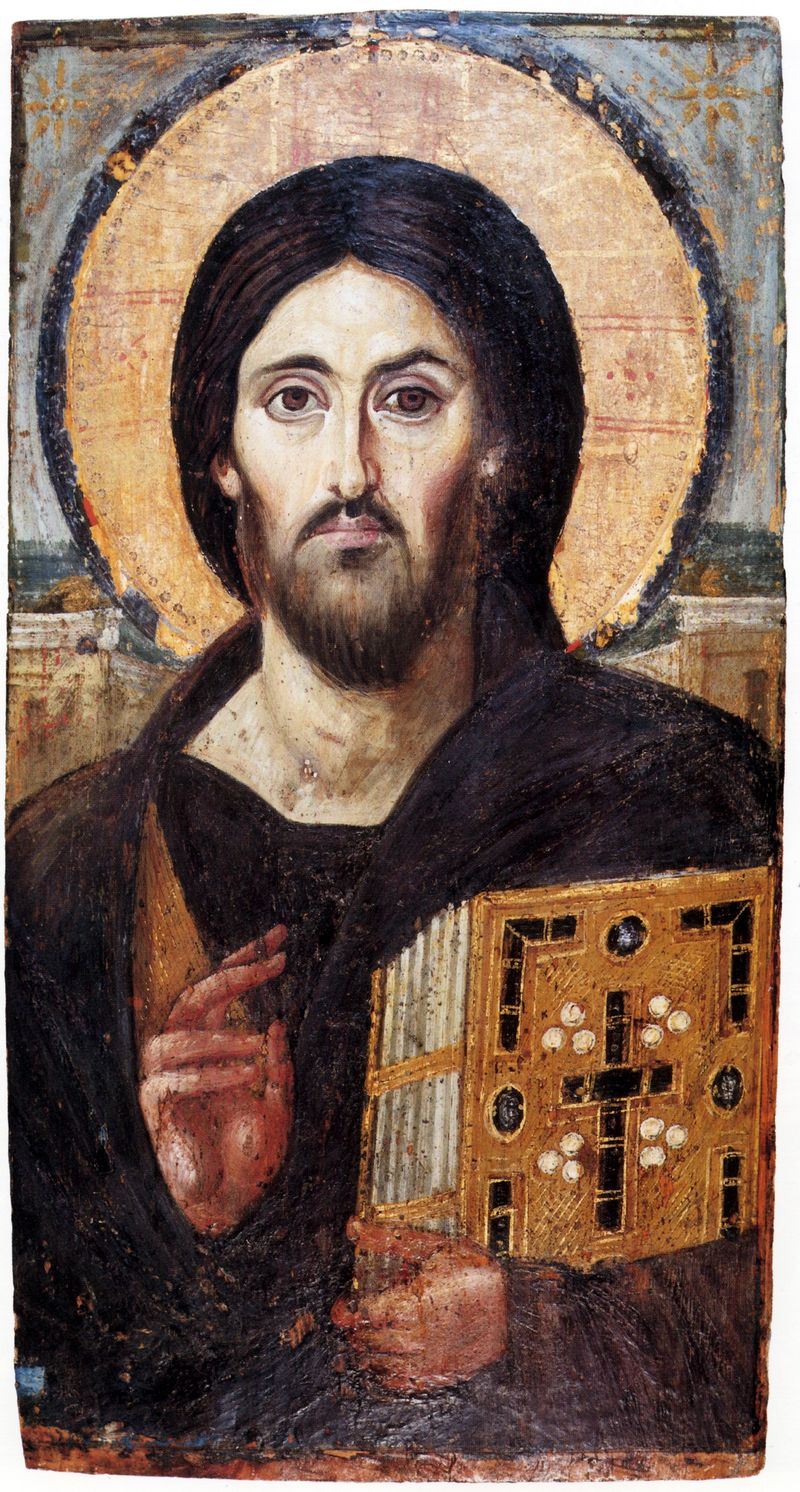
The Pantocrator (from Greek pantokrator, “almighty” or “ruler of all”) is perhaps the most iconic Orthodox image: Christ in majesty, often seated on a throne, one hand raised in blessing and the other holding the Gospels. Typically, there is an asymmetry in the face—one side stern and judging, the other merciful and compassionate—expressing the fullness of Christ’s nature as both judge and savior.33
The gold background is not meant to represent physical space but divine light. The formal pose and frontal gaze make Christ seem to look directly at the viewer. There is no attempt at realistic anatomy or perspective; instead, the inverse perspective draws the viewer forward, toward the throne, into the presence of Christ.
The Theotokos and Marian Icons
Icons of Mary, the Theotokos (God-Bearer), are among the most venerated in Orthodoxy. Several types recur:
The Hodegetria (“She Who Shows the Way”) typically shows Mary holding the Christ Child on her left arm and gesturing toward him with her right hand. Mary is usually depicted in a slight three-quarter pose, her head inclined toward the Child, while Christ faces more directly toward the viewer. This characteristic inclination distinguishes the Hodegetria from more strictly frontal icon types and emphasizes Mary’s role as the one who leads humanity to Christ.34
The Eleousa (“Merciful” or “Tender”) shows Mary with a gentler, more emotional intimacy, often depicted as Mary and the Christ Child embracing, expressing divine mercy and compassion.35
The Platytera (“Wider than the Heavens”) shows Mary with her arms raised in prayer, sometimes with the Christ Child depicted within her body or in a medallion on her breast, symbolizing that she contains the infinite God.36
All Marian icons are understood as centering on her relationship to Christ. Mary is not venerated as a divine figure but as the Theotokos, the one who bore God incarnate, and therefore honored with unique reverence. The icon of Mary always points beyond itself to Christ.
The Deësis
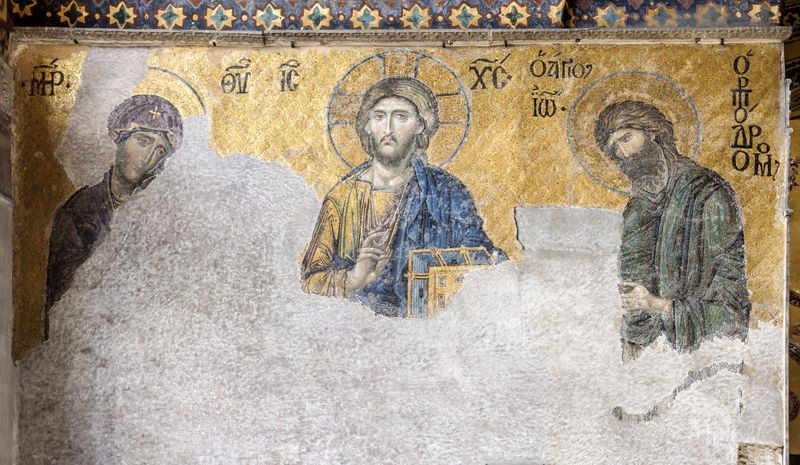
The Deësis (Greek for “prayer” or “supplication”) is an iconic composition showing Christ in the center with Mary on one side and John the Baptist on the other, both in attitudes of intercession. Often, saints are arrayed on either side, creating a grand scene of intercession before Christ the Judge.37
The Deësis emphasizes a fundamental Orthodox belief: that the saints and Mary intercede for us before God. It is a visual theology of intercessory prayer and the communion of saints.
Icons of Saints
Icons of saints follow recognizable patterns. A saint is typically shown full-length, frontal, often with symbols of their martyrdom or their spiritual gifts (a saint might hold a cross or a Gospel book or carry symbols of their profession or manner of death).38 The halo indicates holiness. The gold background again indicates divine light, suggesting that the saint, having achieved theosis (union with God), participates in divine light.
Symbolic Language: Color, Gesture, and Perspective
The Orthodox icon tradition employs a complex symbolic vocabulary. Gold, as mentioned, represents divine light. Deep blues represent the heavens or the transcendent. Reds suggest martyrdom or divine love. Purple indicates royalty. White symbolizes purity or resurrection.39
Gestures, too, are codified. The blessing gesture (fingers arranged in a particular way) conveys Christ’s authorization and grace. Particular stances indicate particular spiritual states or relationships.
Inverse perspective, which recurs throughout this essay, deserves a final note: it is not merely aesthetic but theological. By drawing the viewer forward into the icon rather than allowing the eye to recede into illusionistic depth, inverse perspective makes the icon a gateway. It refuses the naturalism that would make the sacred seem distant and mediated; instead, it opens the sacred toward the worshiper.40
Icons in Catholic Tradition
To this point, this essay has focused on Orthodox theology. But it would be incomplete without noting that the Catholic Church also defended icons at the Second Council of Nicaea and has maintained a theology of sacred images throughout its history.
The Catholic Defense of Icons at Nicaea II
The Second Council of Nicaea was called ecumenical, and it was attended by representatives from the Western Church, including papal legates. Pope Hadrian I supported the council’s decisions regarding icons.41 However, the Western reception of Nicaea II was far more contested than is often acknowledged. The Frankish church—the dominant Western ecclesiastical body beyond Rome—actively rejected the council through two major interventions. The Libri Carolini (c. 790–792), commissioned by Charlemagne and authored primarily by Theodulf of Orléans, explicitly rejected Nicaea II’s formulations, arguing both the iconoclast council of 754 and Nicaea II were “equally erroneous.” The Council of Frankfurt (794), attended by bishops from across the Frankish realm with papal legates present, formally rejected Nicaea II and declared it a “pseudosynod.” A flawed Latin translation of the Greek acts contributed to the controversy, though scholars like Thomas F.X. Noble have shown that the Frankish theologians understood the Byzantine distinctions and simply rejected them. The Paris Synod of 825 again attempted to persuade Rome to abandon its support for Nicaea II. Full Western acceptance of Nicaea II as ecumenical came only gradually, reportedly not until approximately 880. Catholic theology ultimately shares the Orthodox conviction that the Incarnation sanctifies matter and that images can mediate grace without constituting idolatry—but the road to that consensus was far longer and more contested than the council’s ecumenical status might suggest.
The Catechism of the Catholic Church, in its sections on idolatry and sacred images, affirms the legitimacy of venerating (though not worshiping) images of Christ and the saints: “The Christian veneration of images is not contrary to the first commandment which proscribes idols. Indeed, ‘the honor rendered to an image passes to its prototype,’ and ‘whoever venerates an image venerates the person portrayed in it’” (CCC §2132, quoting Nicaea II and St. Basil). The same section clarifies that “religious worship is not directed to images in themselves” but “to the persons they represent.”42
The Divergence in Artistic Tradition
However, the Catholic and Orthodox traditions diverged significantly in their artistic expression. From the Renaissance onward, Western Christianity pursued increasingly naturalistic religious art. Michelangelo, Raphael, Caravaggio—these masters sought to move the viewer through psychological realism and emotional immediacy, even as they worked within a Christian framework.
Meanwhile, the Orthodox Church, even as it allowed for some evolution and regional variation, maintained fidelity to the iconic tradition: flatness, formality, theological rather than naturalistic intention.43 The reasons for this divergence are complex—historical, theological, and cultural—but the result is a sharp visual difference between the two traditions.
This difference is not a matter of the Orthodox being “more primitive” or Catholics being “more sophisticated.” Rather, each tradition embodied a different theological priority. The Western Renaissance pursued the glory and dignity of the human form as created in God’s image and redeemed in Christ. The Orthodox tradition pursued a theology of transfiguration, of matter transfigured by divine light, of the human person as icon of God transformed into the likeness of Christ.44
Icons in Eastern Catholic Churches
It is important to note that the Catholic Church has never abandoned icons. The Eastern Catholic Churches—those in communion with Rome but following Eastern liturgical traditions (Armenian, Byzantine, Maronite, Coptic, Syriac, and others)—use icons extensively, and their theology of images is nearly identical to that of their Orthodox counterparts.45 A Byzantine Catholic church looks and functions very much like an Orthodox church, with iconostasis, liturgical veneration of icons, and domestic icons in homes.
Catholic Teaching on Sacred Images
The Second Vatican Council reaffirmed Catholic support for sacred images, affirming that believers may “venerate” images and that this practice is profitable.46 The Catechism further elaborates: sacred images are reminders of the persons they depict, they arouse us to love those saints, and thus they support prayer and protect us from forgetfulness.47
The Catholic position thus converges substantially with the Orthodox, even if the artistic styles diverged. Both traditions maintain that the Incarnation sanctifies matter, that images can mediate grace, and that veneration of images, properly understood, is not idolatry.
Common Objections and Misunderstandings
The practice of icon veneration remains foreign and even troubling to many Western Christians, especially those from Protestant backgrounds. Several objections recur; each deserves serious engagement.
”Isn’t This Idolatry?”
This is perhaps the most common objection, and it deserves a careful response. Idolatry, in Scripture and in Christian tradition, is not the making or using of images per se. It is the worship of an image as if the image itself were the god.48
The Orthodox (and Catholic) distinction between latreia (worship) and dulia (veneration) is not a theological trick but a real and important distinction. If someone claims to venerate an image of Christ but in their heart worships the wooden panel itself, this would indeed be idolatry. But this is not what icon veneration is.
Consider an analogy: a child has a photograph of his deceased mother. He kisses the photograph, keeps it close, speaks to it. He is not worshiping the photograph; he is expressing love and reverence for the mother through the image. The honor passes through the image to the prototype. This is veneration, not worship.49
The Biblical Prohibition Against Graven Images
A sophisticated objection cites Exodus 20:4-5: “You shall not make for yourself a carved image, or any likeness of anything that is in heaven above, or that is in the earth beneath, or that is in the water under the earth. You shall not bow down to them or serve them.”
But the Hebrew Bible itself is not hostile to all religious images. God commanded the making of the bronze serpent (Numbers 21:8-9), which the Israelites looked upon for healing—a type of Christ on the cross, theologians have long noted. God commanded the sculpting of cherubim on the Ark of the Covenant (Exodus 25:18-20). The Temple was decorated with carved images of lilies and open flowers (1 Kings 6:29). These examples suggest that the prohibition in Exodus was not against images as such, but against idolatry—the worship of images as gods.50
The Protestant Critique and the Orthodox Response
The Protestant Reformation, emerging from a context of what reformers saw as excessive image veneration and superstition, often rejected religious images altogether or severely limited them. Some Reformation churches removed icons and religious art from their spaces.
The Orthodox response is not to deny that abuses can occur, but to argue that abuse does not negate proper use. Icons can be misused; prayers before icons can become superstitious. But proper icon veneration, understood theologically, is not a weakness but a strength of Christian practice. It affirms the goodness of matter, the power of intercession, and the real presence of grace in material things.51
Moreover, the Orthodox would note that the humanity of Christ himself—his body, his face—is an image, an icon, through which divinity is revealed. To reject all images seems to carry a latent docetic temptation, a hesitation to embrace fully the physicality of the Incarnation.
The Theology of Presence: Icons and Theosis
To understand icons fully requires grasping how they relate to theosis, the Orthodox concept of divinization or union with God.
Participation in Divine Reality
The Orthodox understanding of theosis is not merger or absorption into God, but rather participation in God’s uncreated energies while retaining one’s distinct personhood. As St. Athanasius of Alexandria wrote in De Incarnatione, “He became man so that we might become god” (§54.3)—not becoming God’s substance, but becoming god by grace, partaking of the divine life. This formulation, traceable even earlier to St. Irenaeus, was deeply developed by later fathers including Maximus the Confessor.52
Icons are related to this process of theosis. A saint depicted in an icon is one who has achieved theosis, who has been transfigured by grace, whose very matter (the body) has been deified. The icon shows us what it means to be human when humanity is joined to divinity. The saint is “icon-like” precisely because theosis makes humans into icons of God in a deeper way.53
Conversely, venerating icons is itself part of the theotic process. When a believer venerates an icon of Christ or a saint, he or she is participating in the divine reality those images mediate. The icon becomes a means of theosis, a way of joining oneself to the divine life.
The Human Person as Icon of God
Genesis 1:27 declares that humans are made “in the image of God.” This is not a metaphor; it is foundational to understanding what it means to be human in Christian theology. The human person is an icon of God.
This means, first, that matter itself—the human body—is capable of being a vessel of divine presence. The body is not a prison from which the spirit must escape, but a constituent part of the human person, essential to our nature and our eternal destiny.
Second, it means that to develop as a human person is to grow in likeness to God, to allow our lives to be transformed by grace into ever-clearer reflections of divine attributes—love, mercy, justice, beauty.
Third, it suggests why icons matter theologically. If the human person is an icon of God, and if one human person—Jesus Christ—fully realized this vocation, then images of Christ and the saints are more than mere reminders. They are proclamations of what humanity is called to become. They are invitations to theosis.54
The Eschatological Dimension
Icons also have an eschatological significance—they point toward the end times, toward the consummation of all things. In Orthodox theology, the transformation of all matter in the resurrection is prefigured in the icon. Just as Christ rose in his body, transformed yet recognizable, so shall all creation be transfigured.
The icon, with its gold leaf and its flatness, its refusal of naturalism, suggests that reality is not exhausted by the material world as we perceive it. There is another dimension, a heavenly reality, of which the icon is a window. This eschatological hope—that matter itself will be redeemed and glorified—is not abstract belief but visible, tangible, present in the icon.55
Conclusion: What Icons Teach All Christians
Icons are not a uniquely Orthodox phenomenon, though Orthodoxy has preserved their practice with particular fidelity. Rather, they are an inheritance of the early Church, defended by councils of the Church ecumenical, and affirmed by Catholic theology as well.
What do icons teach? They teach that the Incarnation is not an exception to the structure of reality but its culmination and fulfillment. If God became flesh, then matter is not evil or neutral; it is good, capable of mediating the sacred. Icons teach that the visible world is transparent to the invisible, that grace works through material things, that the body and the senses have a role in worship and prayer. They teach that humans are made in the image of God and called to grow in his likeness through theosis. They teach that the communion of saints is real and present, that we are surrounded by a cloud of witnesses who pray for us.
In our age, which tends toward disembodied spiritualities and virtual realities, the icon’s insistence on the dignity of matter, on the goodness of the sensible world, on the possibility of real presence through material things, is profoundly countercultural. It is a reminder that the Christian faith is not a system of beliefs or a moral code, but a lived encounter with God through matter, through beauty, through the witness of those who have gone before us in the faith.
To venerate an icon is to confess that God is not distant, hidden behind infinite transcendence, but present, mediated through the visible world, through paint and wood and gold leaf, through the faces of saints, through matter made luminous by grace.
Footnotes:
1 Leonid Ouspensky, Theology of the Icon, Vol. I (Crestwood, NY: St. Vladimir’s Seminary Press, 1992), p. 35. The phrase “theology in color” (or “theology in colours”) is more properly associated with Prince Eugene N. Trubetskoy (1863–1920), whose Icons: Theology in Color (SVS Press, 1973) popularized the expression. It has become a general term in Orthodox theological discourse.
2 Timothy Ware, The Orthodox Church (London: Penguin Books, 1993), pp. 230–233.
3 Egon Sendler, The Icon, Image of the Invisible: Elements of Theology, Aesthetics and Technique, trans. Fr. Steven Bigham (Redondo Beach, CA: Oakwood Publications, 1988), pp. 78–89.
4 Ouspensky, Theology of the Icon, Vol. I, pp. 56–68. See also Robin Cormack, Painting the Soul: Icons, Death Masks, and Shrouds (London: Reaktion Books, 1997), pp. 48–63.
5 Ouspensky, Theology of the Icon, p. 102.
6 Pavel Florensky, Iconostasis, trans. Donald Sheehan and Olga Andrejev (Crestwood, NY: St. Vladimir’s Seminary Press, 1996), p. 19.
7 John 1:14.
8 John of Damascus, On the Divine Images: Three Apologies Against Those Who Attack the Divine Images, trans. David Anderson (Crestwood, NY: St. Vladimir’s Seminary Press, 1980), First Apology, §16, p. 23.
9 Second Council of Nicaea (787), Horos (Definition), in The Seven Ecumenical Councils, Nicene and Post-Nicene Fathers, Series II, vol. 14, p. 549.
10 Ware, The Orthodox Church, p. 144.
11 Michel Quenot, The Icon: Window on the Kingdom (Crestwood, NY: St. Vladimir’s Seminary Press, 1991), p. 87.
12 Florensky, Iconostasis (1996), p. 67.
13 Jaroslav Pelikan, Imago Dei: The Byzantine Apologia for Icons (Princeton, NJ: Princeton University Press, 1990), p. 23.
14 John of Damascus, On the Divine Images: Second Apology, p. 41.
15 John of Damascus, On the Divine Images: First Apology, p. 18.
16 John of Damascus, On the Divine Images: Second Apology, pp. 34–37.
17 Ibid., p. 58.
18 Ware, The Orthodox Church, pp. 129–146.
19 Leslie Brubaker and John Haldon, Byzantium in the Iconoclast Era, c. 680–850: A History (Cambridge: Cambridge University Press, 2011), pp. 69–116. See also A. Bryer and J. Herrin, eds., Iconoclasm: Papers Given at the Ninth Spring Symposium of Byzantine Studies, University of Birmingham, March 1975 (Birmingham: Centre for Byzantine Studies, 1977).
20 Exodus 20:4-5 (ESV).
21 Christoph Schönborn, God’s Human Face: The Christ-Icon (San Francisco: Ignatius Press, 1994), p. 157.
22 Pelikan, Imago Dei, p. 45.
23 Second Council of Nicaea, Horos, NPNF Series II, vol. 14, p. 549.
24 Ibid., p. 550.
25 Ibid., pp. 549–551.
26 Ware, The Orthodox Church, p. 154.
27 Florensky, Iconostasis, p. 24.
28 Quenot, The Icon: Window on the Kingdom, pp. 112–118.
29 Ware, The Orthodox Church, pp. 306–314.
30 John Garvey, “Icon Veneration in the Orthodox Liturgy,” St. Vladimir’s Theological Quarterly, vol. 22, no. 1 (1978): 23–39.
31 The Catechism of the Catholic Church, §364, teaches that the body shares in the dignity of the “image of God” and that body and soul form a unity. CCC §§1004–1005 address the dignity of the body in the context of bodily resurrection and eschatology rather than icon veneration specifically, though the broader principle of the body’s participation in the spiritual life is relevant.
32 Ware, The Orthodox Church, pp. 272–273.
33 Sendler, The Icon: Image of the Invisible, pp. 121–127.
34 Quenot, The Icon: Window on the Kingdom, pp. 75–82.
35 Ibid., pp. 82–88.
36 Ibid., pp. 88–94.
37 Florensky, Iconostasis, pp. 50–54.
38 Sendler, The Icon: Image of the Invisible, pp. 130–145.
39 Quenot, The Icon: Window on the Kingdom, pp. 124–138.
40 Ouspensky, Theology of the Icon, pp. 118–122.
41 Pelikan, Imago Dei, pp. 78–81.
42 Catechism of the Catholic Church, §2132, quoting the Second Council of Nicaea. See also §§1159–1162 for the broader treatment of sacred images.
43 Ware, The Orthodox Church, pp. 224–231.
44 Christoph Schönborn, God’s Human Face: The Christ-Icon, pp. 176–189.
45 Ware, The Orthodox Church, pp. 299–312.
46 Second Vatican Council, Sacrosanctum Concilium, §125. The full text also includes cautionary language: “Nevertheless their number should be moderate and their relative positions should reflect right order. For otherwise they may create confusion among the Christian people and foster devotion of doubtful orthodoxy.”
47 Catechism of the Catholic Church, §1162.
48 Raymond Brown, “Images in the Old Testament,” Journal of Biblical Literature, vol. 105, no. 3 (1986): 465–482.
49 Ouspensky, Theology of the Icon, p. 45.
50 Pelikan, Imago Dei, pp. 88–96.
51 Quenot, The Icon: Window on the Kingdom, pp. 165–178.
52 St. Athanasius of Alexandria, De Incarnatione, §54.3. The concept traces to St. Irenaeus (Adversus Haereses V, preface) and was extensively developed by Maximus the Confessor. See also Catechism of the Catholic Church, §460; Ware, The Orthodox Church, p. 231.
53 Ouspensky, Theology of the Icon, pp. 66–78.
54 Florensky, Iconostasis, pp. 72–85.
55 Quenot, The Icon: Window on the Kingdom, pp. 145–160.
If you’d like to explore more on related topics, consider reading about Eastern Orthodoxy Explained, the Orthodox vs. Catholic Divide, or the Eastern Christian Concept of Theosis. For historical context, see The Council of Nicaea and The Great Schism.
Garrett Ham
Garrett Ham is an attorney, military veteran, and holds a Master of Divinity from Yale Divinity School. He writes from Northwest Arkansas on theology, law, and service.
More about Garrett →Related Posts
Eastern Orthodoxy Explained
What is Hellenistic Christianity? A complete guide to Eastern Orthodox theology, theosis, liturgy, sacraments, and the Church's ancient roots in Christian Hellenism.
Orthodox vs. Catholic
What are the real differences between Orthodox and Catholic theology? A point-by-point comparison of papal authority, the Filioque, original sin, and sacraments.
The First Council of Nicaea: What It Decided and Why It Matters
What happened at the First Council of Nicaea in 325 AD? A Catholic examination of the Arian crisis, the meaning of homoousios, and why the Nicene Creed still defines Christian orthodoxy.
Stay Informed
Get new writing on faith, law, and service delivered to your inbox.
No spam. Unsubscribe anytime.