Martin Luther: A Fair Catholic Assessment
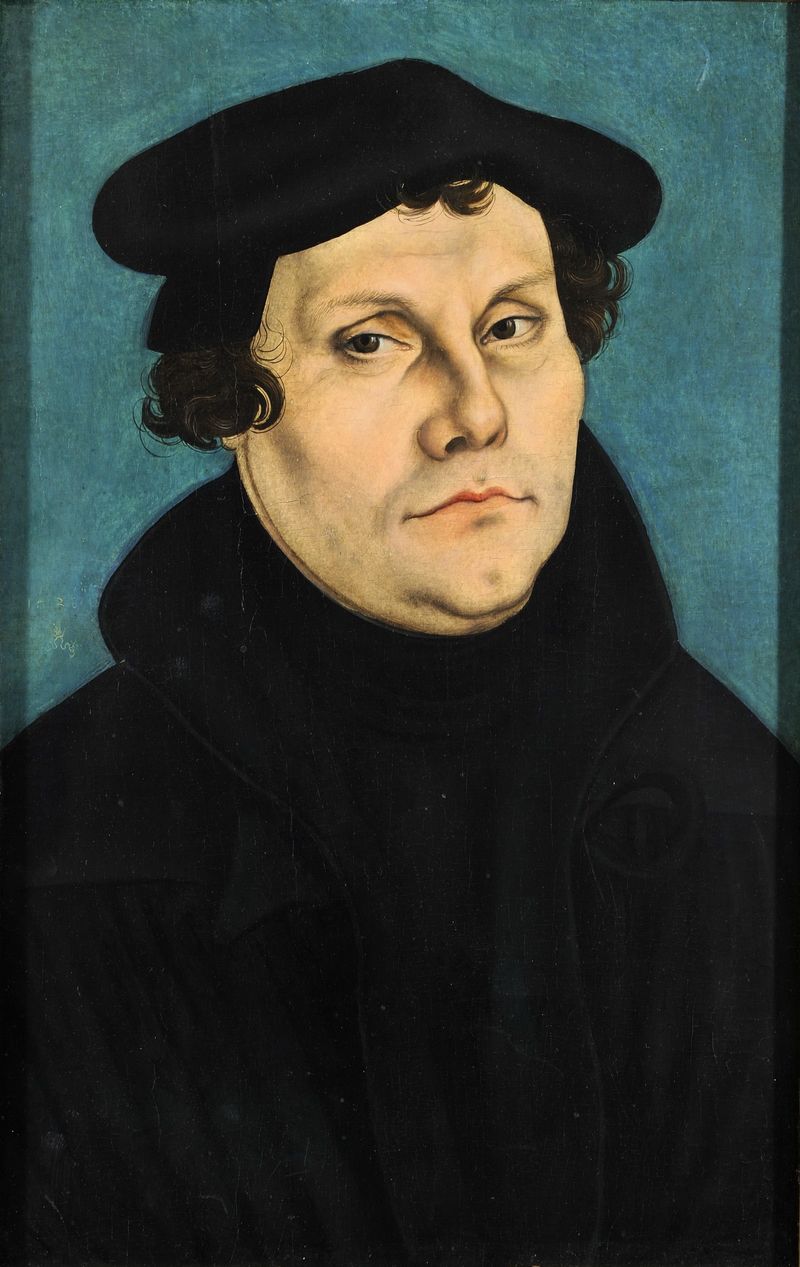
On This Page
“Why does not the pope, whose wealth today is greater than the wealth of the richest Crassus, build this one basilica of St. Peter with his own money rather than with the money of poor believers?” — Martin Luther, Ninety-Five Theses, Thesis 86 (1517)
The Real Abuses Luther Confronted
Fairness demands honesty: the medieval Church of the early sixteenth century was deeply corrupted. To dismiss Luther’s protests as merely schismatic is to ignore the manifest evils he denounced—evils that prompted even his opponents to pursue reform.
The Indulgence Scam
The immediate trigger for Luther’s 1517 Ninety-Five Theses was Johann Tetzel’s sale of indulgences to fund the reconstruction of St. Peter’s Basilica in Rome. Popular tradition associates Tetzel with the jingle “As soon as the coin in the coffer rings, the soul from purgatory springs”—though scholars note the saying predates Tetzel by decades (the University of Paris complained about it as early as 1482) and does not appear verbatim in his extant sermons, even if he taught its substance.1 Either way, the implication conveyed to ordinary believers was transparent: you could purchase release from punishment with cash.
This was a perversion of Catholic doctrine. Strictly speaking, an indulgence never claimed to forgive sin itself—forgiveness comes through the sacrament of Penance, which requires contrition. An indulgence remits only the temporal punishment due to sins already forgiven (CCC 1471). But Tetzel’s marketing collapsed that distinction in the popular mind, presenting indulgences as if they were spiritual currency for absolution. The indulgence was meant as a gift for those truly penitent, not a commodity sold to the highest bidder. Yet the lived practice, especially at the papal court’s instigation, conveyed the opposite message.
Luther’s anger was righteous. The Church’s official response—to continue the practice and brand him a heretic—only hardened his conviction that Rome itself had become hopelessly corrupted.
Worldly Clergy
Beyond the indulgence crisis, the sixteenth-century hierarchy was rotten with worldliness. Cardinals commanded armies, collected benefices they never visited, fathered illegitimate children, and lived in opulence while preaching evangelical poverty. Bishop’s offices were sold to the highest bidder—simony, explicitly condemned by Scripture, flourished openly.
The local parish priest was often ignorant, illiterate, and prone to moral scandal. Many priests could barely recite Latin and had no real knowledge of theology. They were a stumbling block to faith, not a bridge to it.
Luther himself was not the first to notice this. The medieval reform movements—the Waldensians, the Hussites, even movements within the Church like the Observant Franciscans—all protested clerical corruption. The Council of Constance (1414–1418) condemned Jan Hus on thirty articles of doctrinal heresy—chiefly his Wycliffite positions on the nature of the Church, predestination, sacramental validity, and papal authority. (His view that a priest in mortal sin cannot validly administer sacraments is itself the Donatist heresy.) Hus’s broader attacks on clerical corruption created the political atmosphere of his trial, but the formal charges were theological. Even so, the disease of corruption was manifest; what was lacking was the will to cure it.
The Church’s response to Luther included genuine reform at the Council of Trent (1545–1563): seminaries were mandated, clerical education was strengthened, many abuses were curtailed. But Trent came too late to stop the schism. And this is crucial: Trent proved that the Church could reform itself without breaking apostolic succession or abandoning conciliar authority. Luther’s path was not the only one.
Luther’s Central Theological Claims
Luther’s genius lay not in identifying abuses, but in articulating a rival theological framework. His five fundamental claims constitute a comprehensive alternative to Catholic teaching.
Sola Fide: Faith Alone
Luther’s cardinal principle was sola fide—salvation by faith alone, apart from works of the law. He grounded this in Paul’s epistle to the Romans, particularly Romans 3:28, where Paul declares humans are “justified by faith apart from works of the law.”2
Luther argued that Catholic teaching, with its insistence on the necessity of works, sacraments, and cooperation with grace, compromised the sufficiency of Christ’s sacrifice. For Luther—at least on the traditional reading shared by both Catholic critics and confessional Protestants—Christ’s righteousness is imputed to the believer; we are clothed in His justice, not transformed into justice ourselves. Justification is a forensic act, a divine courtroom declaration, not a sanctifying transformation. (The Finnish school of Luther research, led by Tuomo Mannermaa, has argued since the 1970s that Luther’s writings also contain a robust concept of real-ontic union with Christ, complicating the purely forensic reading; but the forensic emphasis has dominated both confessional Lutheranism and Catholic critique.)
The New Perspective on Paul, which has been seriously engaged by both Protestant and (more cautiously) Catholic scholars, has complicated this picture. Scholars like E.P. Sanders and N.T. Wright argue that Paul’s polemic against “works of the law” was directed at Jewish boundary markers (circumcision, food laws, Sabbath observance)—ethnic identity markers, not human effort in general.3 When Paul says we are justified by faith, not works, he means faith in Christ, not adherence to Torah-defined Jewish identity.
This interpretation undermines Luther’s reading. Paul was not denying the necessity of transformed obedience; he was refusing to make Jewish ethnic practice a prerequisite for salvation. James 2:24 explicitly states that “a person is justified by works and not by faith alone”—and this is no late ecclesiastical interpolation but authentic apostolic witness.4
Catholic teaching, affirmed at Trent, holds that faith is the foundation of justification, but that a faith without works is dead (James 2:26). Grace transforms the believer; we are not merely covered with Christ’s righteousness but truly sanctified by the Holy Spirit. This is why Catholic theology emphasizes both the sufficiency of Christ and the necessity of transformed obedience.
Sola Scriptura: Scripture Alone
Luther’s second pillar was sola scriptura—Scripture alone as the source and standard of doctrine. Against Catholic reliance on Tradition, the magisterium, and conciliar teaching authority, Luther declared that the Bible must judge the Church, not the Church the Bible.
Yet Luther faced a dilemma: who interprets Scripture? Luther himself became an interpreter, wielding enormous authority. His translation of the Bible, his commentary on Romans, his sermons all shaped Protestant understanding of Scripture. In practice, Luther’s interpretive authority was immense. Later Protestants disagreed with him sharply (on the real presence in the Eucharist, for instance), claiming Scripture alone as their warrant.
The Catholic response is philosophically stronger. If Scripture is the only standard, and if every reader of Scripture differs from every other in interpretation, then either (1) everyone is right (incoherent), or (2) there must be an authoritative interpreter. The Church that produced the canon cannot be reduced to the canon. The same apostolic authority that determined which texts belonged to Scripture also transmitted Tradition—the lived faith of the apostles and their successors.
Christ promised that the Holy Spirit would guide the Church “into all truth” (John 16:13). This is not a promise of individual illumination, but of the Spirit’s abiding presence in the apostolic Church. Scripture itself directs believers to Tradition: Paul commands the Thessalonians to “hold fast to the traditions which you were taught” (2 Thess. 2:15), and the Apostle exhorts that the faith be “guard[ed]” by the Holy Spirit (2 Tim. 1:14).5
Catholic theology affirms Scripture as the supreme written norm, but insists that Scripture must be read within the living Tradition of the Church and interpreted by the magisterium to which Christ entrusted the keys of the kingdom.
Bondage of the Will
Luther’s third claim was the bondage of the will—the doctrine that fallen humanity cannot, in any real sense, choose to accept God’s grace. In The Bondage of the Will (1525), Luther argued against the humanist Erasmus that human free will is a fiction, that God’s predestination is absolute, and that people are either elect or reprobate from eternity.
This teaching emerges from Luther’s intense experience of despair and his conviction that he could never do enough to satisfy God’s justice. He concluded that God must impute righteousness to us because we cannot achieve it ourselves. De Servo Arbitrio (1525) contains language that many readers (including this one) take to imply an asymmetrical double predestination—God elects some to salvation and passes by the rest. It is worth noting that Luther scholars are divided here: confessional Lutheranism in the Formula of Concord (1580) explicitly rejected double predestination, and scholars like Paul Althaus and Bernhard Lohse read Luther himself as teaching only single predestination. Either way, on Luther’s account human choice in the matter of salvation is illusory.
Catholic theology, following Augustine and refined by medieval theologians like Thomas Aquinas, affirms human free will as a real creaturely power. Yes, fallen humanity is weakened and prone to sin. But grace perfects nature; it does not destroy it. God’s omniscience and human freedom coexist (though how exactly they coexist remains theologically contested). Crucially, Catholic teaching denies that God predestines anyone to damnation. Predestination to glory is God’s gracious choice; those damned are damned by their own refusal of grace.
The Council of Trent explicitly affirmed that divine grace and human free will collaborate in justification. Both are necessary; neither is negated. Luther’s rigorism on predestination, while attempting to honor God’s sovereignty, actually renders human responsibility meaningless. If we cannot choose, how can we be blamed for unbelief?
Two Kingdoms
Luther’s fourth principle was the doctrine of two kingdoms—the kingdom of God (the Church, spiritual, governed by the Gospel) and the kingdom of the world (the state, temporal, governed by reason and natural law). The two operate by entirely different logics. The Church must not wield the sword; the state must not preach grace.
This doctrine had some salutary effects: it resisted theocracy and affirmed the state’s legitimacy as a created good. But it also created a fatal dichotomy. If the spiritual realm is divorced from the temporal, what happens to the incarnational principle—that God entered human flesh and redeemed creation itself? How can the Gospel transform culture if culture is reserved to reason and law?
Luther’s solution also abandoned the medieval dream of Christendom, the unified Christian commonwealth. But it did not produce greater piety. Instead, as Ernst Troeltsch observed, Luther’s doctrine of the two kingdoms became a tool for passive acceptance of political injustice. Believers were to obey magistrates—even unjust ones—without resistance. The temporal kingdom became increasingly divorced from Christian ethics.
Catholic social teaching, developed from Leo XIII onward, maintains that the Gospel has implications for justice, property, human dignity, and the common good. Grace does not abandon the world; it transforms it. The two kingdoms cannot be hermetically sealed.
The Corrupt Papacy as Sign of the Times
Finally, Luther came to believe that the papacy itself was Antichrist, the ultimate expression of spiritual corruption. His later writings grow increasingly bitter and apocalyptic. The pope, once merely the anti-christ’s agent, became the anti-christ incarnate. Luther urged German princes to resist papal authority, end financial payments to Rome, and prevent benefices from falling into Roman hands. (The wholesale secularization of monastic properties that followed in the 1520s and 1530s was carried out by territorial princes acting on their own political interests, not by Luther’s explicit command—but his rhetoric supplied the climate.)
Here Luther’s judgment about medieval abuses curdled into unsubstantiated conspiracy. Yes, Renaissance popes were worldly. But the papacy’s office, rooted in Christ’s promise to Peter, does not become invalid because individual popes are sinful. The apostolic succession, the sacramental life, the deposit of faith—these do not depend on the moral worthiness of the hierarchy.
The Fruit of the Reformation: A Catholic Lament
Here we must speak plainly: measured by its consequences, the Reformation has been a disaster for Christian unity and, arguably, for Christian faith itself.
Luther claimed he merely wanted to reform the Church from within. Yet his actions—burning the papal bull Exsurge Domine on December 10, 1520, translating the Bible without ecclesial authorization, calling on princes to throw off Rome’s authority, founding a new communion—constituted a schism. And schism, once begun, proved irreversible.
Instead of one Church, we have thousands of denominations. Instead of a unified magisterium, we have competing claims to truth, each sect assured of its rightness. Instead of sacramental objectivity (grace mediated through the Church’s ordained ministry), we have increasingly subjective religion—what I feel, my personal relationship with Jesus, my interpretation of Scripture.
Consider the long arc: Luther’s sola scriptura begat Reformed biblicism, which begat Pietism, which begat the evangelical notion that the Bible is a flat text accessible to any reader. The result is a Christianity drained of liturgical memory, apostolic succession, and the Church’s ancient wisdom. It is a faith adrift.
Moreover, the fragmentation enabled the rise of rationalism and modernity. As Christianity lost institutional coherence, Enlightenment thinkers could dismiss “religion” as private opinion. The Church’s lost authority over culture allowed secularism to colonize the public square. Luther wanted to free the gospel from ecclesiastical corruption; instead, he liberated secularism from Christian constraint.
This is not to say Luther alone caused these developments. History is complex. But the rupture with apostolic tradition, with the magisterium, with sacramental ecclesiology—these opened doors that cannot be closed.
Luther’s Later Writings: A Dark Legacy
As Luther aged, his writings grew darker. In 1543, just three years before his death, he published On the Jews and Their Lies, a virulent tract urging Christian princes to burn synagogues, destroy Jewish property, and expel Jews from their lands.6 The work is repulsive, a betrayal of Christ’s command to love the neighbor. Some scholars speculate that Luther’s illness (he suffered from stones, arthritis, and various complaints) embittered him. Others note that medieval antisemitism was pervasive; Luther was not alone in such views.
But none of this excuses the text. And it raises questions about Luther as a moral guide. If he was capable of such venom, if his conscience was so warped by rage, what confidence can we place in his theological judgments? A man who could write such filth about an entire people is not a reliable arbiter of Christian truth.
Moreover, Luther’s tract against the Jews reveals the logical endpoint of his theology. If Scripture alone is the rule, and if the Old Testament is full of divine commands to exterminate entire peoples, what prevents violent religious fanaticism? Without the Church’s living Tradition to contextualize, to interpret, to apply God’s Word with prudence and mercy, Scripture becomes a weapon. This is not a problem unique to Luther, but his framework makes it acute.
Why the Catholic Solution Was Better
The Council of Trent (1545–1563) addressed nearly every genuine abuse Luther condemned—yet without schism, without abandoning apostolic succession, without dissolving the magisterium’s teaching authority.
Trent mandated seminaries to educate priests. It reformed the indulgence system. It clarified Catholic doctrine on justification in a way that, properly read, is not radically distant from Luther’s concern (though not identical). Trent affirmed grace, free will, merit, and the necessity of transformed obedience in a harmonious synthesis.
The Counter-Reformation, often derided as merely defensive, was actually a profound spiritual renewal. Saints like Teresa of Ávila, John of the Cross, Philip Neri, and Charles Borromeo exemplified genuine evangelical holiness within the Catholic framework. The baroque spirituality that followed Trent was not timid or corrupt; it was alive.
Where Luther abandoned the sacramental structure, the magisterium’s authority, and the apostolic communion, Trent preserved these while purifying them. The result was not perfect—no historical Church is—but it was far more coherent than the splintered Reformation world.
Moreover, Catholicism retained what Protestants lost: the conviction that God works through creation, not merely against it. Grace elevates nature. The Church is not merely an invisible communion of believers but a visible sacramental communion. The saints intercede for us. Mary, the Mother of God, is a type of the Church. These doctrines, rooted in Scripture and Tradition, are not corruptions but treasures.
A Fair Judgment
So what is a fair Catholic judgment of Martin Luther?
We must say: Luther was right about the abuses. The Church of his time was worldly, corrupt, and in need of radical reform. Any honest historian acknowledges this. Luther deserves credit for his courage in speaking truth to power.
We must also say: Luther was a brilliant theologian with real insights. His critique of late medieval scholasticism, his emphasis on the sufficiency of Christ’s grace, his insistence that the clergy must be reformed—these were valuable contributions. Luther’s translation of the Bible was magnificent; his catechisms remain useful. He was a man of genuine piety, wrestling deeply with God’s Word.
But we must also say: Luther’s solution was worse than the disease. Sola fide, sola scriptura, the bondage of the will, the two kingdoms—these doctrines, taken together, do not constitute a faithful development of apostolic Christianity. They represent a break, a rupture. And the long-term fruits—fragmentation, subjectivism, the loss of the Church’s institutional coherence and teaching authority—have weakened Christianity immeasurably.
The tragedy is that Luther did not have to leave the Church. The Church was already reforming itself (Vatican I was centuries away, but Trent was the response). Had Luther accepted the councils’ authority, accepted that grace and free will coexist, accepted that Scripture is best read within the living Tradition of the apostolic communion, he could have been the great reformer the Church needed. Instead, he became the schismatic the Church’s enemies wanted.
Conclusion
Martin Luther remains a towering figure in Western history. His courage, his theological acumen, his linguistic genius—these are undeniable. But courage and genius do not guarantee truth. A man can be brave and wrong, brilliant and destructive.
For Catholics, Luther serves as a warning: that even the most sincere reformer can go astray when he abandons the living magisterium and the apostolic tradition. Truth is not found in individual conscience, no matter how elevated. It is found in the Church—the pilgrim but apostolic community, guided by the Spirit, preserving the deposit of faith across the centuries.
We honor Luther for his witness against corruption. We learn from his theological insights. But we do not follow him into schism. Instead, we trust that the Church Luther rejected, for all her human weakness, is the Body of Christ, and that her Head will never abandon her to falsehood.
Footnotes
1. The jingle is attested in popular complaints against indulgence preachers as early as the late fifteenth century (the University of Paris registered an objection to similar language in 1482), and Tetzel's surviving sermons do not contain it verbatim, though they teach its substance. The indulgence crisis is well documented in Hartmann Grisar, Martin Luther: His Life and Work, adapted from the second German edition by Frank J. Eble, ed. Arthur Preuss (B. Herder, 1930), 174–186. See also Heiko Oberman, Luther: Man Between God and the Devil, trans. Eileen Walliser-Schwarzbart (Yale University Press, 1989), 190–220.
2. Romans 3:28 (ESV): "For we hold that one is justified by faith apart from works of the law." Luther's reading is in Martin Luther, Commentary on Romans (1516), in Luther's Works, vol. 25, trans. Walter G. Tillmanns and Jacob A. O. Preus (Concordia Publishing House, 1972), 192–208.
3. E. P. Sanders, Paul and Palestinian Judaism (Fortress Press, 1977); N. T. Wright, The New Testament and the People of God (Fortress Press, 1992). These works argue that Paul's "works of the law" refers specifically to Torah observance as an identity marker, not to human moral effort generally.
4. James 2:24 (ESV): "You see that a person is justified by works and not by faith alone." This passage, which Luther infamously called an "epistle of straw," directly contradicts the sola fide principle if Luther's interpretation is correct.
5. 2 Thessalonians 2:15 (ESV): "So then, brothers, stand firm and hold to the traditions that you were taught by us, either by our spoken word or by our letter." And 2 Timothy 1:14 (ESV): "By the Holy Spirit who dwells within us, guard the good deposit entrusted to you." These passages suggest that apostolic Tradition is not inferior to Scripture but complementary.
6. Martin Luther, On the Jews and Their Lies (1543), in Luther's Works, vol. 47, trans. Martin H. Bertram (Fortress Press, 1971), 137–306. The tract is thoroughly documented as one of the most virulent antisemitic writings of the Reformation era. Luther advocates, among other things, burning synagogues, destroying Jewish homes, confiscating property, and expelling Jews.
7. Joseph Lortz, The Reformation in Germany, trans. Ronald Walls, 2 vols. (Herder & Herder, 1968), provides a balanced German Catholic perspective on the Reformation and Luther's role.
8. Brad Gregory, The Unintended Reformation: How a Religious Revolution Secularized Society (Belknap Press of Harvard University Press, 2012), argues that the Reformation's fragmentation inadvertently enabled secularization and the loss of Christian cultural authority.
9. Joint Declaration on the Doctrine of Justification, signed by the Lutheran World Federation and the Roman Catholic Church in 1999, represents an attempt to reconcile Lutheran and Catholic understandings of justification. It affirms that both traditions can confess the centrality of Christ and grace, though they employ different emphases and language. The JDDJ achieves only a "differentiated consensus" (§40), and its reception has been contested—the Catholic side issued an accompanying "Annex" of clarifications, and observers like Cardinal Avery Dulles judged that the document's language at key points favored the Lutheran framing.
10. Catholic Catechism, nos. 1987–2011, on justification; nos. 2034–2051, on the role of the Church's moral teaching and divine law.
11. Ernst Troeltsch, The Social Teaching of the Christian Churches, trans. Olive Wyon, 2 vols. (Harper & Row, 1960), discusses Luther's two kingdoms doctrine and its social implications.
12. Council of Trent (1545–1563), Session VI: Decree on Justification, affirms the necessity of both grace and free will in justification. The decree steers a middle course between Luther's determinism and Pelagian naturalism.
13. Teresa of Ávila and John of the Cross exemplify the spiritual renewal of the Counter-Reformation. See John of the Cross, The Dark Night of the Soul (treatise composed c. 1584–1586), and Teresa of Ávila, The Interior Castle (1577).

Garrett Ham
Garrett Ham is an attorney, military veteran, and holds a Master of Divinity from Yale Divinity School. He writes from Northwest Arkansas on theology, law, and service.
More about Garrett →Related Posts
The First Vatican Council (1869-1870)—What It Taught and Why It Matters
Vatican I defined papal infallibility and primacy while defending faith against rationalism. Explore its two major constitutions, the context that prompted it, and its enduring significance for Catholic theology.

Orthodox vs. Catholic vs. Protestant
How do Orthodox, Catholic, and Protestant Christians differ? A scholarly side-by-side comparison of authority, salvation, sacraments, worship, and what all three still share.
Stay Informed
Get new writing on faith, law, and service delivered to your inbox.
No spam. Unsubscribe anytime.