Irrevocable Agencies
On This Page
As I discussed in my overview of creating and terminating an agency relationship, a principal can generally terminate an agency relationship at any time. After all, the agent acts on behalf of the principal, as if the agent were the principal himself, and so it makes sense that the principal should be able to terminate this arrangement whenever he likes.
There are, however, situations in which a power given to an agent is irrevocable, even by the principal. Once given, these powers cannot be reassumed. The law calls this an agency coupled with an interest — or, equivalently, a power coupled with an interest — and it is one of the most important exceptions to the general rule that agency relationships are terminable at will.
Agency Coupled with an Interest at Common Law
The foundational case on irrevocable agency in American law is Hunt v. Rousmanier’s Administrators, 21 U.S. (8 Wheat.) 174 (1823). Writing for the Supreme Court, Chief Justice John Marshall drew a critical distinction: a mere power of attorney, even one declared “irrevocable,” is extinguished by the death of the principal. But where the power is coupled with an interest — meaning the agent holds a present, legally cognizable interest in the subject matter itself — the power survives the principal’s death and cannot be revoked during the principal’s lifetime.
The Hunt v. Rousmanier Decision
The facts of Hunt illustrate the doctrine well. Rousmanier borrowed money from Hunt and executed a power of attorney authorizing Hunt to sell Rousmanier’s interest in a vessel to satisfy the debt. When Rousmanier died, the question became whether Hunt’s power to sell survived. Marshall held that it did not — because Hunt had received a power of attorney rather than a conveyance of an interest in the vessel itself. The power was merely a naked authority, not a power coupled with an interest.
Had Rousmanier instead granted Hunt a lien or security interest in the vessel — and then authorized Hunt to sell it to enforce that lien — the result would have been different. In that case, Hunt’s authority to sell would have survived death, because the power would have been coupled with a legally cognizable interest in the subject matter.
Interest in Subject Matter vs. Proceeds
At common law, the only situation that gave rise to irrevocable agencies was where the agency power was given as a security or where the power was coupled with an interest — both of which mean essentially the same thing. In this situation, the agent has essentially paid for, or otherwise acquired, a right that the agency power is designed to protect.
An important limitation: the agent’s interest must be in the subject matter of the agency, not merely in the proceeds of the agency’s exercise. As Marshall explained in Hunt, an interest in commissions or fees does not make a power irrevocable. A real estate agent, for instance, has an interest in the commission on a sale, but that interest does not make her authority to sell irrevocable because her interest is in the compensation, not in the property itself.
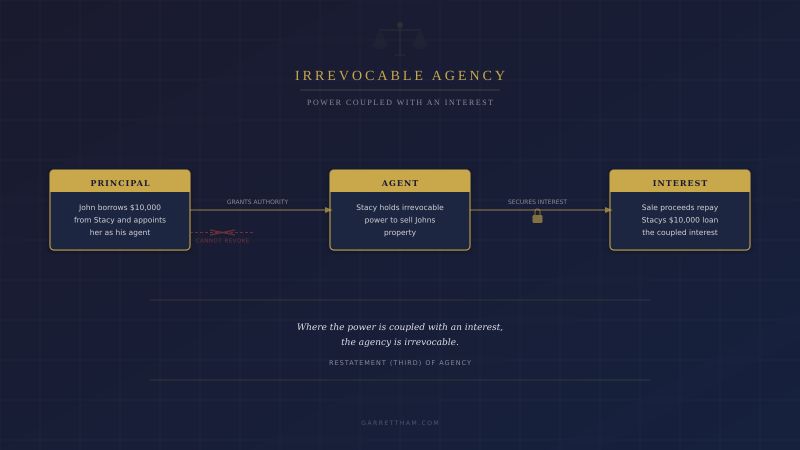
So, for example, if John borrows $10,000 from Stacy and appoints Stacy as his agent to sell a piece of property, the proceeds of which will repay John’s debt to Stacy, there exists an agency power coupled with an interest. Stacy’s authority to sell is irrevocable because she holds a present interest — her right to repayment — in the very property the agency empowers her to sell.
The Restatement (Third) of Agency
The Restatement (Third) of Agency (2006), published by the American Law Institute, codifies and clarifies the common law doctrine. Section 3.12 defines a power given as security as a power to affect the legal relations of its creator that is (1) created in the form of a manifestation of actual authority, and (2) held for the benefit of the power holder or a third person. This power is given to protect a legal or equitable title or to secure the performance of a duty apart from any duties incident to the agency relationship itself.
What Cannot Terminate a Power Given as Security
Section 3.13 then specifies what cannot terminate such a power: a manifestation of revocation by the principal, loss of capacity by either party, or even the death of the principal (so long as the underlying obligation survives). The power terminates only when the secured obligation is discharged, when its exercise becomes illegal or impossible, or when the beneficiary surrenders it.
The Restatement’s framework is analytically cleaner than the common law’s because it focuses on the purpose of the power rather than attempting to classify the agent’s “interest.” Under the Restatement, the question is whether the power was given to protect a right or secure performance of a duty, and whether that right or duty exists independently of the agency relationship. If so, the power is irrevocable regardless of what label the parties attach to it.
Irrevocable Agencies in Modern Statutory Law
Today, the situations in which an agency is irrevocable are usually defined by state statute. Legislatures have determined that certain agency relationships are so important that allowing their unilateral termination would cause significant harm.
The Uniform Power of Attorney Act
The Uniform Power of Attorney Act (2006), adopted by a majority of states, addresses a related concept — the durable power of attorney, which survives the principal’s incapacity. Although durability and irrevocability are distinct doctrines (a durable power can still be revoked by a competent principal, while an irrevocable power cannot be revoked at all), the two often appear together in practice. The Uniform Act does not specifically govern irrevocable powers, but it preserves common law and Restatement principles for powers given as security.
State-by-State Statutory Variations
The general statutory pattern follows the Restatement approach: if the principal grants authority to be held for the benefit of the agent or a third party in order to protect legal or equitable title, or to secure the performance of a duty other than the duty owed by the principal incidental to the agency, the agency is irrevocable. While specific requirements vary from state to state, the core principle is consistent.
Several important variations exist. The Uniform Commercial Code (adopted in all 50 states) recognizes irrevocable powers in commercial contexts: UCC § 2-403 protects entrusting arrangements, and UCC § 9-509 authorizes secured parties to file financing statements — a form of irrevocable authority given as security. New York General Obligations Law § 5-1501 distinguishes between durable powers (which survive incapacity but are revocable) and statutory short-form powers (which can be made irrevocable by express language when coupled with an interest). California Probate Code §§ 4150–4545 similarly preserves common law irrevocability principles while establishing a comprehensive framework for durable powers.
Some states have codified specific irrevocable agency provisions for particular industries. Delaware General Corporation Law § 218, for example, provides that a proxy coupled with an interest in the shares to which it relates is irrevocable. This is particularly significant in corporate governance, where voting agreements and proxy arrangements frequently rely on irrevocable agency doctrine.
Commercial Applications
Irrevocable agencies appear frequently in commercial contexts beyond the basic loan-and-security pattern. In publishing contracts, for example, a literary agent may negotiate for an irrevocable appointment coupled with an interest in the underlying intellectual property rights. Security agreements and escrow arrangements are other common settings where irrevocable agency powers protect parties who have advanced value in reliance on the agency.
Real estate transactions offer another illustration. When a mortgage lender includes a power-of-sale clause in a deed of trust, the trustee’s authority to conduct a foreclosure sale upon default is an irrevocable power coupled with an interest — the lender’s security interest in the property. The borrower cannot revoke the trustee’s authority precisely because the power exists to protect the lender’s investment.
In joint ventures and partnership arrangements, one partner may be granted irrevocable authority to manage a specific asset or project on behalf of the venture. If that partner has contributed capital or assumed personal liability tied to the asset, the power is coupled with an interest and cannot be revoked by the other partners. This is distinct from the ordinary right of partners to participate in management under the Uniform Partnership Act.
Irrevocable Agency vs. Durable Power of Attorney
Because these two doctrines frequently overlap in practice, it is worth distinguishing them carefully. A durable power of attorney is one that survives the principal’s loss of capacity — typically because the instrument includes language such as “this power of attorney shall not be affected by my subsequent disability or incapacity.” Durability addresses the question of what happens when the principal becomes incapacitated.
An irrevocable agency, by contrast, addresses the question of whether the principal can revoke the agent’s authority at all. The two concepts are independent: a power can be durable but revocable (the principal can revoke it while competent, but it survives incapacity), irrevocable but not durable (the principal cannot revoke it, but it terminates upon incapacity), or both durable and irrevocable (it survives incapacity and cannot be revoked). The latter combination is common in secured lending transactions, where a creditor’s power to liquidate collateral must survive both the debtor’s change of heart and the debtor’s loss of capacity.
| Feature | Durable Power of Attorney | Irrevocable Agency |
|---|---|---|
| Survives incapacity | Yes | Not necessarily |
| Revocable by principal | Yes (while competent) | No |
| Survives death | No (unless coupled with interest) | Yes |
| Requires interest in subject matter | No | Yes |
| Primary purpose | Continuity of management | Protection of agent’s investment |
| Typical context | Estate planning, healthcare | Secured lending, commercial transactions |
The practical lesson: if you need a power that cannot be revoked, a durable power of attorney alone is not enough. You need an agency coupled with an interest — and the interest must be in the subject matter of the agency, not merely in the proceeds of its exercise.
Drafting an Irrevocable Agency Provision
Creating a valid irrevocable agency requires more than simply labeling a power of attorney as “irrevocable.” Courts have consistently held that the word “irrevocable” alone is not sufficient — the power must actually be coupled with an interest for the irrevocability to be enforceable. Careful drafting is therefore essential.
Essential Elements
A well-drafted irrevocable agency provision should include four elements.
First, it should identify the agent’s interest in the subject matter with specificity. Rather than stating vaguely that the agent “has an interest,” the provision should describe the nature of the interest (a lien, a security interest, an ownership stake) and tie it to specific property or rights.
Second, it should state expressly that the power is coupled with an interest and is therefore irrevocable. While the express statement alone is not sufficient, it reinforces the legal conclusion and signals the parties’ intent to any reviewing court.
Third, it should specify the duration of the irrevocable power — typically until the secured obligation is satisfied, the underlying interest is extinguished, or a specified termination event occurs.
Fourth, it should address what happens upon the principal’s death or incapacity, confirming that the power survives both events if that is the parties’ intention.
Common Drafting Pitfalls
Several drafting errors can undermine an irrevocable agency. The most common is failing to establish a genuine interest in the subject matter: a clause stating that “Agent’s authority is irrevocable and coupled with an interest” is legally meaningless unless the agent actually holds an identifiable interest in the property or rights at issue. Equally problematic is confusing an interest in proceeds with an interest in the subject matter — a distinction that has tripped up drafters since Hunt v. Rousmanier. A third pitfall is neglecting to address termination conditions, which can leave the power open-ended in ways that courts may find unreasonable and therefore unenforceable.
Remedies When an Irrevocable Agency Is Wrongfully Revoked
Despite the doctrine of irrevocability, principals sometimes attempt to revoke an agency coupled with an interest. When this happens, the law provides the agent with several remedies.
The most straightforward remedy is a court order declaring the revocation void and the agency still in effect. Because the power is legally irrevocable, the principal’s purported revocation has no legal effect, and the agent may seek a declaratory judgment confirming that the agency continues. The agent may also seek an injunction restraining the principal from interfering with the agent’s exercise of the power.
If the principal has already acted on the wrongful revocation — for example, by selling the property that the agent was authorized to sell, or by appointing a new agent to perform the same function — the original agent may recover damages. The measure of damages is typically the value of the interest that the agent’s power was designed to protect. In the case of a creditor-agent whose power to sell collateral was wrongfully revoked, this would be the outstanding balance of the debt.
In some circumstances, a court may impose a constructive trust on property that the principal transferred in violation of the irrevocable agency. If, for instance, the principal sold property to a third party who knew of the agent’s irrevocable authority, the court may treat the purchaser as holding the property in trust for the agent’s benefit. This remedy is equitable rather than legal, and its availability depends on the third party’s knowledge and the applicable state’s rules on constructive trusts.
Practical Significance
Understanding irrevocable agency matters for anyone who enters into a business relationship where one party is authorized to act on another’s behalf. If you are a principal, granting an agency coupled with an interest means you have given up the right to change your mind. If you are an agent who has advanced value — whether through a loan, the purchase of an interest, or the assumption of personal liability — the irrevocability of your authority protects your investment.
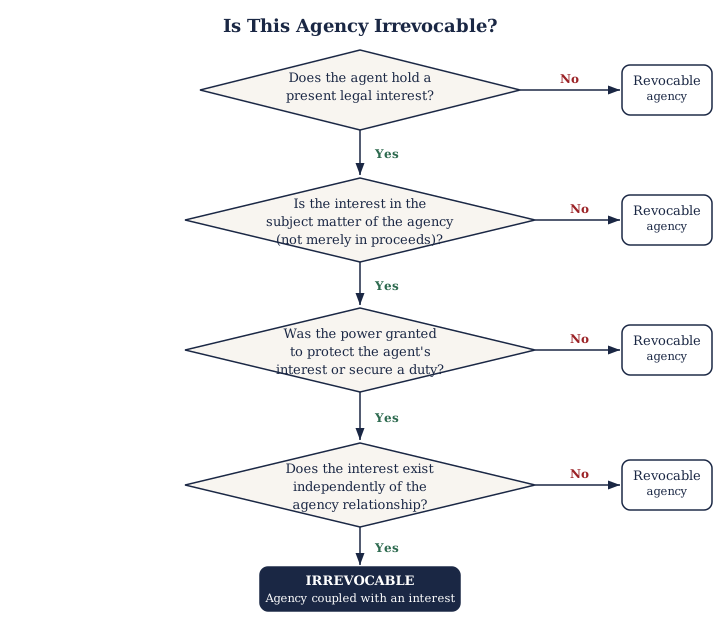
The key questions are always the same: Does the agent hold a present interest in the subject matter of the agency? Was the power granted to protect that interest? If the answer to both is yes, the agency is likely irrevocable — by the principal’s own act, by incapacity, or even by death.
Decision Tree: Is This Agency Irrevocable?
The following flowchart summarizes the analysis. At each step, a “no” answer means the agency is revocable under the general rule. Only when every condition is satisfied does the agency qualify as irrevocable.
Frequently Asked Questions
What is an irrevocable agency? An irrevocable agency is an agency relationship in which the principal cannot terminate the agent’s authority. This occurs when the agent’s power is “coupled with an interest” — meaning the agent holds a legally recognized interest in the subject matter of the agency itself, not merely in the compensation for exercising the power. Once an irrevocable agency is established, it cannot be terminated by the principal’s revocation, incapacity, or death.
What does “agency coupled with an interest” mean? An agency coupled with an interest describes a relationship in which the agent has both the authority to act on the principal’s behalf and a present, legally cognizable interest in the property or rights that are the subject of the agency. The classic example is a creditor who is authorized to sell the debtor’s property to satisfy a loan — the creditor’s interest in the property (as security for the debt) is coupled with the authority to sell it.
Can a principal revoke an agency coupled with an interest? No. That is the defining feature of an irrevocable agency. The principal’s attempt to revoke the power has no legal effect because the agent’s authority exists to protect the agent’s own interest in the subject matter. The agency terminates only when the secured obligation is satisfied, the interest is extinguished, or the agent voluntarily surrenders the power.
What is the difference between an irrevocable agency and a durable power of attorney? A durable power of attorney survives the principal’s loss of capacity but can still be revoked by a competent principal at any time. An irrevocable agency cannot be revoked at all — not by the principal’s express revocation, incapacity, or death. The two concepts are independent: a power can be durable but revocable, irrevocable but not durable, or both.
What happens to an irrevocable agency when the principal dies? Unlike an ordinary agency, which terminates upon the principal’s death, an irrevocable agency survives because the agent’s power is coupled with an interest that exists independently of the principal’s life. The agent retains authority to exercise the power against the principal’s estate or successors until the underlying obligation is satisfied.
For more on the fundamentals of agency law, see Agency Relationships and Creating and Terminating an Agency Relationship. For the agent’s side of the equation, see Duties of an Agent and Agent Liability to Third Parties.

Garrett Ham
Garrett Ham is an attorney, military veteran, and holds a Master of Divinity from Yale Divinity School. He writes from Northwest Arkansas on theology, law, and service.
More about Garrett →Related Posts

Agency Relationships
Agency law governs when one person has authority to act on behalf of another. Actual authority, apparent authority, ratification, and estoppel each create binding obligations.

Creating and Terminating an Agency Relationship
In this post, I discuss the agency relationship. I particularly discuss how both to create and terminate such relationships.

Fiduciary Duties of an Agent
An agent owes fiduciary duties of loyalty and care to the principal. In partnerships, these duties apply to every partner — and they cannot be waived by agreement.
Stay Informed
Get new writing on faith, law, and service delivered to your inbox.
No spam. Unsubscribe anytime.