The First Vatican Council (1869-1870)—What It Taught and Why It Matters
On This Page
“The human mind by its natural light can, without doubt, arrive at a true knowledge of God the Creator, inasmuch as He made Himself known through His works… Nevertheless, it pleased God, in His goodness, to reveal Himself and the eternal decrees of His will to mankind by another and a supernatural way.” — Dei Filius, Chapter II
The Crisis of the Modern World
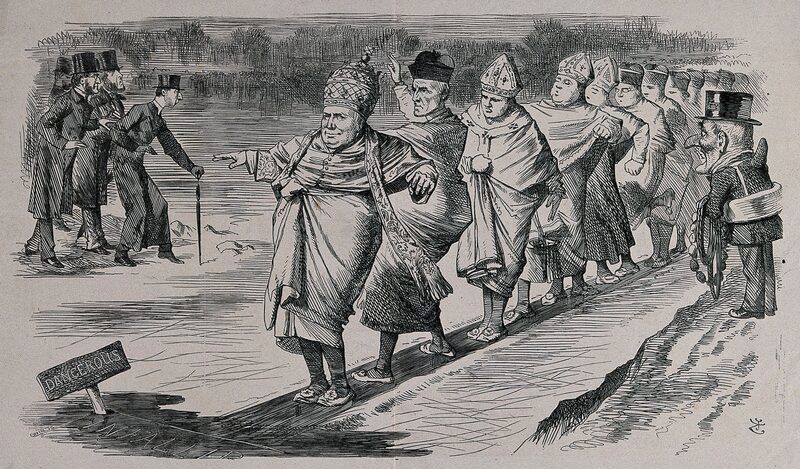
When Pope Pius IX convoked the First Vatican Council on December 8, 1869, the Catholic Church faced a civilizational reckoning. The nineteenth century had brought not only scientific progress and industrial transformation, but a systematic challenge to religious authority itself. Rationalism promised that human reason alone could unlock the mysteries of existence. Liberalism asserted that the state need not—indeed, should not—acknowledge God or grant the Church institutional authority. And unfolding before Rome’s eyes was the seizure of the Papal States, the ancient temporal territory that had defined the Church’s independence for a thousand years.
Pius IX, the longest-reigning pope of the modern era, had witnessed this upheaval directly. As a younger cardinal, he had harbored liberal sympathies; his election in 1846 had been hailed as a breakthrough for Church reform. But the revolutions of 1848 shattered his hopes. When Roman revolutionaries invaded his residence and forced him to flee to Gaeta, the pope emerged convinced that dialogue with modern liberalism was futile. The Church could not accommodate the modern world’s deepest assumptions about reason, authority, and human dignity without losing its soul.
This conviction crystallized in 1864 with the publication of the Syllabus of Errors, a document that catalogued eighty erroneous propositions, from rationalism’s denial of revelation to liberalism’s insistence on absolute freedom of conscience. The Syllabus reads today as Pius IX’s declaration that the Church and modernity inhabited irreconcilable universes. It was provocative, uncompromising, and—to many contemporaries inside and outside the Church—alarming.
Yet the Syllabus was not a final word. It was a diagnosis. The First Vatican Council would be the treatment.
Pius IX and the Papacy in Crisis
To understand Vatican I, one must grasp the existential anxiety that gripped the papacy at mid-century. For more than thirteen centuries, the popes had wielded temporal power—ruling a slice of territory in central Italy that shielded the Church from secular interference. That arrangement had crumbled. Italian nationalism, energized by Cavour and Garibaldi, was consolidating the peninsula into a unified nation-state. The Papal States were not compatible with this vision. When Rome itself fell to Italian troops in September 1870, Pius IX refused to leave the Vatican, declaring himself a “prisoner.” The self-imposed seclusion continued under his successors—Leo XIII, Pius X, Benedict XV, and Pius XI—until the Lateran Treaty of February 11, 1929, signed under Pius XI, established Vatican City as an independent state and resolved the Roman Question.
This loss stripped away the one form of temporal power the papacy had ever fully commanded. What remained was spiritual authority: the capacity to teach, to sanctify, to govern the Church’s internal life. But could that spiritual authority survive intact in a world of nation-states that mocked religious claims and celebrated human autonomy? And how could the pope exercise universal jurisdiction when his very office seemed to depend on temporal independence that was slipping through his fingers?
The answer, paradoxically, was to redefine and fortify papal authority on spiritual grounds. If the pope could no longer rule a state, he would reign over souls—with an explicitly, irreversibly defined primacy of universal jurisdiction and an infallibility that no secular power could question or diminish. This was not, as critics charged, mere defensiveness or a clinging to power. It was, rather, a recognition that the Church’s authority must be grounded in something the world could not take away: divine commission and the supernatural protection of the Holy Spirit.
This theological logic underwrote the convocation of Vatican I.
The Council Convoked and Assembled
On December 8, 1869, the feast of the Immaculate Conception, Pius IX opened the council with a solemn pontifical Mass in St. Peter’s Basilica. The council hall, constructed within the basilica itself, filled with bishops from across the Catholic world. Some 700 bishops attended the opening; the number fluctuated as the council progressed.
The assembly was international but heavily influenced by the Ultramontanist movement—a conviction that the pope’s authority was the ultimate guarantee of Catholic orthodoxy in an increasingly fragmented world. Ultramontanists distrusted national churches and the old collegial structures of church governance. They looked to Rome. This ideological orientation shaped the council’s trajectory.
Yet voices of caution existed. Archbishop Darboy of Paris, the English Catholic historian Lord Acton, and others urged the bishops to be cautious about defining papal infallibility. Not because they doubted papal teaching authority, but because they feared that formally defining it would provoke Gallicanism, Jansenism, and state opposition, especially in France. Some bishops also worried that an ill-defined doctrine would invite ridicule and misunderstanding.
These concerns were not baseless. But the council’s preparatory commissions, under the influence of ultramontane theologians, had already drafted the texts. The momentum was set.
Dei Filius: The Dogmatic Constitution on the Catholic Faith
The first major document promulgated by Vatican I was the Dogmatic Constitution on the Catholic Faith, which came to be known by its opening words: Dei Filius.
The context of Dei Filius was the intellectual turbulence of the modern age. Rationalism—especially the Hegelian idealism that had swept through German universities—had convinced many educated people that human reason could penetrate all mysteries, that revelation was unnecessary, that faith was mere feeling. Simultaneously, a skeptical empiricism questioned whether we could even know that God exists, let alone what God is like.
Dei Filius responds with serene confidence, but not with obscurantism. The constitution opens by affirming that “the same God, our Lord and Master, who speaks by the Prophets and by His Son, teaches not only by the words which He has spoken to us, but also by the light of human reason.”1
Chapter I: God the Creator
The first chapter treats Deum, creatorem omnium—God, creator of all things. It establishes, against pure rationalism, that knowledge of God’s existence is attainable by the natural light of reason. But it goes further, articulating several divine attributes that became fundamental to subsequent Catholic theology:
God is infinite. Not trapped in space or time, not dependent on creation, but subsisting in perfect actuality. This infinity is not mere extension but the plenitude of being itself.
God is immutable. He does not change, not because He is static or passive, but because He already possesses all perfection. Change presupposes potentiality, and God is pure actuality.
God is omniscient. Here Vatican I treads into theologically contested ground. The constitution teaches that God knows all things, past, present, and future, with an eternal knowledge that does not precede or follow His very nature. This stands against open theism, which had not yet emerged in its modern form but which historically threatened to compromise God’s comprehensive foreknowledge.
God is simple. The doctrine of divine simplicitas—divine simplicity—holds that God has no composition whatsoever. God is not body plus soul, essence plus existence, nature plus person. God’s very being is His nature. His justice is His mercy is His love. This is not to say these are identical in meaning; it is to say they are identical in reality. They are one in God as they cannot be in creatures.
These doctrines, rooted in patristic theology and refined by medieval scholasticism, were not novel. But they were formally restated and defended against an age that found them unintelligible. In our own time, they remain challenging—as anyone who reads Aquinas on divine simplicity will discover.
Chapter II: Revelation
The second chapter of Dei Filius turns to revelation as a supernatural communication of divine truth. Here the constitution makes a claim that is both obvious and radically countercultural: that God has revealed Himself and His will to humanity through means other than reason alone.
This revelation is not arbitrary or capricious. Rather, “God, in His infinite wisdom and power, ordains means suitable for directing mankind to that end which he has appointed.”2 Revelation has an end—finis—which is the salvation of humanity and the communication of truths necessary for salvation.
The constitution identifies the supreme moment of revelation in Jesus Christ, “the Word of God made flesh,” and the continuing transmission of revealed truth through the Apostles and their successors. Sacred Scripture and Sacred Tradition are the twin sources through which revelation is preserved and expounded. Scripture is the written word of God; Tradition is the living transmission of apostolic faith and practice throughout the Church.
This chapter’s affirmation of divine revelation stands squarely against two errors. First, against rationalism, which denies that God can or does reveal anything beyond what reason can discover. Second, against a kind of pseudo-mysticism that claims private revelations supersede the apostolic deposit. The Church, through the magisterium, is the authorized interpreter of both Scripture and Tradition.
Chapter III: Faith
The third chapter defines faith itself. Against the rationalists who see faith as mere subjective feeling, and against the fideists who see faith as contradicting reason, Vatican I teaches that faith is an act of the intellect, a supernatural virtue by which we assent to revealed truth.
“Faith,” the constitution states, “is a supernatural virtue, whereby, inspired and assisted by the grace of God, we believe those things to be true which He has revealed, not because their intrinsic truth is perceived by the natural light of reason, but because of the authority of God Himself, who reveals them.”3
This is a crucial formulation. Faith is not irrational; it is supra-rational. The object of faith—what we believe—does not contradict reason, but it exceeds reason’s capacity to demonstrate. We believe on the authority of God, who cannot deceive and who, having created reason, cannot ask us to abandon it.
The council explicitly condemns the position that the articles of faith can be known with scientific certainty by reason alone. This was a rebuke to those rationalist theologians who imagined that the Trinity, the Incarnation, or the sacraments could be “proven” geometrically. Some mysteries exceed natural understanding. That is precisely why they must be revealed.
Chapter IV: Faith and Reason
The fourth and final chapter of Dei Filius addresses the proper relationship between faith and reason. This chapter is remarkably irenic, yet firm in its claims.
The council teaches that faith and reason, both gifts from God, cannot ultimately contradict one another. “If there should appear to be a contradiction, the defect must necessarily be in one or other of the two, since God cannot deny Himself.”4 If a truth is genuinely revealed by God, and another claim is genuinely established by reason, they must be harmonizable, even if the harmony is not immediately apparent to us.
This is not to say that faith reduces to reason, or that we can expect a complete rational demonstration of all doctrine. Rather, Vatican I holds that reason can clarify and defend faith, that the believer can understand some truths of revelation more deeply through philosophical reflection, and that reason can remove supposed contradictions between faith and science.
The constitution also affirms that reason can demonstrate the motives of credibility—the signs and evidences that show revelation to be credible. Miracles, the holiness of the martyrs, the unlikely expansion of the Church—these appeal to reason as reasons for believing. Faith itself is not reasoned out; but the reasonableness of faith can be shown.
Pastor Aeternus: Papal Infallibility and Primacy
If Dei Filius answered the rationalist threat to Catholic faith in general, Pastor Aeternus—the Dogmatic Constitution on the Church of Christ—addressed a specific issue that had become urgent: the nature of papal authority.
This document, promulgated on July 18, 1870, remains controversial both inside and outside the Church. To understand it properly, one must distinguish what it actually teaches from the caricatures that surround it.
What Vatican I Actually Taught About Papal Infallibility
The first thing to understand is what papal infallibility does not mean:
It does not mean the pope is impeccable or immune to personal sin. Popes can commit grave sins. The infallibility concerns teaching, not personal morality.
It does not mean every papal utterance is infallible. The pope speaks infallibly only when he teaches in a very specific manner.
It does not mean the pope is a new source of revelation. Infallibility preserves and expounds what has been revealed; it does not add to it.
It does not mean the pope can overturn the faith of the Church or contradict Scripture and Tradition. Infallibility serves to keep the pope bound to apostolic faith, not to liberate him from it.
What Vatican I does teach is this: When the Roman Pontiff speaks ex cathedra—that is, when he acts as the universal pastor and teacher of all Christians, intending to bind the whole Church, and teaching on a matter of faith or morals—he is preserved from error by the assistance of the Holy Spirit. His teaching is infallible.
The conditions for infallible teaching are thus:
- The pope must be intentionally teaching as the universal pastor of the Church.
- He must be addressing a matter of faith or morals.
- He must clearly intend to bind the entire Church.
- He must be exercising the supreme authority of the papal office.
When these conditions are met, the Holy Spirit preserves the pope from error. Not because the pope is personally brilliant or holy, but because Christ promised that the gates of hell would not prevail against His Church. The infallibility is Christ’s gift, not the pope’s accomplishment.
The Scriptural and Historical Basis
Vatican I grounds papal infallibility in the words of Christ to Peter in Matthew 16:18–19. “Thou art Peter, and upon this rock I will build My Church, and the gates of hell shall not prevail against it. And I will give to thee the keys of the kingdom of heaven.”5
The council argues that if Christ promised that His Church would never fall into definitive error, and if Christ placed Peter and his successors at the head of that Church with universal jurisdiction, then the promise must extend to Peter’s office. Otherwise, the Church could be abandoned by its head to false teaching.
This is not a novel argument. Aquinas had made similar reasoning centuries earlier. Medieval canonists appealed to papal infallibility in certain contexts. But Vatican I was the first ecumenical council to formally define the doctrine and set forth its conditions.
Primacy of Jurisdiction
Equally important to infallibility, though sometimes overlooked, is Vatican I’s teaching on papal primacy of jurisdiction. The pope does not merely preside over a collegial body of bishops; he possesses immediate jurisdiction over the whole Church. Bishops are not subordinate administrators; they are true shepherds with their own episcopal authority. But the pope’s jurisdiction is immediate and universal; it cannot be circumvented or overruled by any earthly authority.
This doctrine too had historical roots in medieval canon law and papal tradition. But Vatican I formalized it and set it against modern theories of Church governance that envisioned bishops as representatives in a kind of ecclesiastical parliament, with the pope as ceremonial figurehead.
The doctrine of primacy served Vatican I’s purposes in several ways. First, it clarified that the Church has a visible head and principle of unity. Second, it provided a bulwark against the nation-state’s attempts to control national churches. If the pope had immediate jurisdiction, no emperor or king could impose Gallicanism or suppress the Church in a nation without confronting Rome directly. Third, it reasserted the Church’s supernatural character: this is not a human institution organized by democratic vote, but a divinely ordained society with Christ’s representative at its head.
The Council’s Opponents and Their Fears
Not all bishops supported Vatican I’s definition. A minority, led by the theologian Johann Joseph Ignaz von Döllinger of Munich and Cardinal Rauscher of Vienna, urged caution. They feared that defining infallibility would drive Catholic intellectuals away from the Church, provoke civil governments to intensify persecution, and deepen the East-West schism. They were not doubting papal teaching authority; they worried about the prudence and consequences of formal definition.
Their concerns were not absurd. The definition did provoke the Old Catholic movement. Döllinger himself was excommunicated in April 1871 for refusing to accept the infallibility definition, though he never formally joined the Old Catholic Church that formed in his wake. German and Swiss Catholics who rejected Vatican I separated from Rome, though their numbers remained small. And in some countries, especially Bismarck’s Germany during the Kulturkampf, anti-Catholic campaigns intensified.
But time has vindicated the council’s judgment. The Old Catholic church remains marginal. The definition, properly understood, has not harmed Catholic theology or discipleship. Indeed, it has provided clarity where confusion reigned.
The Council Suspended
Vatican I’s work was interrupted by history itself. As the council debated and debated through the spring and summer of 1870, the Franco-Prussian War erupted in July. French troops, which had been garrisoned in Rome to protect papal territory, were withdrawn to defend France. On September 20, 1870, Italian forces, now unopposed, breached the walls of Rome and seized the city.
Pius IX, maintaining his symbolic protest, withdrew into the Vatican. The Papal States, which had endured for over a thousand years, ceased to exist. The council had not yet addressed other important matters on its agenda: the nature of the episcopate, the sacraments, eschatology. Many bishops had departed for their dioceses to cope with the new political chaos.
Pius IX formally suspended the council, intending to reconvene it. But it never resumed. The tensions created by Vatican I, the new political situation, and the pope’s self-imposed seclusion made continuation impractical. Vatican I remained unfinished.
Yet what it had accomplished was historic. Two major dogmatic constitutions, defining Catholic faith against modern errors and clarifying papal authority, would shape Catholic theology for a century.
Vatican I and Subsequent Catholic Theology
The decades following Vatican I witnessed an intense theological struggle to integrate the council’s teachings into Catholic thought. In France, the Modernist crisis erupted in the 1890s, as scholars like Alfred Loisy and George Tyrrell sought to reinterpret Catholic doctrine in light of evolutionary and historical consciousness. They treated the infallibility definition with barely concealed contempt, viewing it as a rearguard action against inevitable progress.
Pope Leo XIII and especially Pope Pius X responded with vigor. Pascendi dominici gregis, Pius X’s 1907 encyclical, condemned Modernism root and branch. Part of its argument rested on Vatican I: if the Church is infallible in faith and morals, it cannot have erred for centuries and then been corrected by modern scholars. The very notion was incoherent.
Vatican I also influenced the development of Mariology, Eucharistic theology, and other doctrinal domains. Its insistence on the complementarity of faith and reason found expression in the Thomistic revival sponsored by Leo XIII, which sought to show that the natural philosophy and metaphysics of Aquinas remained intellectually respectable in the age of Darwin and Einstein.
The council’s teachings on divine attributes—omniscience, immutability, simplicity—became normative for Catholic theology. Even Catholic theologians who departed from Aquinas on other matters rarely questioned these fundamental doctrines. Vatican I had, in effect, canonized medieval metaphysics as the necessary framework for Catholic theology.
Vatican II: Continuity, Not Contradiction
A common misunderstanding holds that Vatican II “reversed” or “contradicted” Vatican I. This is fundamentally mistaken.
Vatican II (1962–1965) took place ninety years after Vatican I suspended. Much had changed: two world wars, the Holocaust, the emergence of a pluralistic global culture. Yet Vatican II did not retract Vatican I’s definitions. Rather, it developed them.
Vatican II’s Lumen Gentium, the Dogmatic Constitution on the Church, reaffirmed papal primacy and infallibility. But it also restored a fuller understanding of episcopal collegiality. Bishops, acting together with the pope (and not apart from him), possess supreme teaching authority. The Church is not a monarchy in which bishops are mere agents of the pope, but a communion in which the pope and bishops together shepherd God’s flock.
This was not a contradiction of Vatican I, but a complement to it. Vatican I had defined papal primacy because that truth seemed imperiled. Vatican II, with papal authority now secure, could accent the bishops’ role more fully.
Similarly, Vatican II’s Dei Verbum, the Dogmatic Constitution on Divine Revelation, reaffirmed the teaching of Vatican I’s Dei Filius. Revelation is complete in Christ. Scripture and Tradition transmit it. The magisterium interprets it authoritatively. Vatican II did not reverse this; it restated it, while opening the Church more fully to dialogue with modern biblical scholarship and to ecumenical engagement with other Christian traditions.
The relationship between Vatican I and Vatican II is one of organic development, not rupture. They inhabit the same doctrinal universe.
The Enduring Significance of Vatican I
Why does Vatican I matter today?
First, it articulates the grounds on which the Catholic faith can be defended against rationalism, skepticism, and the modern impulse to dismiss revelation as obsolete. Dei Filius insists that reason alone cannot penetrate all mysteries, that God has spoken in history, and that faith is not irrational even if it exceeds reason. In our own age, when a shallow scientism often passes for wisdom, this remains a prophetic word.
Second, Vatican I clarifies the nature of papal authority in a way that protects ecclesiastical independence and unity. A Church without a visible head is a Church vulnerable to fragmentation, cultural captivity, and political manipulation. By defining the pope’s role and authority, Vatican I sought to preserve the Church as a supernatural society with its own integrity.
Third, Vatican I’s teachings on divine attributes—God’s omniscience, immutability, simplicity, and infinity—remain foundational for Catholic theology. They provide the metaphysical framework within which the mysteries of the Trinity, Incarnation, and Providence are understood. Even theologians who wish to refine or revise certain implications must begin with these teachings.
Fourth, Vatican I models how the Church can address modern errors without retreating into obscurantism. It did not forbid scientific research or demand intellectual conformity. Rather, it clarified the limits of rationalism and reasserted the necessity of revelation. It spoke to modern people in their modern concerns, rather than simply repeating medieval formulas.
Common Questions About Vatican I
Q: Does papal infallibility mean the pope is always right about everything?
A: No. Papal infallibility applies only when the pope teaches ex cathedra—with the full authority of his universal pastoral office, intending to bind the whole Church, on a matter of faith or morals. Popes can be mistaken in personal judgments, in prudential matters, in scientific claims, and in ordinary teaching that does not meet these conditions. The infallibility is a negative charisma: preservation from error in the specific act of defining doctrine.
Q: Have modern popes used infallibility very often?
A: Rarely. Most scholars identify only one clear ex cathedra pronouncement since Vatican I: Pius XII’s definition of the Assumption of Mary in 1950. Paul VI’s 1968 encyclical Humanae Vitae, which addressed contraception, is authoritative but is not considered ex cathedra by mainstream scholarship. The rarity reflects the very specific conditions required for ex cathedra teaching. Popes typically teach through encyclicals and other means that do not invoke infallibility.
Q: Does Vatican I contradict the other councils, especially Vatican II?
A: No. Vatican II reaffirmed the infallibility definition and papal primacy. It complemented Vatican I by emphasizing the episcopal college and the bishops’ role in the Church’s life. The relationship is one of development and complement, not contradiction. The two councils represent one continuous tradition.
Q: Why did it take so long for the Church to formally define papal infallibility?
A: Several reasons. First, the doctrine was not contested in the medieval period; nearly all Catholic theologians assumed papal teaching authority. Second, formal definitions occur when truth is challenged. Papal infallibility became explicitly contested in the modern period, especially by Gallicans and by the logic of modern democracy. Third, prudence urged caution; defining the doctrine risked political backlash. But by the 1860s, Pius IX judged that the modern crisis made clarity necessary.
Conclusion
The First Vatican Council stands at the threshold between the premodern and modern Catholic Church. It did not deny modernity or call for the Church’s isolation. Rather, it redefined the Church’s self-understanding in light of modern challenges. Faith and reason are gifts of the same God; they cannot ultimately conflict. Human beings need revelation; reason alone cannot suffice for salvation. The Church possesses an infallible teaching office; this is not an oppressive imposition but a liberation from the anxiety of doctrinal uncertainty.
Vatican I was also, in a sense, Pius IX’s swan song—his final, definitive statement about the Church’s nature and the modern world’s pretenses. He had begun his pontificate as a liberal who believed the Church could accommodate modernity. He ended it as the prophet who declared that the Church and secular modernism inhabited irreconcilable worlds. History has vindicated neither extreme. The Church has engaged modernity far more dynamically than Pius IX imagined; yet it has also preserved the truths that Vatican I defended, refusing to sacrifice faith to fashionable skepticism.
The council’s legacy endures. Its dogmas are not passé; they are permanent. The deeper we penetrate the mysteries of faith and reason, of God’s nature and humanity’s destiny, the more luminous Vatican I’s definitions become. For all who care about the integrity of Catholic faith in the modern world, Vatican I remains indispensable.
- First Vatican Council, *Dogmatic Constitution on the Catholic Faith* (*Dei Filius*), chapter 2. The First Council of the Vatican was held in 1869–1870 in Rome.
- *Dei Filius*, chapter 2.
- *Dei Filius*, chapter 3. The constitution cites 1 Corinthians 13:12 and John 4:24 in support of this understanding of faith as a supernatural virtue.
- *Dei Filius*, chapter 4.
- Matthew 16:18–19. Vatican I draws on this passage to ground papal primacy and, by implication, infallibility in Scripture.
- See Norman P. Tanner, ed., *Decrees of the Ecumenical Councils*, 2 vols. (Washington, DC: Georgetown University Press, 1990), 2:804–816 for the Latin text of *Dei Filius*.
- *Pastor Aeternus*, the dogmatic constitution on the Church of Christ, defined papal infallibility on July 18, 1870. See Tanner, *Decrees*, 2:816–821.
- The Franco-Prussian War (July–May 1870–1871) precipitated the end of French military protection for Rome and enabled Italian unification to complete itself with the seizure of the city.
- Pope Pius X, *Pascendi dominici gregis* (Encyclical on the Doctrines of the Modernists), September 8, 1907.
- Leo XIII, in his encyclical *Aeterni Patris* (1879), promoted Thomistic philosophy as the framework for integrating faith and modern learning.
- For a thorough study of Vatican II's *Lumen Gentium* and its treatment of primacy and collegiality, see Avery Dulles, *Models of the Church*, rev. ed. (New York: Doubleday, 2002), 200–237.
- Vatican II, *Dogmatic Constitution on Divine Revelation* (*Dei Verbum*), especially chapters 1–2, reaffirms the sufficiency and completeness of revelation and the role of Scripture and Tradition.
- Thomas Aquinas, *Summa Theologiae* I, questions 2–11, develops the doctrine of divine simplicity and the metaphysical attributes of God that Vatican I reasserted.
- For discussion of divine simplicity and its coherence, see David Burrell, *Analogy and Philosophical Language* (New Haven: Yale University Press, 1973), which sympathetically interprets classical theism.
- The doctrine of divine omniscience and its relationship to human freedom has generated centuries of theological debate. See the discussion in Molina's theory of *scientia media*, which attempts to reconcile divine foreknowledge with creaturely freedom. See further, Luis de Molina, *Concordia liberi arbitrii cum gratiae donis* (1588).
- The [Council of Nicaea](/council-of-nicaea/), convened by Constantine in 325 AD, addressed the Arian heresy and established the divinity of the Son. Vatican I's treatment of God's attributes builds on Nicaean theology while employing medieval metaphysical language.
- The relation of faith and reason in medieval theology is masterfully treated in Étienne Gilson, *Reason and Revelation in the Middle Ages* (New York: Charles Scribner's Sons, 1938).
- Johann Joseph Ignaz von Döllinger was a respected church historian and theologian who, as a minority voice at Vatican I, opposed the definition of infallibility on grounds of historical prudence. He was excommunicated in April 1871 for refusing to accept the definition, though he never formally joined the Old Catholic Church that formed in his wake.
- The [Counter-Reformation](/counter-reformation/) had already established papal authority more firmly; Vatican I, in the modern context, gave that authority its most explicit and formal doctrinal expression.
- Otto von Bismarck's *Kulturkampf* (1871–1878) attempted to suppress Catholicism in Germany through restrictive legislation. The context of Vatican I's definition in the midst of this conflict illustrates the real stakes involved.
- Paul VI's 1968 encyclical *Humanae Vitae*, which addressed contraception (not priestly celibacy), is authoritative but is not classified as *ex cathedra* by mainstream Catholic scholarship. The scholarly consensus recognizes only the 1950 Assumption definition as a clear post–Vatican I exercise of ex cathedra authority.
- Vatican I's suspension in 1870 left unfinished business. Vatican II, reconvening the ecumenical council process, took up some matters Vatican I had not completed, though not in a way that undermined Vatican I's definitions.
- On [divine simplicity](/divine-simplicity/) and its challenges, see Eleonore Stump, *Aquinas* (New York: Routledge, 2003), which discusses how medieval metaphysics handles the apparent tension between God's unity and the plurality of attributes.
- The relationship between faith and reason remains contested. See the thoughtful treatment in John Casey, *Pagan Virtue: An Essay in Ethics* (Oxford: Oxford University Press, 1990), which engages classical Christian ethics without dismissing the insights of pagan philosophy.
- For a comprehensive history of Vatican I, see Klaus Schatz, *Papal Primacy: From Its Origins to the Present*, trans. John Otto (Collegeville, MN: Liturgical Press, 1996).
Garrett Ham
Garrett Ham is an attorney, military veteran, and holds a Master of Divinity from Yale Divinity School. He writes from Northwest Arkansas on theology, law, and service.
More about Garrett →Related Posts
Open Theism: A Catholic Evaluation
What is open theism? A Catholic evaluation of the open model of God, its scriptural case, philosophical arguments, and why it falls outside defined Catholic dogma.
Divine Simplicity: God's Absolute Oneness
An exploration of divine simplicity—the doctrine that God is utterly simple, without composition or division. How this classical Catholic teaching shapes our understanding of God's nature and attributes.
The First Council of Nicaea: What It Decided and Why It Matters
What happened at the First Council of Nicaea in 325 AD? A Catholic examination of the Arian crisis, the meaning of homoousios, and why the Nicene Creed still defines Christian orthodoxy.
Stay Informed
Get new writing on faith, law, and service delivered to your inbox.
No spam. Unsubscribe anytime.