Cyril of Alexandria on Light and Darkness in John's Gospel
On This Page
τὸ φῶς ἐν τῇ σκοτίᾳ φαίνει, καὶ ἡ σκοτία αὐτὸ οὐ κατέλαβεν.
“The light shines in the darkness, and the darkness did not master it.”—John 1:5
Who Was Cyril of Alexandria?
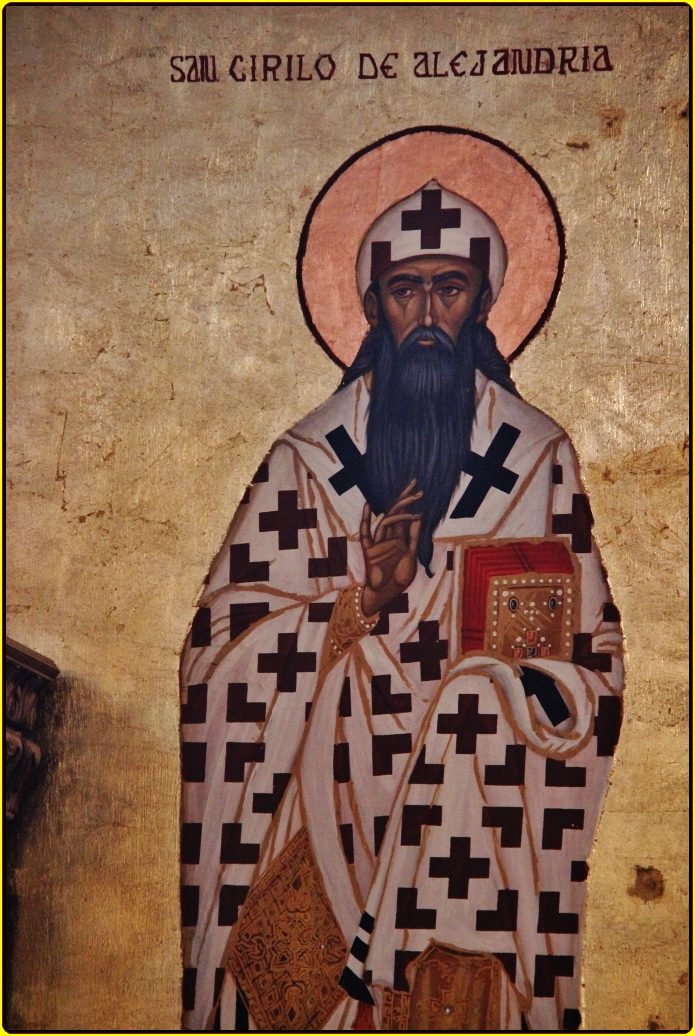
Cyril of Alexandria (c. 376–444) was the Patriarch of Alexandria during one of the most turbulent and theologically fertile periods in Christian history. His tenure as patriarch began in 412 and lasted until his death, making him a central figure in the church’s response to the great Christological controversies of the fifth century—most notably his conflict with Nestorius over the proper way to speak about Christ’s person.
Cyril was an aggressive theological polemicist, but also a profound exegete and a Doctor of the Church. The Council of Ephesus (431), which condemned Nestorianism, vindicated his position on the unity of Christ’s person and affirmed his authority as a teacher of the faith. Yet his legacy is not merely polemical. His Commentary on the Gospel of John, written over many years and running to more than a thousand pages in modern editions, represents one of the most systematic and theologically sophisticated readings of that Gospel produced in the patristic period.
In Cyril, we see the convergence of biblical interpretation, systematic theology, and pastoral concern. He wrote not to display learning but to defend the Gospel’s proclamation of Christ against distortion. When he reads John’s Prologue—and John 1:5 in particular—he does so as a theologian already committed to a particular understanding of Christ’s person and nature. That theological framework shapes his exegesis, but it does not distort it; rather, it draws out the Christological depth already present in the text.
Cyril’s Commentary on John: Scope and Method
Cyril’s Commentary on the Gospel of John survives in a fragmentary but substantial form. The standard English translation, by P.E. Pusey (1874), remains the most complete, though scholars today have access to a more recent and scientifically rigorous edition in the Ancient Christian Texts series, translated by David R. Maxwell (IVP Academic, 2013–2015).1 The work is organized by lemmata—short passages of text followed by Cyril’s exegetical and theological commentary.
What distinguishes Cyril’s approach is his integration of literal-historical and spiritual-allegorical interpretation within an explicitly Christological framework. He is not content merely to parse the grammar of the Greek or to explore the immediate narrative context; he constantly refers the reader back to Christ’s person, nature, and work. For Cyril, every verse of John is a witness to the Incarnate Logos, and the Prologue in particular is a cosmic proclamation of the eternal Word’s entry into time and flesh.
The Commentary was written in the context of Cyril’s earlier conflicts with the Arians and Nestorians, so anti-heretical concerns frequently surface. But these are never mere polemics; they emerge naturally from the text itself. When Cyril reads verse 5’s affirmation that the darkness did not master the light, he is already thinking about what it means for the eternal Light to become incarnate while remaining unblemished by the darkness of human sinfulness and mortality. This is not importation of alien concerns; it is the logic of the text itself driving the theology.
The Inviolability of the Divine Light: Cyril’s Christological Reading
For Cyril, John 1:5’s declaration that “the darkness did not master the light” is fundamentally a statement about the nature and power of the Word itself. The Light is unconquerable not because it is a particularly strong force or because God is vigilant against the darkness, but because of what the Light is. The Logos is God; God cannot be overcome; therefore, the Light cannot be overcome.
This move is crucial for understanding Cyril’s entire theological project. He is not defending an abstract principle of divine omnipotence. He is defending the reality of the Incarnation. The Light that shines in the darkness is not a temporary visitation, not a wavering flame that might be snuffed out, not a divine power temporarily lent to a human vessel. It is the eternal Word who “became flesh and dwelt among us” (John 1:14). And because the Word is God—true God from true God, as the Nicene Creed confesses—the darkness can no more overcome him than it can overcome God himself.
Cyril appeals explicitly to John’s own Christological grammar. In the Prologue, the Word is called logos (Logos), zoe (life), and phos (light). Each of these terms carries layers of theological significance. The Word is not merely a light; the Word is light in his very being. The darkness faces not a created power or an alien force, but the creative power itself, eternally distinct from what it creates.
In his treatment of John 1:3–4 (verses closely bound to verse 5), Cyril emphasizes that “all things came into being through him.” The Logos is the source and sustainer of all created reality. Darkness, insofar as it is anything real at all, is a creature of the Logos. It cannot, by logical necessity, overcome the source of its own being. The darkness might oppose the light, might harbor creatures who resist it, might create conditions of confusion and moral blindness; but it cannot vanquish what is intrinsically prior to and superior to itself.
This is why, for Cyril, the Arians and Nestorians pose such a grave threat to the Gospel. If the Logos is a creature—as Arius taught—then the light might theoretically be vulnerable; the darkness might really overcome it. But if the Logos is true God, then the inviolability of the light follows necessarily. Cyril is not simply defending an abstract theology; he is protecting the very foundation of Christian hope.
The Vulnerability of Individual Souls: The Critical Qualification
Here is where Cyril makes a move of theological precision that is easy to overlook but absolutely essential to his interpretation. Having established the inviolability of the Light, Cyril insists—explicitly and emphatically—that this does not mean individual human beings are guaranteed invulnerability to darkness.
Cyril reasons as follows: If it were the case that the darkness could not apprehend anyone, if the Light’s invincibility extended automatically to all human souls, then Christ would not have spoken as he did throughout his ministry. The Gospel narratives repeatedly depict people choosing darkness over light, hardening their hearts against the light, losing themselves in ignorance. If such a condition were impossible, Christ’s teaching would be incoherent. But the Gospel is not incoherent; therefore, the invincibility of the Light must not be understood as a guarantee of universal human salvation or universal human enlightenment.
This argument appears throughout Cyril’s Commentary, not merely in his treatment of verse 5 but consistently as he works through the Fourth Gospel, where the light-darkness motif is woven throughout the narrative. When John recounts that “people preferred darkness to light because their works were evil” (John 3:19), Cyril reads this not as a contradiction of verse 5 but as its necessary elaboration. The light shines. The light is unconquerable. But the light can be refused. The darkness cannot overcome the light; but people can choose to remain in the darkness, refusing the light that is offered to them.
This preserves what Cyril takes to be two non-negotiable truths: the absolute inviolability of Christ and the real moral culpability of those who resist him. Both are essential to the Gospel as Cyril understands it. The darkness did not master the light on the cross, in Christ’s passion and death; but those who engineered that passion chose darkness and will be judged for their choice. The victory of the light is objective and permanent; but it must be subjectively received.
Cyril’s concern here is deeply pastoral. His congregation includes people who are suffering, people who are struggling with sin and temptation, people who are uncertain whether the light can truly overcome the darkness they experience in their own lives. Cyril wants them to understand two things simultaneously: first, the light has already overcome the darkness in Christ, and nothing can change that cosmic reality; second, they themselves can still be ensnared by darkness if they turn away, and they bear real responsibility for that turning. The objective victory does not annul subjective struggle.
How Cyril Holds Both Truths Together
The theological synthesis Cyril achieves rests on a careful distinction between the light as it is in itself and the light as it relates to human receivers.
The light in itself is absolutely inviolable. This is a matter of being and nature. The Logos cannot be overcome because the Logos is God. No amount of human resistance can change what the Word is. No sin can taint the divine nature. No created darkness can extinguish uncreated light. Here, Cyril is adamant, and here the stakes are the very Christological foundations of Christian faith.
But the light as it relates to human beings presents a different picture. Humans are free creatures with real capacity to resist, to refuse, to turn away. The light offers itself; humans may accept or reject that offering. Christ teaches, acts, suffers, rises; humans witness all this and must respond. The response is not predetermined; the choice is real. A person may hear the gospel and believe, or hear the gospel and disbelieve. The light cannot be overcome, but it can be rejected—and that rejection constitutes a genuine darkness, a genuine loss, a genuine culpability.
Cyril is here working in a tradition that includes Augustine and will later include Thomas Aquinas. Augustine had argued that moral blindness is real: people in sin are genuinely unable to see the light, not by a failure of the light but by a failure of their own capacity to perceive. Cyril adapts and develops this insight. The darkness that people experience is not primarily a cosmic force opposing the light; it is a spiritual-moral condition, a preference for shadows over illumination, a refusal to come into the light.
And yet—and this is crucial for Cyril—this refusal is real. It is not predetermined; it is not inevitable; it is freely chosen by those who choose it. The light does everything the light can do: it shines continuously, it offers itself universally, it fulfills all God’s promises. But it does not coerce. This is where Cyril aligns with the later Chrysostomic tradition (represented in John Chrysostom’s own commentary on John) that insists God draws human beings not “by necessity and force” but by consent. The light is supremely powerful; but it is powerful as an offer, not as a compulsion.
Cyril’s Christological Framework: The Hypostatic Union and the Light
All of Cyril’s exegesis of John 1:5 is framed by his understanding of the hypostatic union—the doctrine that in Christ, two natures (divine and human) are united in one person without confusion, change, division, or separation. This doctrine was crystallized at the Council of Chalcedon in 451, after Cyril’s death, but Cyril himself articulated its essential contours in his anti-Nestorian polemics.
For Cyril, when John speaks of the Light that shines in the darkness, he is speaking of the Logos who has become human. The light is not a divine power operating through a human instrument; it is the Logos as human, the Word as incarnate, operating in and through the unified reality of the person of Jesus Christ.
This has profound implications for understanding the inviolability of the light. The Logos could never be overcome by darkness because the Logos is God. But now, the Logos has become human, has taken on flesh, has entered into the very realm of darkness and mortality and sin. And precisely in that entering, the light has proven inviolable. Christ died—but death could not hold him. Christ was tempted—but he did not sin. Christ suffered—but he did not lose his identity as the Word of God. The darkness did its worst; the light shone through it undiminished.
Cyril also emphasizes the permanence of the Incarnation in connection with verse 5. When he treats the present-tense verb phaínei (“shines” in John 1:5), he connects it to the permanence of the Word’s assumption of human nature. The Word did not assume flesh temporarily and lay it aside. The Word remains incarnate. And therefore, the light that shines is not a past event but a present reality—the Incarnate Word continues to shine, continues to offer light, continues to call all humanity to receive him.
This is why Cyril’s doctrine of the Theotokos (the divine motherhood of Mary) is integral to his reading of the light-darkness motif. If Mary is truly the mother of God (theotokos), if the eternal Word truly and fully became human, then the light has truly and fully entered the darkness of human existence. The darkness that Christ assumed did not overcome him, but neither did he bypass it or merely hover above it. He entered into it fully while remaining fully what he was. This is the theological density of verse 5 as Cyril reads it.
Cyril’s Legacy in Catholic Doctrine
Cyril’s influence on Catholic doctrine concerning Christ, the light, and the relationship between divine power and human freedom extends far beyond the fifth century.
The Council of Ephesus (431) vindicated Cyril’s Christology and his insistence on the divine motherhood of Mary. Twenty years later, the Council of Chalcedon (451) would crystallize the doctrine of the hypostatic union in language influenced by Cyril’s theological project. Although Chalcedon did not simply repeat Cyril’s formulas (and later Chalcedonians would argue about how to interpret Cyril in light of Chalcedon), the fundamental commitment was Cyril’s: one person in two natures, the same Christ understood as fully divine and fully human.
In the medieval synthesis, Thomas Aquinas drew extensively on Cyril through the Catena Aurea, his compilation of patristic commentaries on the Gospels. Aquinas cites Cyril frequently on the meaning of John 1:5 and related passages. The scholastic tradition’s wrestling with the relationship between grace and freedom, between divine omniscience and human choice, owes a profound debt to the patristic framework Cyril articulated.
The Catechism of the Catholic Church does not cite Cyril by name when treating light and darkness (CCC §§285–295 on creation and the fall; §§456–478 on the Incarnation), but the theological structure it employs is recognizably descended from Cyril’s synthesis. The CCC affirms both the absolute transcendence and inviolability of God (and therefore of the Word) and the real existence of evil and human freedom to reject God’s offer of grace. The Catechism teaches that God does not cause evil but permits it; that creation itself is good; that human beings are free and responsible. All of this reflects the Cyrillian framework: the light cannot be overcome, but darkness remains a real possibility for those who turn from the light.
Similarly, the Catholic doctrine on grace and freedom, developed from Augustine through Thomas Aquinas and articulated in the Council of Trent, follows the Cyrillian pattern. God offers grace universally and earnestly; humans are genuinely free to accept or refuse it; God’s foreknowledge does not determine human choice. The light shines for all; but all must freely receive it.
The Present-Tense Victory of the Light
One final aspect of Cyril’s reading deserves emphasis: his attention to the present-tense structure of verse 5. The light shines (φαίνει); the darkness did not master it (οὐ κατέλαβεν). This is not a statement about past history alone, though it certainly includes Christ’s historical ministry and passion. It is a statement about the perpetual, continuous reality of Christ’s ongoing offer of light to the world.
For Cyril, the Gospel is not a museum of historical facts. It is a living proclamation. When we encounter Christ in the pages of John’s Gospel, we encounter not a figure of the past but a presence that addresses us now. The light that once shone for Nicodemus and the Samaritan woman shines still, addressing the reader of John’s Gospel in every generation.
This is why the moral-spiritual darkness that John speaks of—the preference for darkness over light (John 3:19)—is not a first-century problem alone. It is a perennial possibility for human beings. We may still choose to remain in darkness. We may still refuse the light that is offered. But the light continues to offer itself. The invitation remains open. The victory of the light is not a past achievement that is now closed off; it is an eternally present reality.
Study & Reflection Questions
-
On the Inviolability of the Light: Cyril argues that the light cannot be overcome because the light is the Logos, and the Logos is God. Do you find this Christological argument more compelling than an argument based merely on divine omnipotence? What difference does it make to ground the light’s invincibility in who Christ is rather than merely what God can do?
-
On Individual Vulnerability: Cyril insists that while the Light is inviolable, individual souls remain genuinely vulnerable to darkness. How do you reconcile this with John 3:19, where people are said to prefer darkness to light? Is the vulnerability that of genuine temptation, or is it the vulnerability of those who choose to remain ensnared?
-
On the Hypostatic Union: Cyril’s reading of John 1:5 depends entirely on the doctrine that the eternal Word became fully human in Christ. How does understanding that the light is the Incarnate Word (not merely a divine power or influence) change the meaning of the Prologue for you?
-
On Present-Tense Victory: John uses the present tense (φαίνει, “shines”) rather than the past tense. Cyril takes this to mean the light continues to shine now, not merely in first-century Galilee. Where do you encounter the light shining in your own present moment? How is it offered to you?
-
On Moral Blindness and Responsibility: Cyril adopts Augustine’s insight that people in sin experience genuine moral blindness—they cannot see the light. But he also insists they remain responsible for their blindness. How can both of these be true? Is moral blindness a tragedy or a culpability, or somehow both?
-
On the Already and Not Yet: The Catholic tradition teaches that Christ has already won a decisive victory, yet evil continues and the final peace is not yet fully restored. How does Cyril’s distinction between the invincibility of the Light and the vulnerability of individual souls help you live within this tension?
-
Pastoral Reflection: Imagine you are counseling someone who has experienced deep darkness—sin, despair, confusion about faith. How would Cyril’s teaching about the inviolable light and the genuine vulnerability of the soul address that person’s situation? What would you want them to know?
Frequently Asked Questions
Q: Did Cyril of Alexandria actually write a complete Commentary on John? Where can I read it?
A: Cyril wrote extensively on John, and substantial portions of his commentary survive. The most complete English translation remains P.E. Pusey’s (1874), available in modern reprints. A newer, more scientifically rigorous translation by David R. Maxwell in the Ancient Christian Texts series (IVP Academic, 2013–2015) is also valuable. Some sections of Cyril’s commentary survive only in fragmentary form, particularly the later chapters, so no complete reconstruction is possible. For specific passages on light and darkness, the Catena Aurea of Thomas Aquinas excerpts key passages from Cyril and makes them accessible in a traditional theological context.
Q: How does Cyril’s view of light and darkness compare to Augustine’s?
A: Both emphasize the moral-epistemic dimension of darkness: darkness is not primarily a cosmic force but a condition of spiritual blindness and refusal to see. Both ground the inviolability of the light in the nature of God. However, Augustine tends to emphasize divine sovereignty and predestination more emphatically, whereas Cyril places greater stress on the universality of the light’s offer and the genuine freedom of human acceptance or refusal. Cyril was writing in the context of anti-Nestorian polemic, which made him particularly concerned to defend the reality of Christ’s human nature and the genuine possibility of human choice.
Q: What is the relationship between Cyril’s teaching on John 1:5 and the doctrine of the hypostatic union?
A: For Cyril, they are inseparable. The light that shines in the darkness is the Logos who has become human. The inviolability of the light is grounded in the eternal nature of the Logos, while the reality of the light entering darkness is grounded in the authenticity of the Incarnation. If the Logos is truly God (against Arianism), the light cannot be overcome. If the Logos truly became human (against Docetism and Nestorianism), the light has truly entered into the realm of human experience and temptation. The two doctrines work together: the light is inviolable because it is divine; the light is present because it is incarnate.
Q: Does Cyril teach that some people are predestined to darkness?
A: No. While Cyril affirms that the darkness did not master the light, and while he acknowledges that people do in fact choose darkness, he does not teach predestinarian doctrine. His position is closer to the later Catholic synthesis: God offers grace universally and earnestly to all; God foresees who will accept and who will refuse; but this foreknowledge does not determine the choice. People are genuinely free, and darkness is a real possibility for those who turn from the light. Cyril’s concern is always to preserve both divine omniscience and human freedom.
Q: How does Cyril’s commentary influence the Catholic Catechism’s teaching on light and darkness?
A: While the Catechism does not cite Cyril by name, the theological structure it employs in discussing evil, grace, freedom, and salvation is recognizably descended from the patristic tradition Cyril articulated. The Catechism affirms the absolute transcendence and inviolability of God, the reality of created darkness and evil, human freedom to accept or refuse grace, and the universal offer of salvation. All of these reflect the Cyrillian synthesis working through Augustine, Thomas Aquinas, and the Council of Trent into modern Catholic doctrine.
Q: What should I read first: John 1:5 or Cyril’s Commentary on John?
A: Start with John 1:5 itself. Read the verse slowly, noticing the present tense of the shining and the double meaning of “did not master.” Then read the John 1:5 post on this site to understand the Greek and the patristic options. Then come to Cyril. Having engaged directly with the text and the basic exegetical options, you will understand Cyril’s synthesis much more clearly. Cyril is not a lightweight read; he rewards serious preparation.
For Further Study
Primary Sources
- Cyril of Alexandria, Commentary on the Gospel of John, trans. P.E. Pusey (1874); modern reprint available through various publishers.
- Cyril of Alexandria, Commentary on the Gospel of John, trans. David R. Maxwell, 2 vols., Ancient Christian Texts series (IVP Academic, 2013–2015). More recent and scientifically rigorous than Pusey.
- Thomas Aquinas, Catena Aurea: Commentary on the Four Gospels, available online at multiple sites. Contains extensive excerpts from Cyril organized verse-by-verse through John.
- Augustine of Hippo, Lectures on the Gospel of John, trans. John Gibb (Nicene and Post-Nicene Fathers, Series 1, vol. 7). Augustine’s commentary represents an earlier synthesis that influenced Cyril.
Secondary Sources on Cyril
- McGuckin, John Anthony. Saint Cyril of Alexandria and the Christological Controversy: His Life, His Times, His Legacy. Crestwood, NY: St. Vladimir’s Seminary Press, 1994. The standard modern biography and theological study; essential background.
- Russell, Norman. Cyril of Alexandria. London: Routledge, 2000. A more concise introduction to Cyril’s theology and exegesis.
- Wilken, Robert Louis. Judaism and the Early Christian Mind. New Haven: Yale University Press, 1971. Situates the patristic interpretation of John within the Jewish context that shaped both the Gospel and its exegesis.
- Torrance, Thomas F. Divine Meaning: Studies in Patristic Hermeneutics. Edinburgh: T&T Clark, 1995. Contains substantive discussion of Cyril’s exegetical method and Christological hermeneutics.
Catholic Doctrine
- The Catechism of the Catholic Church, §§456–478 (The Incarnation), §§285–295 (Creation and the Fall), §§600–682 (Christ’s Paschal Mystery). Traces the evolution of Catholic teaching on Christ, creation, and salvation.
- Second Vatican Council, Lumen Gentium (“Dogmatic Constitution on the Church”), §§3–9. The conciliar foundation for modern Catholic Christology and ecclesiology, drawing on patristic sources including Cyril.
- The Definition of the Council of Chalcedon (451), available in Jaroslav Pelikan, The Christian Tradition, Vol. 1: The Emergence of the Catholic Tradition (100–600) (University of Chicago Press, 1971). Chalcedon crystallizes themes central to Cyril’s theology.
Comparative Patristic Study
- Brown, Raymond E. The Gospel According to John (I–XII), Anchor Bible 29. Garden City, NY: Doubleday, 1966. The standard scholarly commentary; includes extensive patristic parallels and contextual information.
- Pelikan, Jaroslav. The Christian Tradition, Vol. 1: The Emergence of the Catholic Tradition (100–600). University of Chicago Press, 1971. Places Cyril and the Christological controversies within the broader history of doctrine.
- Fortuna, Stephane. The Creation of the World and the Time of the World in Philo of Alexandria, With Special Reference to the Exegetical Treatises. Lanham, MD: University Press of America, 1997. While focused on Philo, provides comparative context for Jewish and Christian interpretation of creation and light.
- David R. Maxwell’s translation in the *Ancient Christian Texts* series is more recent and incorporates advances in patristic scholarship. However, Pusey’s remains the most complete English rendering of the full commentary, and many citations in secondary literature still refer to Pusey’s pagination. For serious study, consulting both editions alongside the original Greek fragments is advisable. ←
- The semantic range of κατάλαμβάνω is substantial. BDAG (Bauer, Danker, Arndt, Gingrich), the standard Greek lexicon for the New Testament, lists: “to seize or grasp,” “to overtake,” “to attain,” “to comprehend or understand.” This polysemy is almost certainly intentional in John 1:5, and the patristic interpreters exploited it with precision. ←
- Cyril’s emphasis on the inviolability of the divine nature while insisting on the genuine vulnerability of individual souls represents a Christological precision that later becomes central to the doctrine of the hypostatic union. The eternal nature of the Word cannot be overwhelmed (because it is divine); but the human nature that the Word assumed includes genuine participation in human limitation and temptation (because it is truly human). This is the theological depth of the Incarnation for Cyril. ←
- The echoes of Genesis 1 in the Johannine Prologue are well established in patristic interpretation. The phrase Ἐν ἀρχῇ (“In the beginning”) deliberately parallels the Septuagint rendering of Genesis 1:1. But John’s “beginning” is also the “beginning” of the Logos’s eternal being—a theological reinterpretation of Genesis that is characteristic of Cyril’s Christological reading. ←
- The Community Rule (1QS) from Qumran explicitly uses the language of “sons of light” and “sons of darkness” to describe the cosmic struggle between the children of light and the forces of darkness. While the Dead Sea Scrolls antedate the Gospel of John, they attest to the conceptual world in which John’s light-darkness symbolism would be understood. Cyril, though separated from this Jewish context by centuries, is aware (through patristic tradition and his reading of the Gospels themselves) that John’s language is rooted in Jewish apocalyptic. ←
- The “already / not yet” framework is articulated in CCC §672 in these terms: “Before his Ascension Christ said to his apostles: ’All power in heaven and on earth has been given to me.’ But the Ascension does not mean his withdrawal from history. Rather, Jesus Christ remains with his Church, but now through the gift of his Spirit. There remain challenges for the Church even now as it approaches the final consummation.” This structure of decisive victory and ongoing struggle is recognizably Cyrillian in its theological framework. ←
- The specific citation is from the *Catechism of the Catholic Church* §465, which draws on patristic sources (including Cyril through the tradition) to articulate the permanence of the Incarnation: “What he was, he remained and what he was not, he assumed, so that he might heal what was suffered.” This principle—that the Incarnation is not merely temporary but eternal—is essential to Cyril’s reading of John 1:5’s present-tense “shines.” ←

Garrett Ham
Garrett Ham is an attorney, military veteran, and holds a Master of Divinity from Yale Divinity School. He writes from Northwest Arkansas on theology, law, and service.
More about Garrett →Related Posts
John 1:5 Meaning Explained: The Light Shines in the Darkness
What does John 1:5 mean? A study of the Greek—the present tense of φαίνει, the double meaning of κατέλαβεν, and the already/not yet of eschatology.
John 1:3–4 Meaning Explained: The Creator Who Became the Light
What do John 1:3–4 mean in the Gospel of John? A close reading in the original Greek — the punctuation of ὃ γέγονεν, Incarnation as life in the Word, and Chalcedonian Christology.

In the Beginning Was the Word: John 1:1 Explained
A deep dive into John 1:1 in the original Greek—the Logos, Colwell's rule, Nicene consubstantiality, and why this verse is the whole Gospel.
Stay Informed
Get new writing on faith, law, and service delivered to your inbox.
No spam. Unsubscribe anytime.