The Church of the East: Christianity's Forgotten Third Branch
On This Page
“He, the Voice, has become a body, the Word has put on a garment, the Invisible is made manifest. He who is boundless has accepted bounds, He, the Timeless, is placed in time. He who is beyond measure took measure.” — From the Liturgy of Addai and Mari, the Church of the East’s most ancient Eucharistic prayer (4th century)
The Third Branch of Christendom
When Western Christians speak of Christianity’s great divisions, they typically invoke three historic separations: the East-West schism of 1054 (splitting Orthodoxy from Catholicism), the Reformation of the sixteenth century (fragmenting Western Christianity), and the earlier split at the councils of Ephesus (431) and Chalcedon (451), which created the Oriental Orthodox churches. But there is a fourth, often overlooked: the Church of the East, which split at Ephesus yet remained geographically distinct from both the Byzantine East and the Latin West, maintaining its own apostolic succession, liturgy, theology, and missionary expansion for two thousand years.
The Church of the East is Christianity’s forgotten third branch—not Eastern Orthodox, not Roman Catholic, not Oriental Orthodox, but sui generis, a living apostolic communion that at its medieval zenith spanned from the Mediterranean to Beijing, with more metropolitan sees than Rome itself. That it is unfamiliar to most Western Christians is a historical tragedy. Its story is one of apostolic fidelity, missionary audacity, theological sophistication, and martyrological endurance. It remains, in our own time, a small but vital witness to the catholicity of the Christian faith.
Apostolic Origins: The East Syriac Tradition
The Church of the East claims apostolic origins in Mesopotamia, the ancient heartland between the Tigris and Euphrates rivers. Christian tradition ascribes its founding to three apostles: Thomas (who, legend holds, evangelized India and Mesopotamia before his martyrdom), Thaddeus (also called Addai), and Mari.
Unlike the churches of Jerusalem, Antioch, or Alexandria, which developed within the Mediterranean Roman Empire and were shaped by Greek philosophical categories, the Church of the East developed in the Sassanid Persian Empire, drawing on Aramaic linguistic and theological traditions. Its liturgical language is East Syriac, a dialect of Aramaic so close to the language Jesus himself spoke that modern scholars studying the Church of the East’s theology often feel they are hearing echoes of first-century Jerusalem itself.
The church’s early ecclesiastical center was at Seleucia-Ctesiphon, the Persian capital (modern Iraq), where a metropolitan see was established early in the Christian era. Unlike the bishops of Rome, Constantinople, Jerusalem, and Alexandria—the four patriarchs of the Mediterranean world—the catholicos (patriarch) of Seleucia-Ctesiphon governed a church that faced eastward, toward the vast unmissionized lands of Central Asia, India, and the Far East.
The Liturgical Foundation: Addai and Mari
At the spiritual heart of the Church of the East lies one of Christianity’s most ancient and theologically profound liturgies: the Liturgy of Addai and Mari, still in use in the church today. This Eucharistic prayer is remarkable for its antiquity and its singular theological content. Dating to the fourth century or earlier, it stands as a monument to the church’s continuity with apostolic practice.
Most striking to modern liturgists is what the Anaphora (Eucharistic prayer) notably lacks: the institution narrative—the explicit recitation of Christ’s words at the Last Supper (“This is my body… this is my blood”). Instead, the prayer emphasizes the memorial (zacharona) of Christ’s entire redemptive work, the epiclesis (invocation of the Holy Spirit), and the remembrance of the church’s communion with heaven. For centuries, Roman theologians argued that a Eucharistic prayer without an institution narrative was invalid. Only in 2001 did the Vatican formally recognize the Liturgy of Addai and Mari as a valid Eucharistic prayer, confirming the consecration as valid despite the absence of the narrative formula.
This recognition signified something profound: that the Church of the East’s ancient practice, developed independently of Rome, embodied orthodox sacramental theology and was worthy of recognition as authentically apostolic.
The Christological Controversy and the Council of Ephesus (431)
To understand the Church of the East’s historical identity and the “Nestorian” epithet that has dogged it, one must grasp the great Christological controversies of the fifth century.
The question was deceptively simple: How are Christ’s divinity and humanity related? Is He one person with two natures? Two persons in one union? One nature that combines divine and human? The answers seemed to determine not only Christology but the entire structure of salvation itself.
The Antiochene Theological Tradition
The Church of the East inherited the theological tradition of Antioch, which emphasized the distinction between Christ’s divine and human natures. The great Antiochene theologians—Diodore of Tarsus (d. 394) and especially Theodore of Mopsuestia (d. 428)—taught a dyophysite (two-nature) Christology that stressed that in Christ, the divine Word and the human nature remained truly distinct, united not by confusion or fusion but by a perfect union of will and action.
This tradition was not heretical. Theodore and Diodore were orthodox theologians. Yet their insistence on maintaining the distinction between natures, their emphasis on Christ’s human will and agency, and their caution about language that seemed to blur the boundary between divine and human, would become the bone of contention.
Nestorius and His Formulation
Nestorius, patriarch of Constantinople (428–431), inherited this Antiochene theological sensibility. When Nestorius heard Christians addressing Mary as Theotokos (God-bearer or Mother of God), he recoiled. To call Mary the mother of God seemed, in Nestorius’s view, to confuse the divine and human natures. Was not God eternal and immutable? How could He have a mother?
Nestorius insisted on precision: Mary was the mother of Christ (Christotokos), the mother of the human nature, not the mother of the divine Word. He seemed to teach—though the exact extent of his teaching remains debated—that Christ consisted of two distinct persons loosely united, rather than two natures in one person.
The Council of Ephesus (431) and Condemnation
Cyril of Alexandria, theologically opposed to Nestorius and invested in defending the Theotokos title, pressed for an ecumenical council to condemn Nestorius’s teaching. In 431 AD, the Council of Ephesus convened. Cyril dominated the proceedings. The council condemned Nestorius, declaring that Christ is truly one person, that the Word did indeed assume human nature, and that Mary is rightly called the Theotokos.
Yet Ephesus was not a purely theological triumph. The council was marred by procedural confusion, the absence of some key bishops, and—most significantly—by Cyril’s own theological language, which seemed to many (especially Antiochene theologians) to verge on monophysitism, the teaching that Christ has only one nature (the divine absorbing the human).
The Church of the East, governed from Persia outside the Roman Empire, rejected the council’s terms. Not because they believed in two persons in Christ, but because the council’s condemnation of Nestorius seemed to them to rest on misunderstandings and because they found the council’s own language (especially Cyril’s) suspicious. They preferred to maintain their own Antiochene vocabulary: two natures, united in one person (or prosopon, roughly “face” or “persona”).
Modern Scholarly Consensus
Here a crucial point must be emphasized: the modern scholarly consensus, crystallized in the 1994 Common Christological Declaration between Pope John Paul II and Mar Dinkha IV (the patriarch of the Assyrian Church of the East), recognizes that the Church of the East was never truly “Nestorian” in the heretical sense.
The declaration states: “We have been blessed to discover that we have the same faith regarding Christology despite the different theological vocabularies developed in different contexts.”1 The church teaches an orthodox two-natures Christology; it simply uses different terminology (Greek qnome for person/hypostasis, kyane for nature/ousia) that was easily misunderstood by Western theologians.
The “Nestorian” label, imposed by polemicists and perpetuated through centuries of ecclesiastical politics, was fundamentally a misnomer. The Church of the East does not hold that Christ is two persons; it holds that Christ is one person with two natures, united in an unconfused, inseparable union—which is precisely what Chalcedon (451) also taught. The difference lies in vocabulary and hermeneutical tradition, not in fundamental doctrine.
The Extraordinary Missionary Expansion
If the Church of the East’s theological sophistication is underappreciated, its missionary achievement is virtually unknown in the West. Yet between the fifth and fourteenth centuries, it undertook the most expansive missionary effort in pre-modern Christianity, spanning continents and converting vast populations from Central Asia to China.
The Silk Road Missions
From its base in the Sassanid Empire, the Church of the East began, in the fifth century, to push eastward along the caravan routes we now call the Silk Road. Monks and missionaries established monasteries at key trading posts, baptized local populations, and gradually established metropolitan sees across Central Asia, India, and beyond.
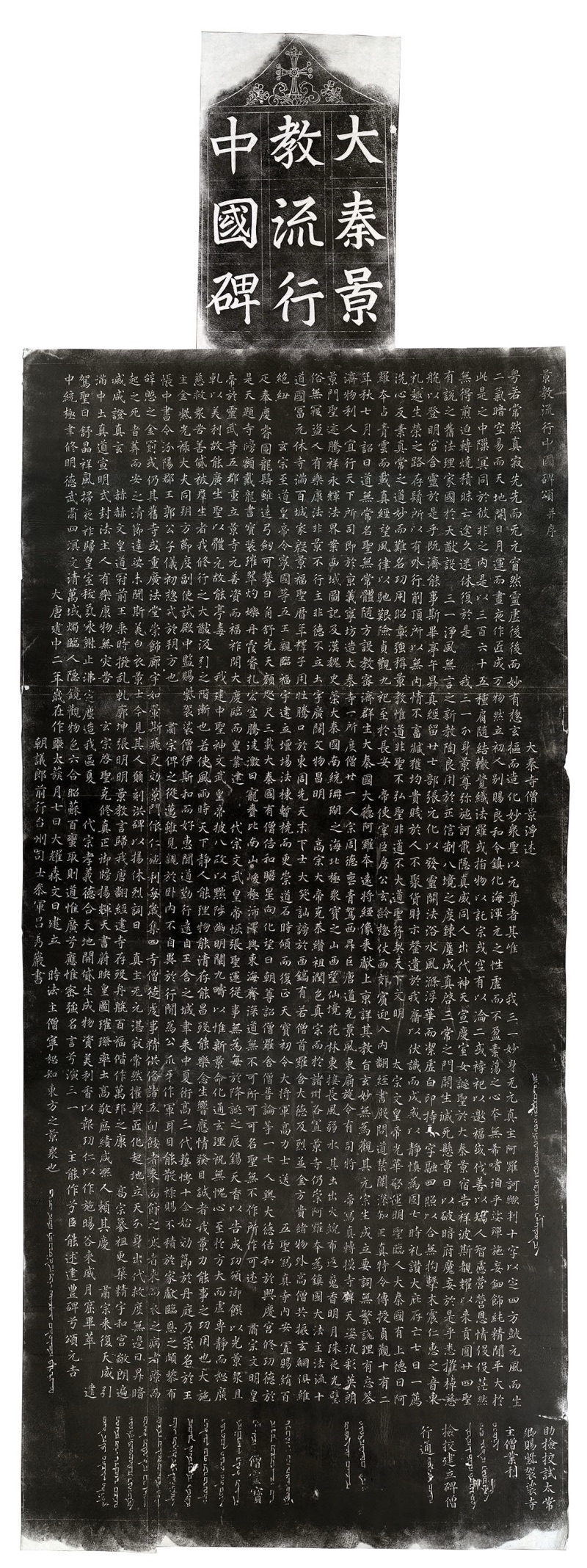
By the seventh century, the church had reached China. In 635 AD, a missionary named Alopen arrived in Chang’an (modern-day Xi’an), the capital of the Tang dynasty. The Tang emperor, Taizong, was intrigued by this foreign faith. A century and a half later, in 781 AD, a magnificent limestone monument was erected in Chang’an to commemorate the arrival of the “Luminous Teaching” (as the Chinese called Christianity). This Xi’an Stele, as it is known, provides a detailed account of Christian doctrine, Christ’s redemptive work, the sacraments, and the church’s liturgical life—all translated into classical Chinese.2
Metropolitan Sees and Geographic Reach
At its medieval apex, the Church of the East possessed an astonishing geographic footprint. It maintained:
- Metropolitan sees in India, including the famous St. Thomas Christian communities of the Malabar Coast, which claimed apostolic succession from Thomas the Apostle himself
- A metropolitan see in Samarkand (Central Asia)
- Extensive communities in Persia and Mesopotamia
- Presence in Tibet, where Nestorian Christianity competed with Buddhism for influence
- Multiple communities in Mongol domains, including the Khan’s court itself
- A thriving presence in China, where Chinese Christians called the church the “Persian Religion”
In the thirteenth and fourteenth centuries, when the Mongol Empire united vast territories under a single political umbrella, the Church of the East flourished. Mongol khans often patronized Christianity. The patriarch of the church commanded the loyalty of millions of Christians spread across half the known world. Some scholars estimate that at its height, the Church of the East had more metropolitan sees—and thus more ecclesiastical authority—than the Pope of Rome.
Missionary Methods and Adaptation
The Church of the East’s success lay partly in its willingness to adapt to local contexts while preserving apostolic faith. Missionaries learned local languages and incorporated local customs into Christian practice. The liturgy, though always conducted in East Syriac, could be adorned with local musical traditions and artistic styles. The church did not insist on celibacy for all clergy, allowing married men to be ordained as priests and even as bishops—a practice that facilitated its integration into local communities and the establishment of hereditary ecclesiastical families.
This adaptability, which would have seemed suspect to medieval Rome, was a strength. It allowed the church to flourish in diverse cultural contexts without sacrificing its apostolic identity.
Catastrophic Decline: Timur and the Ottoman-Safavid World
The Church of the East’s golden age ended abruptly and catastrophically in the late fourteenth century.
The Devastations of Timur
In 1369, Timur (Tamerlane), the Turco-Mongol conqueror, launched his campaigns of conquest. Unlike the relatively tolerant Mongol khans, Timur was ferociously destructive. He conquered Persia, Mesopotamia, the Caucasus, and Central Asia, leaving behind a wake of devastation. Christian communities—especially the Church of the East—were decimated. Monasteries were destroyed, bishops were martyred, and entire populations were either killed or displaced.
By Timur’s death in 1405, the Church of the East had suffered irreversible losses. The great monasteries of Central Asia were in ruins. The metropolitan sees of Central Asia and Persia were depopulated. The Indian communities, though isolated, survived. But the grand continental span of the church, its metropolitan sees reaching from the Mediterranean to China, was broken.
Ottoman and Safavid Pressure
The subsequent rise of the Ottoman Empire (1453 onward) and the Safavid Persian Empire (1501 onward) further weakened the Church of the East. Both empires were zealously Islamic and actively hostile to Christian minorities. Christian communities were taxed, restricted, and sometimes persecuted.
By the sixteenth century, the Church of the East had shrunk to a small remnant community, concentrated in the mountainous Hakkari region (modern-day southeastern Turkey and northern Iraq), where it sought refuge in inaccessible terrain. The grand metropolitan sees of antiquity were no more. The church had been reduced from a continental power to a persecuted minority.
The Chaldean Catholic Uniate (1552)
In 1552, amid Ottoman pressure and seeking the protection that union with Rome might afford, a portion of the Church of the East under Patriarch John Sulaqa entered into communion with the Roman Catholic Church. This union gave rise to the Chaldean Catholic Church, one of the 23 sui iuris (self-governing) Eastern Catholic churches in full communion with Rome.
The distinction between the Assyrian Church of the East (not in communion with Rome, maintaining apostolic independence) and the Chaldean Catholic Church (in communion with Rome) is crucial. Both trace their ancestry to the ancient Church of the East. Both use the East Syriac liturgy and maintain married clergy (at least for priests; bishops are typically celibate). But the Chaldean Catholic Church recognizes papal primacy and infallibility, submits to Vatican authority, and maintains communion with the worldwide Catholic Church.
The split was not doctrinal but jurisdictional—a consequence of historical pressures and the seeking of political protection. Yet it meant that the ancient church’s unity was fractured into two bodies, each claiming legitimacy and apostolic succession.
Theology and Liturgical Life: The East Syriac Tradition
To understand the Church of the East as a living tradition (not merely as a historical curiosity), one must grasp its theological distinctives and its continued liturgical practice.
Christology in East Syriac Vocabulary
The Church of the East teaches Christ as one prosopon (person) with two qnome (natures) and two kyane (essences). These terms, rooted in Antiochene theology and perpetuated in East Syriac philosophical tradition, operate somewhat differently from the Greek hypostasis and ousia of Chalcedon.
A qnome in East Syriac theology denotes not merely a universal nature but a mode of subsistence, a particular way of being. Christ’s divine qnome and human qnome are distinct (i.e., the divine nature and human nature remain truly separate, not confused or fused), yet they subsist in a single prosopon—a single person, a unified face presented to the world.
This is not a heretical compromise between Nestorian dualism and Monophysite fusion. It is, rather, an authentic articulation of two-nature Christology in different conceptual vocabulary. As the 1994 Common Christological Declaration affirmed, this confession is entirely compatible with Chalcedon.
The Anaphora of Addai and Mari
The Liturgy of Addai and Mari remains the spiritual heart of the Church of the East. This ancient Eucharistic prayer, prayed continuously for over seventeen centuries, embodies the church’s theology in liturgical form.
The prayer emphasizes Christ’s redemptive work: His Incarnation, His teaching, His passion, resurrection, and ascension. It invokes the Holy Spirit to descend upon the gifts of bread and wine, transforming them into the body and blood of Christ. And it does so without the explicit institution narrative (the words “This is my body”), relying instead on the church’s apostolic tradition and the anaphoral prayer itself to consecrate the gifts.
This ancient practice, once thought invalid by Rome, is now recognized as a legitimate expression of apostolic Christianity. The consecration occurs through the church’s prayer and the Spirit’s action, not merely through the repetition of dominical words. In this, the Church of the East preserves a very primitive form of Eucharistic theology, predating the medieval Western emphasis on the recitation of the institution narrative as the sine qua non of validity.
Clerical Marriage and Monasticism
Unlike the Latin Church, which from the eleventh century onward required celibacy of all clergy, the Church of the East permits priests to marry. Bishops are typically chosen from among celibate monks, but ordinary priests may (and typically do) have wives and children. This practice, rooted in apostolic times and maintained throughout the church’s history, has enabled the church to sustain a living priesthood and to integrate fully into family and community life.
The Church of the East also maintains a monastic tradition of significant scholarly and spiritual importance. Its monasteries have been centers of theological learning, biblical scholarship, and spiritual discipline. The monastery of St. Sergius (Sergis) in Syria, the monastery of St. Hormuz in Persia, and others served as places of learning where the church’s theological tradition was developed and preserved.
The Biblical Canon and Liturgical Distinction
The Church of the East recognizes a biblical canon slightly different from the Western Catholic canon. It includes the deuterocanonical books of the Old Testament (Tobit, Judith, Wisdom, Sirach, Baruch, 1–2 Maccabees), but in a different order and with different numbering of Psalms. The New Testament canon is identical with the Catholic and Orthodox canons.
More distinctively, the Church of the East preserves a unique liturgical and spiritual tradition developed over centuries in a non-Western context. Its hymnody, drawn from the profound mawtaba (metrical homilies) of great saints like Ephrem the Syrian and Jacob of Nisibis, represents some of Christendom’s most sublime theological and poetic expression.
The Church of the East Today: A Living Witness
The modern Church of the East is a small communion, numbering perhaps 300,000 to 500,000 faithful worldwide, concentrated in Iraq, Syria, Lebanon, and diaspora communities in the West (particularly in the United States and Australia). Yet it remains a living, apostolic church with unbroken succession and a vibrant spiritual life.
The Assyrian Church of the East
The Assyrian Church of the East, not in communion with Rome, is the larger of the two Eastern bodies claiming descent from the ancient Church of the East. Its patriarch is based in Erbil, Iraq (though the See has shifted geographically due to modern conflicts). The church maintains all the apostolic features: apostolic succession, the seven sacraments (baptism, confirmation, the Eucharist, penance, anointing of the sick, ordination, and marriage), the fullness of the Catholic faith (in its Asiatic and non-Latin expression), and the ancient East Syriac liturgy.
The Assyrian Church of the East has suffered enormously in the twentieth and twenty-first centuries. The Assyrian genocide of 1915, perpetrated by Ottoman forces against Armenian, Greek, and Assyrian Christians, killed hundreds of thousands of Assyrians. The Simele massacre of 1933 in Iraq killed further thousands. Most recently, the rise of ISIS in 2014–2017 led to the displacement of thousands of Assyrians from their ancient homeland in the Nineveh Plain.
Yet the church persists. Despite trauma, persecution, and diaspora, it maintains its apostolic faith, its ancient liturgy, and its missionary consciousness. The current Patriarch, Mar Awa III (elected in 2021), leads the church in bearing witness to Orthodox Christianity in the Middle East and in supporting diaspora communities worldwide.
The Chaldean Catholic Church
The Chaldean Catholic Church, in full communion with Rome, has similarly endured. It maintains the same apostolic succession, the same East Syriac liturgy, and the same theological tradition as the Assyrian Church. The difference lies in its submission to papal authority and its integration into the worldwide Catholic communion.
The Chaldean Catholic Church also suffered profoundly during the Iraqi wars and the subsequent rise of ISIS. Thousands of Chaldean Catholics fled Iraq. The Patriarch, Louis Raphael I Sako (elected in 2013), has been a prophetic voice for persecuted Christians in the Middle East and a bridge between the Eastern Catholic world and Rome.
The Ancient Church of the East and Reconciliation
A third, smaller body is worth noting: the Ancient Church of the East, which broke from the Assyrian Church in 1968 over calendar differences (the calculation of Easter). In 2022, after decades of separation, representatives of the Assyrian Church of the East and the Ancient Church of the East formally re-established communion, healing this schism and reuniting the church’s witness.
This reconciliation, though little-noticed in the West, is theologically significant. It represents a movement toward unity among the Eastern churches and a recognition that ancient ecclesial bonds should not be sundered over disciplinary matters.
Ecumenical Recognition and the Common Christological Declaration (1994)
A watershed moment in the Church of the East’s modern history came on November 11, 1994, when Pope John Paul II and Mar Dinkha IV, Patriarch of the Assyrian Church of the East, signed the Common Christological Declaration.
For nearly sixteen centuries, the Church of the East had been labeled “Nestorian,” accused of Christological heresy, and effectively isolated from the broader Christian world. The 1994 declaration reversed this narrative. It explicitly affirmed that both Rome and the Assyrian Church of the East profess the same orthodox Christology: Christ is one person with two natures (divine and human), united without confusion, without separation, and without division.
The declaration stated: “We recognize in each other the common apostolic faith of the Church of the first centuries.”3 It acknowledged that terminological and traditional differences had historically obscured this fundamental agreement.
This recognition was not merely symbolic. It opened the door to closer communion, though full structural unity remains distant. It validated the Church of the East’s claim to apostolic orthodoxy and signaled to the broader Christian world that this ancient church’s theological voice deserves serious engagement.
The Vatican’s Validation of the Anaphora
In 2001, the Vatican further affirmed the Church of the East’s liturgical tradition by officially recognizing the validity of the Liturgy of Addai and Mari, the ancient Eucharistic prayer that lacks an institution narrative. This recognition, issued by the Pontifical Council for Promoting Christian Unity, acknowledged that consecration can occur through the church’s ancient prayer tradition without the explicit recitation of Christ’s words at the Last Supper.
Significance for Western Christians
Why should Western Christians care about the Church of the East? Several reasons compel attention.
First, the Church of the East testifies to the catholicity of Christianity. The faith that Jesus taught in Aramaic in first-century Palestine developed not merely in Greek and Latin but also in Syriac. The Christological questions that the councils of Ephesus and Chalcedon wrestled with were not settled in a single moment of perfect clarity; different Christian communities, working in different linguistic and philosophical traditions, developed distinct but fundamentally compatible ways of expressing the same apostolic faith. The Church of the East reminds us that Christianity is larger, more diverse, and more venerable than a merely Western narrative can capture.
Second, the Church of the East provides a living example of apostolic continuity in hostile circumstances. For nearly two thousand years, often under persecution, often isolated from other Christian communities, the Church of the East has maintained unbroken apostolic succession, the fullness of the sacraments, and faithful transmission of apostolic doctrine. It did not require papal protection, conciliar validation, or imperial sanction to preserve the faith. This witness is significant for any Christian tradition concerned with the nature of apostolic authority and the sources of Christian identity.
Third, the Church of the East’s liturgical and theological tradition enriches the broader Christian world. The Liturgy of Addai and Mari, with its profound theology and ancient form, stands as a witness to a Eucharistic theology that predates medieval Western developments. The church’s Syriac theological and spiritual tradition, preserved in saints like Ephrem the Syrian and Jacob of Nisibis, offers resources for contemporary spirituality that Western Christianity has largely overlooked. The church’s permission of married clergy demonstrates that celibacy, though valuable, is not essential to apostolic ministry.
Fourth, the Church of the East challenges Western triumphalism. For centuries, Western Christianity (both Catholic and Protestant) has operated with the assumption that the great divisions in Christianity are essentially the business of the Western tradition—that Catholicism and Protestantism are the primary players. The Church of the East reminds us that vast Christian populations, with their own apostolic pedigree and theological sophistication, developed and flourished independent of Western ecclesiastical politics. Christianity’s story cannot be told as a Western narrative without serious distortion.
Finally, the Church of the East’s modern witness of persecution and endurance is deeply relevant. In the twenty-first century, when Christian communities in the Middle East face extinction, the witness of the Assyrian Church of the East and the Chaldean Catholic Church—maintaining faith and liturgy in their ancestral lands despite centuries of persecution and recent displacement—is a powerful testimony to the Spirit’s work in history. Western Christians who learn this story are called to deeper solidarity with persecuted Christians everywhere.
The Ongoing Mystery of Two Natures and One Person
At the heart of the Church of the East’s theological witness lies the mystery that occupied the ancient councils: How can Christ truly be God and truly be human? How can the infinite Word become flesh without ceasing to be infinite? How can the eternal God experience time, suffer, and die without compromising His divinity?
The Council of Chalcedon (451) confessed that Christ is one person with two natures, “without confusion, without change, without division, without separation.” These adverbial formulas mark the limits of human language when approaching the mystery of the Incarnation. They do not explain the mystery; they protect it from false explanation.
The Church of the East, using Syriac philosophical categories rather than Greek ones, confesses the same mystery. Its vocabulary is different; the faith is identical. This realization—that the ancient quarrels were partly a matter of linguistic and cultural misunderstanding—ought to humble Western Christian theology. It suggests that doctrinal diversity, grounded in genuine apostolic faith, is not always scandalous division but sometimes the natural flowering of Christianity’s catholicity.
Conclusion: The Forgotten Third
The Church of the East stands in Christian history as a monument to apostolic fidelity, missionary courage, and theological sophistication. It reminds us that the splits of 431 and 451 did not merely divide the Christian world into East and West; they created parallel Christianities, each claiming apostolic succession, each maintaining the fullness of the sacraments, each bearing witness to Jesus Christ in its own cultural and linguistic context.
For nearly fourteen centuries, the Church of the East flourished on a scale that dwarfs the imagination of modern Western Christians. Its missionaries traversed the Silk Road. Its patriarchs commanded the loyalty of millions. Its monasteries became seats of learning. Its liturgy, ancient and profound, was prayed in dozens of languages across half the world.
That this great church has become nearly invisible to Western consciousness is a tragedy of historical amnesia. The Church of the East is not a footnote to Christian history; it is a major chapter that has been lost or misplaced.
Yet the church persists. In Iraq, Syria, and diaspora communities worldwide, Assyrian Christians and Chaldean Catholics continue to pray the Liturgy of Addai and Mari, to ordain bishops, to confess the faith of Nicea and Chalcedon (in their own vocabulary), and to bear witness that Christianity is far larger, older, and more diverse than a Western narrative can capture.
The Church of the East is not the “other” Christianity, the heretical rival, the Nestorian sect. It is a sister church, a venerable apostolic communion, a living witness to the universality of Christ’s Body. To encounter the Church of the East is to encounter Christianity as it should be encountered: not as a Western religion, but as a truly catholic faith, spanning cultures and centuries, united in apostolic succession and sacramental grace, bearing the name of Christ across the world.
Western Christians who learn this story are invited to expand their theological and spiritual horizons, to recognize in the Church of the East a voice of authentic apostolic Christianity, and to stand in solidarity with this persecuted but unbroken communion as it navigates the trials of our own age.
Footnotes
1. Pope John Paul II and Mar Dinkha IV, Common Christological Declaration between the Catholic Church and the Assyrian Church of the East (Vatican City: Vatican Press, 1994). The declaration is available at https://www.vatican.va/content/john-paul-ii/en/speeches/1994/november/documents/hf_jp-ii_spe_19941111_dichiarazione-cristologica.html.
2. The Xi’an Stele, erected in 781 AD during the Tang dynasty, records the arrival of the “Luminous Teaching” (Christianity) in Chang’an. The inscription provides valuable evidence of the Church of the East’s presence in China and its theological content as adapted for Chinese audiences. See Paul Yun Chuei Wong, The “Nestorian” Documents and Relics of China, rev. ed. (Tokyo: Toho Gakkai, 1998), for comprehensive analysis of the Xi’an Stele and other Chinese sources on the Church of the East.
3. Common Christological Declaration (1994), section 2. This declaration formally reversed centuries of mutual anathemas and recognized the Church of the East as holding orthodox Christology despite difference in theological vocabulary.
4. Sebastian Brock, The Hidden Pearl: The Syrian Orthodox Church and Its Ancient Aramaic Heritage, 2 vols. (Rome: Piscataway, 2001), remains the standard scholarly treatment of Syriac Christianity and the Church of the East. Brock is the leading English-language scholar of this tradition.
5. Christoph Baumer, The Church of the East: An Illustrated History of Assyrian Christianity (London: I.B. Tauris, 2006), provides an accessible, well-illustrated survey of the Church of the East from its origins to the modern period.
6. Wilhelm Baum and Dietmar W. Winkler, The Church of the East: A Concise History (London: Routledge, 2003), offers a succinct theological and historical overview.
7. Samuel Hugh Moffett, A History of Christianity in Asia: Beginnings to 1500, vol. 1 (Maryknoll, NY: Orbis Books, 1992), provides extensive coverage of the Church of the East’s missionary expansion across Asia.
8. John Meyendorff, Imperial Unity and Christian Divisions: The Church 450–680 A.D. (Crestwood, NY: St. Vladimir’s Seminary Press, 1989), offers the best theological treatment of the fifth-century councils and their context.
9. On the Council of Ephesus (431) and its condemnation of Nestorius, see Norman P. Tanner, ed., Decrees of the Ecumenical Councils, 2 vols. (Washington, DC: Georgetown University Press, 1990), 1:42–59. Tanner provides the conciliar documents in both Latin and English.
10. On the “Nestorian” label as a misnomer, see Sebastian Brock, “The ‘Nestorian’ Church: A Lamentable Misnomer,” Bulletin of the John Rylands Library of Manchester 78, no. 3 (1996): 23–35. Brock argues convincingly that the Church of the East’s theology is not heretical Nestorianism but orthodox dyophysite Christology expressed in different terminology.
11. The Liturgy of Addai and Mari is one of the oldest continuously used Eucharistic prayers in Christianity. For scholarly analysis, see Paul F. Bradshaw, The Search for the Origins of Christian Worship: Sources and Methods for the Study of Early Liturgy, 2nd ed. (Oxford: Oxford University Press, 2002), which discusses the anaphora’s primitive character and unique form.
12. The Vatican’s recognition of the Anaphora of Addai and Mari as valid appears in the Pontifical Council for Promoting Christian Unity, Ecclesia Catholica de Liturgia Siro-Orientalis (Vatican City: Vatican Press, 2001), which affirmed that the absence of an explicit institution narrative does not invalidate the Eucharistic prayer when the church’s tradition and epiclesis accomplish the consecration.
13. On the Assyrian genocide of 1915 and its impact on the Church of the East, see David Gaunt, Massacres, Resistance, Protectors: Muslim-Christian Relations in Eastern Anatolia during World War I (Piscataway, NJ: Gorgias Press, 2006).
14. The Simele massacre (1933) in Iraq killed many Assyrian Christians. See Donald Quataert, The Ottoman Empire, 1700–1922, 2nd ed. (Cambridge: Cambridge University Press, 2005), which addresses Ottoman and post-Ottoman persecution of Christian minorities.
15. On the Chaldean Catholic Church and its history, see John Joseph, The Nestorians and Their Muslim Environments (Princeton: Princeton University Press, 1961), which discusses the 1552 union with Rome and the subsequent development of the Chaldean Catholic Church as a sui iuris Eastern Catholic communion.
16. The distinction between the Assyrian Church of the East and the Chaldean Catholic Church is jurisdictional, not doctrinal. Both maintain apostolic succession, the East Syriac liturgy, and orthodox faith. The Chaldean Catholic Church recognizes papal primacy and infallibility; the Assyrian Church does not. See Codex Canonum Ecclesiarum Orientalium (Code of Canon Law for the Eastern Churches) (Vatican City: Vatican Press, 1990), which provides the canonical framework for the Eastern Catholic churches.
17. The reconciliation between the Assyrian Church of the East and the Ancient Church of the East in 2022 healed a schism that began in 1968 over the calculation of Easter (the Julian versus Gregorian calendar). See the joint statement issued by both patriarchs in 2022, available through the official websites of both churches.
18. On Ephrem the Syrian and Jacob of Nisibis, foundational figures in the Church of the East’s theological tradition, see Sebastian Brock, Saint Ephrem the Syrian: Hymns on Faith (Kottayam: Orthodox Syrian Church Publications, 1992), which provides translations and theological commentary on this profound spiritual tradition.
19. The Catechism of the Catholic Church (2nd ed., Vatican City: Vatican Press, 2000), no. 855, acknowledges the schism of 431 and notes that separated Eastern churches (including those not in communion with Rome) retain apostolic succession and genuine sacraments.
20. The Council of Chalcedon (451) confessed Christ as “one person in two natures, without confusion, without change, without division, without separation.” See Tanner, ed., Decrees of the Ecumenical Councils, 1:86–87. These formulas represent the boundary of conciliar language when approaching the mystery of the Incarnation.
Garrett Ham
Garrett Ham is an attorney, military veteran, and holds a Master of Divinity from Yale Divinity School. He writes from Northwest Arkansas on theology, law, and service.
More about Garrett →Related Posts
Orthodox vs. Catholic vs. Protestant
How do Orthodox, Catholic, and Protestant Christians differ? A scholarly side-by-side comparison of authority, salvation, sacraments, worship, and what all three still share.
The Council of Chalcedon (451): How Political Rivalry Reshaped Christendom
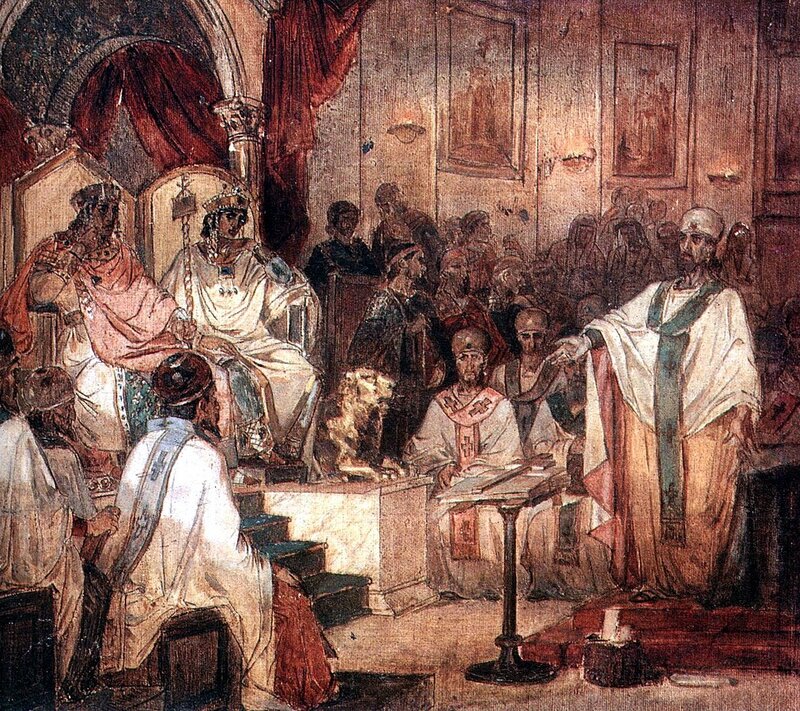
The Council of Chalcedon (451 AD) resolved a Christological crisis but reshaped the political map of Christendom. How it destroyed Alexandria, elevated the papacy, and set the stage for the Great Schism.
The Arian Heresy Explained: What Arius Taught and Why the Church Condemned It
What is Arianism? A Catholic guide to the Arian heresy — what Arius actually taught, why it was condemned at Nicaea, and why the debate over Christ's divinity still matters.
Stay Informed
Get new writing on faith, law, and service delivered to your inbox.
No spam. Unsubscribe anytime.