The Chalcedonian Definition: What the Council Actually Declared About Christ
On This Page
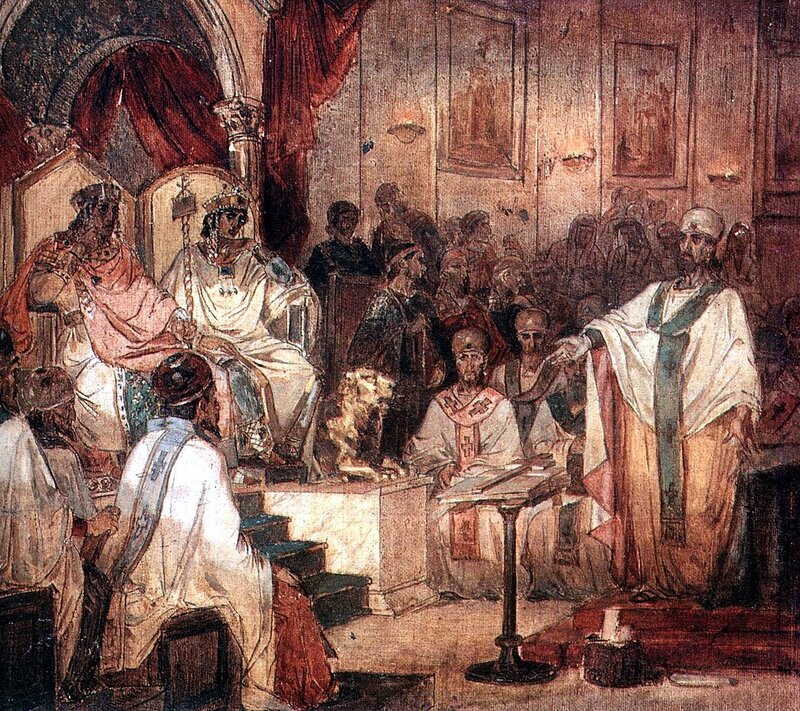
The Chalcedonian Definition stands as one of Christianity’s most important and most misunderstood theological statements. Proclaimed at the Council of Chalcedon in 451 AD, this ecumenical formula attempted to resolve the deepest question of Christian faith: who exactly is Jesus Christ? Is he fully God? Fully human? Both? And if both, how do these natures relate to one another in the single person we call Christ?
Nearly 1,600 years later, the Definition remains the touchstone of Christological orthodoxy in Catholicism, Orthodoxy, and most Protestant traditions. Yet its elegant formula—particularly its four distinctive negative adverbs—continues to perplex theologians and lay believers alike. This essay explores what Chalcedon actually declared, why that declaration was necessary, and what it has meant for Christian theology ever since.
What the Chalcedonian Definition Says
The Definition itself is remarkably concise. After condemning various heresies, the assembled bishops proclaimed:
We, then, following the holy Fathers, all with one consent, teach men to confess one and the same Son, our Lord Jesus Christ, the same perfect in Godhead and also perfect in manhood; truly God and truly man, of a reasonable soul and body; consubstantial with the Father according to the Godhead, and consubstantial with us according to the Manhood; in all things like unto us, without sin; begotten before all ages of the Father according to the Godhead, and in these latter days, for us and for our salvation, born of the Virgin Mary, the Mother of God, according to the Manhood; one and the same Christ, Son, Lord, Only-begotten, to be acknowledged in two natures, without confusion, without change, without division, without separation; the distinction of natures being by no means taken away by the union, but rather the property of each nature being preserved, and concurring in one Person and one Subsistence, not parted or divided into two persons, but one and the same Son, and only begotten, God the Word, the Lord Jesus Christ.
Text follows the translation in Philip Schaff, Creeds of Christendom, Vol. II, with minor modernizations.
This is dense theological language, but the core claim is straightforward: Christ is one person (unus et idem Christus) existing in two complete natures—divine and human—without mixing them together, without changing them, without dividing the person, and without separating the natures from one another. It is this paradox—genuine unity and genuine duality held in tension—that defines Chalcedon’s lasting contribution to Christian thought.
The Christological Crisis: Why Chalcedon Was Necessary
To understand why the bishops gathered at Chalcedon felt compelled to speak so carefully about Christ’s natures, we must understand the theological chaos that preceded them.
The Council of Nicaea in 325 AD had settled the first great Christological question: Was the Son truly divine, or merely a created being subordinate to the Father? Nicaea answered firmly that the Son was homoousios—of one substance with the Father. Christ was fully God.
But Nicaea’s victory over Arianism created a new problem: if Christ is fully God, and we also confess him as fully human, how do these two natures coexist in one person without contradiction? Two great heresies emerged to answer this question, each in a direction that the Church ultimately rejected.
Nestorianism, associated with Nestorius, Archbishop of Constantinople, seemed to solve the problem by keeping the natures rigorously separate. Nestorius taught that Christ consisted essentially of two distinct realities—a divine Son of God and a human son of Mary—loosely conjoined but not truly unified into a single person. The Godhead and the manhood were, on this view, like two actors playing a role—present together but not genuinely united. This approach protected the integrity of each nature, but at the cost of fragmenting Christ’s personhood. It also created the pastoral problem that seemed to divide Christ’s experiences: did the divine Logos suffer? Did the human Jesus possess genuine divine knowledge? If the natures were truly separate, these questions became nonsensical.
Eutychianism, represented by Eutyches, an archimandrite (monastic superior) of Constantinople who for thirty years governed a monastery of some three hundred monks outside the city walls, took the opposite path. Unable to see how two complete natures could coexist in one person without some kind of mixture or synthesis, Eutyches taught that Christ’s human nature was absorbed into his divine nature, or at least so transformed by divine power that it became something intermediate between human and divine. After the Incarnation, there was no longer a truly human nature, only a divine-human hybrid. This preserved the unity of the person but destroyed the completeness of the human nature. If Christ was not truly human, then what did his Incarnation accomplish? How could he be the perfect human offering to God? How could his human struggle against temptation, his growth in wisdom, his death—how could any of these be real if his humanity was merely apparent?
Both heresies failed, but in opposite ways. Nestorianism divided the person; Eutychianism confused the natures. Chalcedon’s task was to find a middle path that could affirm both the real unity of Christ’s personhood and the real completeness of each of his two natures.
Pope Leo’s Tome: The Theological Foundation
Before the Council convened, Pope Leo I had already provided the theological framework that would shape its definition. His Tome to Flavian (449 AD) offered a classical formulation of how the two natures could coexist without confusion or change. Leo insisted that each nature retained its own proper operations and characteristics. The divine nature did not become human; the human nature did not become divine. Yet both natures belonged to the single person of the Word incarnate.
Leo’s language became the template for Chalcedon. When the bishops at Chalcedon read Leo’s Tome aloud, they reportedly cried out, “Peter has spoken thus through Leo!” This was not mere deference to Rome, though papal authority certainly mattered. Rather, Leo had articulated with unparalleled clarity how one could hold together truths that seemed contradictory: the unchangeability of God and genuine human change in Christ; the impassibility of the divine nature and real suffering in Christ’s human body.
The Definition essentially enshrines Leo’s theology in conciliar form, giving it ecumenical authority.
The Four Negations: Precision Through Negation
The theological genius of Chalcedon lies in its four negative adverbs, which define the relationship between Christ’s two natures by ruling out false options:
Without confusion (asynchytōs)—The two natures do not blend together or merge into a third thing. The divine does not become humanized, nor the human divinized. Eutychianism is excluded. Each nature retains its distinct characteristics. The divine nature remains impassible (incapable of suffering); the human nature remains limited in knowledge and power. Yet they are united in the one person.
Without change (atreptōs)—The two natures do not transform one another. The divine nature does not undergo any alteration through the Incarnation. God does not become less divine. The human nature is not metamorphosed into something other than human. This negation guards against pantheistic confusion and ensures that the Incarnation is an act of divine condescension, not divine transformation.
Without division (adiairetōs)—The two natures do not split apart. Christ is not two persons. The actions and experiences of either nature belong to the one unified subject. When we say “Christ died,” we do not mean merely the human part died while the divine part remained untouched. The one person—who exists in both natures—underwent death in his human nature. Nestorianism is excluded.
Without separation (achōristōs)—The two natures cannot be separated or isolated from one another. They belong together in the unity of Christ’s person. We cannot speak of the Word independent of the human nature he assumed, as if the Incarnation were a temporary costume to be removed. The union is permanent and integral.
These negations are not merely logical; they are existentially profound. They preserve the reality of Christ’s humanity against docetic or Eutychian minimalism, while preserving the sovereignty and immutability of God against any compromise with pantheism or process theology. They answer the pastoral need of Christian faith: Christ must be whole—fully God to merit worship and obedience, fully human to be our Redeemer and our model.
Lasting Significance for Catholic, Orthodox, and Protestant Christianity
The Chalcedonian Definition became the litmus test of orthodox Christology across all three major Christian traditions.
For Catholicism, Chalcedon provided the dogmatic foundation for reflection on Christ’s person. The Scholastic theologians—especially Thomas Aquinas—built their entire doctrine of the Incarnation on Chalcedonian principles. Thomas demonstrated how Christ could possess a complete human soul while being the divine Word, how his human will could be subordinate to his divine will yet genuinely free. The Definition also underwrote Catholic Mariology; if Christ is one person in two natures, then Mary’s title Theotokos (Mother of God) is not merely acceptable but necessary—she gave birth to the person of the Word, even if not to his divine nature as such.
Orthodox Christianity made Chalcedon even more central, though often with nuance. The icon tradition depends on Chalcedonian Christology; if the Word truly assumed human flesh, then the flesh can be depicted, and icons are legitimate expressions of Christian devotion. The liturgy also presupposes the Definition—the deification (theosis) of humanity through Christ requires genuine presence of God in genuine humanity.
Protestantism inherited Chalcedon without always recognizing how deeply. Luther affirmed the Definition even as he attacked medieval theology. The Reformation’s insistence on Christ’s humanity—his struggle, his learning, his development—actually reinforces Chalcedonian anti-Eutychian sensibilities. Modern Protestant systematic theologians continue to reckon with Chalcedon, though in markedly different ways. Karl Barth explicitly affirmed the Chalcedonian definition as “factually right and necessary,” creatively reinterpreting its categories within his own dogmatic framework. Wolfhart Pannenberg, by contrast, subjected the two-natures tradition to more radical revision, questioning the classical Christological procedure “from above” and arriving at conclusions that many scholars place outside Chalcedonian parameters even where he affirms Christ’s genuine divinity. Contemporary figures continue to work within, alongside, and sometimes against the Definition, testifying to its enduring centrality in Christological debate.
The Miaphysite Question and Modern Ecumenical Dialogue
Not all Christians accepted Chalcedon. The Oriental Orthodox churches—the Coptic, Armenian, and Syrian Orthodox—rejected the Definition, not because they embraced Eutychianism, but because they feared it opened a door to Nestorianism. They preferred to speak of “one nature of the Word incarnate” (miaphysis) rather than “two natures in one person.” This was not straightforward heresy; the miaphysites were trying to protect the unity of Christ and the efficacy of his redemptive power. Their negations were different from their critics’ negations.
For centuries, this disagreement severed communions and created lasting ecclesial divisions. But in recent decades, significant progress has occurred. The Vatican and the Coptic Orthodox Church issued a Common Declaration (1973) confessing a shared Christological faith in carefully neutral language, while acknowledging that “theological differences, nourished and widened by non-theological factors” had grown since 451. Subsequent agreements went further: the 1984 Common Declaration between John Paul II and Syrian Patriarch Ignatius Zakka I Iwas stated that the divisions “in no way affect or touch the substance of their faith, since these arose only because of differences in terminology and culture.” Both sides, it turned out, rejected Nestorianism and Eutychianism. When theologians sat down to translate back and forth between Chalcedonian (two natures, one person) and miaphysite (one nature—meaning one reality—of the incarnate Word) language, they discovered remarkable convergence.
This ecumenical development illustrates that Chalcedon’s definitions, while infallibly true, are primarily apophatic in character—defining by exclusion rather than exhaustive positive description. The Definition rules out Nestorianism and Eutychianism decisively, and subsequent councils (Constantinople II in 553 and Constantinople III in 681) built upon its foundation with further positive elaboration. Within these dogmatic boundaries, legitimate theological schools continue to explore precisely how the unity and duality of Christ’s being should be conceived and articulated.
Conclusion
The Chalcedonian Definition, with its famous four negations, represents one of the Church’s finest theological achievements. It did not explain the mystery of the Incarnation—mystery remains. Rather, it drew the boundaries of orthodox reflection on that mystery. It said: you may speculate about how Christ’s two natures unite, but you may not dissolve either the unity or the duality. You may explore the implications, but not at the cost of making Christ less than fully divine or less than fully human.
For Catholic faith, Chalcedon remains normative. Yet the Definition also demonstrates the humility required of theology: having spoken so carefully about the deepest truth, the bishops acknowledged that they had not exhausted it. The Incarnation continues to astonish and perplex the faithful. Chalcedon simply marks the ground on which that astonishment and perplexity may safely occur.
- ^ The Greek adverbs—*asynchytōs*, *atreptōs*, *adiairetōs*, *achōristōs*—were drawn primarily from prior Christological debates, especially the writings of Cyril of Alexandria, who used *asynchytōs* and *atreptōs* repeatedly against Eutychianism, and *adiairetōs* as a key term against Nestorianism. *Achōristōs* appears in Gregory of Nazianzus's *Letter to Cledonius* and in Theodoret of Cyrus. While the apophatic method of defining by negation has structural parallels with Neoplatonic negative theology, the terms themselves are standard alpha-privative Greek formations from common verbal roots, not technical philosophical jargon borrowed from any particular school.
- ^ Thomas Aquinas, *Summa Theologiae* III, questions 2-7, offers the classic medieval Catholic development of Chalcedonian Christology, demonstrating how Christ's human will could be entirely subordinate to his divine will yet genuinely human and free.
- ^ See the Common Declaration of His Holiness Paul VI and His Holiness Patriarch Amba Shenouda III (May 10, 1973), which confesses a shared Christological faith using carefully neutral language while also acknowledging "theological differences, nourished and widened by non-theological factors" since 451. The stronger claim that the disagreement was "one of language rather than substance" more precisely describes the 1984 Common Declaration between John Paul II and Syrian Patriarch Ignatius Zakka I Iwas, which states the divisions "in no way affect or touch the substance of their faith, since these arose only because of differences in terminology and culture."

Garrett Ham
Garrett Ham is an attorney, military veteran, and holds a Master of Divinity from Yale Divinity School. He writes from Northwest Arkansas on theology, law, and service.
More about Garrett →Related Posts
The Council of Chalcedon (451): How Political Rivalry Reshaped Christendom
The Council of Chalcedon (451 AD) resolved a Christological crisis but reshaped the political map of Christendom. How it destroyed Alexandria, elevated the papacy, and set the stage for the Great Schism.
The First Council of Nicaea: What It Decided and Why It Matters
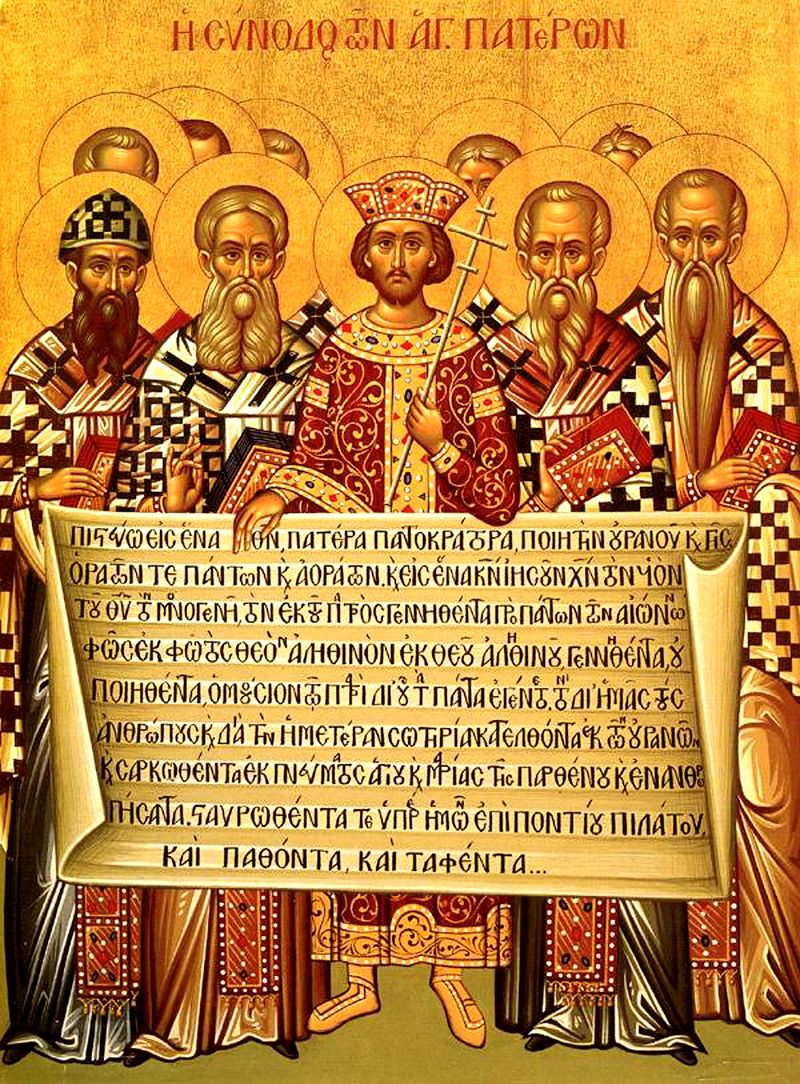
What happened at the First Council of Nicaea in 325 AD? A Catholic examination of the Arian crisis, the meaning of homoousios, and why the Nicene Creed still defines Christian orthodoxy.
Five Heresies That Misread John 1 — and How the Church Answered Them
Five major heresies misread John 1: Arianism, Modalism, Adoptionism, Ditheism, and Docetism. Learn what each taught, where they went wrong, and how the Church's response was anchored in the text.
Stay Informed
Get new writing on faith, law, and service delivered to your inbox.
No spam. Unsubscribe anytime.