The Parallels Between Cana and Calvary in John's Gospel
On This Page
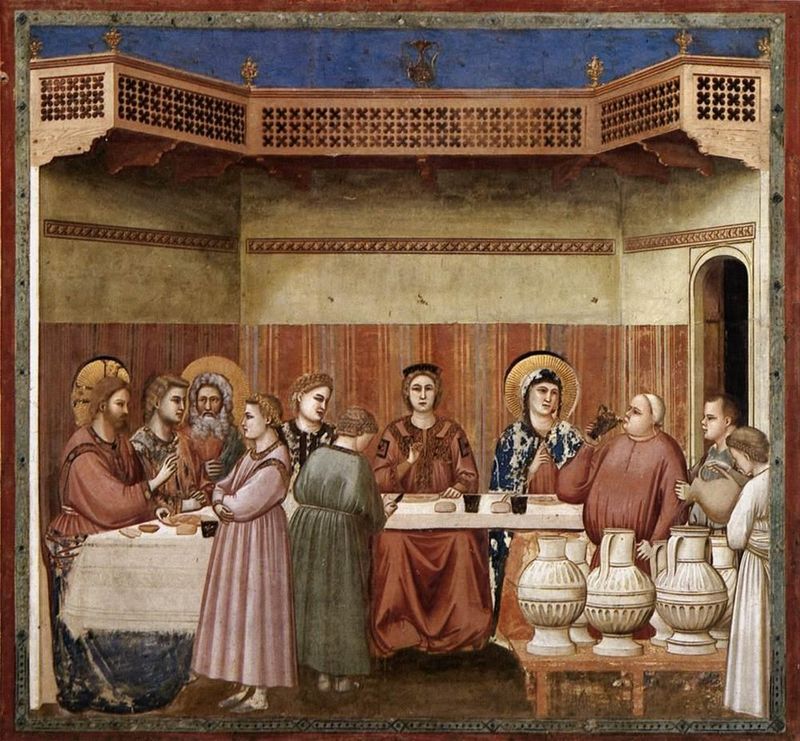
The mother of Jesus appears as an active character only at the wedding at Cana (2:1-12) and at the foot of the cross (19:25-27). She is not named or addressed in the intervening chapters, though Jesus’ opponents refer obliquely to his known parentage in 6:42. Her narrative disappearance from the story — as distinct from these incidental references — is itself a literary choice.
This is not an accident. The parallels between Cana and Calvary are too numerous, too precise, and too structurally significant to be coincidental. Taken together, these two passages form a literary inclusio — a framing device in which the beginning and end of a narrative unit mirror each other — that brackets the entire public ministry of Jesus in John’s Gospel. Everything that happens between them is meant to be read in their light.
I catalogued several of these parallels in my earlier analysis of the mother of Jesus as a named source in John. What follows is an expanded treatment of each parallel, drawing on the work of Brown, Beasley-Murray, Keener, Pate, Mary L. Coloe, and Francis J. Moloney, among others.
The Presence of the Mother
The most basic parallel is also the most important: the mother of Jesus is there at the beginning, and she is there at the end.
At Cana, she appears immediately: “the mother of Jesus was there” (2:1, καὶ ἦν ἡ μήτηρ τοῦ Ἰησοῦ ἐκεῖ). At Calvary, she appears standing beside the cross: “standing near the cross of Jesus were his mother” (19:25, εἱστήκεισαν δὲ παρὰ τῷ σταυρῷ τοῦ Ἰησοῦ ἡ μήτηρ αὐτοῦ). The Evangelist never names her — she is always “the mother” or “the mother of Jesus” — and this consistent designation across both scenes reinforces the intentional pairing.1
Her absence from the intervening chapters is itself a literary choice. As Keener observes, the Evangelist was not unaware that the mother continued to accompany Jesus — indeed, 2:12 tells us she traveled with him to Capernaum — but the narrative omits her precisely so that her reappearance at Calvary will be conspicuous.2 The reader is meant to recall Cana the moment the mother reappears. Coloe argues that this structural pairing is one of the Evangelist’s primary literary strategies, creating a “narrative arc” that connects Jesus’ first sign to his final hour.3
This is no minor literary detail. The mother’s presence at both scenes establishes the frame within which the entire ministry must be interpreted. She witnessed the first revelation of glory (2:11) and the final glorification on the cross. No other character in John’s Gospel serves this precise function. (For a broader discussion of women’s roles in the Fourth Gospel, see my analysis of women in the Gospel of John.)
Messianic Symbolism: Wedding and Kingship
The settings of Cana and Calvary appear to be opposites — a joyful wedding feast and a Roman execution. But both scenes are saturated with messianic symbolism, and the Evangelist exploits this contrast to make a theological argument about what messiahship actually means.
At Cana, Jesus attends a wedding. In the Hebrew prophetic tradition, the wedding feast is one of the central images for the messianic age. Isaiah 54:4-8 portrays God as a husband who restores his bride Israel after a period of abandonment. Isaiah 62:4-5 declares that the land will be called “married” (בְּעוּלָה) and that God will rejoice over his people “as the bridegroom rejoices over the bride.” Hosea 2:19-20 uses the same imagery. The rabbis, too, expected the messianic banquet to feature an abundance of wine.4 When Jesus provides wine at a wedding, the Evangelist is signaling that the messianic age has arrived.
At Calvary, however, the messianic imagery takes a radically different form. Jesus is “lifted up” (ὑψόω), a term John uses with deliberate double meaning throughout the Gospel (3:14; 8:28; 12:32-34). The word refers both to physical elevation on the cross and to exaltation in glory. He is crowned — but with thorns. He is proclaimed king — but the inscription is written by Pilate, in three languages, over the objection of the religious authorities (19:19-22). Beasley-Murray notes that in the Johannine passion narrative, “the crucifixion is Jesus’ triumph,” and the details of the scene — the royal title, the seamless garment reminiscent of the high priestly robe, the sovereignty Jesus displays throughout — all support this reading.5
Both scenes, then, present messiahship. But they present it in inverted form. At Cana, the messianic age arrives with abundance and celebration. At Calvary, the messianic king is enthroned on a cross. The Evangelist’s argument is that these are not two different things but the same reality, viewed from different angles. The abundance at Cana only makes sense because of Calvary; the suffering at Calvary only makes sense because it is the fulfillment of what Cana began.
Drink and Thirst
The theme of drink runs through both passages with a precision that repays close attention.
At Cana, the crisis is a shortage of wine. The mother alerts Jesus: “They have no wine” (οἶνον οὐκ ἔχουσιν, 2:3). The crowd is thirsty, and Jesus acts to provide. His provision is not merely adequate — it is extravagant. The steward of the feast marvels that the host has kept “the good wine” (τὸν καλὸν οἶνον) until last, when the usual practice was to serve the best wine first and the cheaper wine after guests had drunk freely (2:10). Six stone jars holding twenty to thirty gallons each yield somewhere between 120 and 180 gallons of the finest wine. The scale is deliberate. This is not a host restocking his cellar; it is a sign of messianic abundance.6
At Calvary, the situation is reversed with a specificity that can only be intentional. It is Jesus who is thirsty (διψῶ, 19:28), and it is Jesus who asks for a drink. What he receives is not the best wine but the worst: ὄξος, a cheap, sour wine — essentially vinegar diluted with water — that was the standard drink of Roman soldiers.7 Beasley-Murray notes that the Hebrew term חמץ (homes) designated vinegar, and the Greek ὄξος denoted a drink that was popular among soldiers precisely because of its low quality and low cost.8
The reversal is total. At Cana, a thirsty crowd receives the finest wine from Jesus. At Calvary, a thirsty Jesus receives the cheapest wine from the crowd. At Cana, he provides abundance. At Calvary, he receives deprivation. Grassi catalogues this as one of the most striking of the parallels, and it is difficult to read the two passages side by side without concluding that the Evangelist composed them — or at least arranged them — to mirror each other.9
This reversal also picks up a broader Johannine theme. Throughout the Gospel, Jesus is the one who gives drink to the thirsty. He offers “living water” to the Samaritan woman (4:10-14). He cries out at the Festival of Tabernacles, “Let anyone who is thirsty come to me and drink” (7:37). The one who provides drink for the world is, at the moment of his death, the one in need of drink. The theology of the incarnation — the Word become flesh (1:14) — reaches its most concrete expression in this detail. (For a fuller treatment of John’s incarnational theology beginning with the Prologue, see my analysis of John 1:1.)
Substance Exchange: Water, Wine, Blood
Closely related to the theme of drink is a pattern of substance exchange that operates across the two scenes.
At Cana, Jesus commands the servants to fill six stone jars with water (2:7). They fill them to the brim (ἕως ἄνω). When the steward draws from the jars, the water has become wine (2:9). The direction of the transformation is clear: water goes in, wine comes out.
At Calvary, the direction reverses. Jesus receives wine — the cheap vinegar-wine placed on a hyssop branch and lifted to his lips (19:29). After he dies, a soldier pierces his side with a spear, “and at once blood and water came out” (καὶ ἐξῆλθεν εὐθὺς αἷμα καὶ ὕδωρ, 19:34). Wine goes in, and blood and water come out.10
The Evangelist treats this detail with extraordinary seriousness. Immediately after recording the flow of blood and water, he inserts a solemn attestation: “He who saw it has borne witness — his testimony is true, and he knows that he is telling the truth — so that you also may believe” (19:35). Whatever else is happening in this scene, the Evangelist wants the reader to know that an eyewitness verified it.
The eucharistic overtones are difficult to miss. Brown and Moloney both observe that the transformation of water into wine at Cana and the outpouring of blood and water at Calvary together constitute a sacramental arc.11 The wine at Cana anticipates the blood of the cross; the water at Cana anticipates the water that flows from Jesus’ side. Coloe pushes this further, arguing that the Cana-Calvary inclusio is itself a eucharistic frame: the entire ministry of Jesus, from first sign to death, is enclosed within images of wine and blood.12
At the same time, the blood and water serve the Evangelist’s anti-docetic purpose. The ancient humoral understanding, articulated by Hippocrates and systematized by Galen, held that the human body was constituted by blood and various aqueous fluids. The flow of blood and water from Jesus’ side is therefore an emphatic assertion of his real, physical death — the death of a genuine human body, not the dissolution of a phantom.13
”My Hour Has Not Yet Come” / “It Is Finished”
Perhaps the most theologically significant parallel between Cana and Calvary is the theme of “the hour.”
At Cana, when the mother informs Jesus about the wine, he responds: “Woman, what concern is that to you and to me? My hour has not yet come” (τί ἐμοὶ καὶ σοί, γύναι; οὔπω ἥκει ἡ ὥρα μου, 2:4). The phrase “my hour” (ἡ ὥρα μου) is one of the Gospel’s most important theological terms, and it appears here for the first time. (For a discussion of the address “woman,” see my analysis of why Jesus called his mother “woman”.)
At Calvary, that hour has finally arrived. Jesus declares τετέλεσται — “It is finished” (19:30) — and dies. The perfect passive tense of τελέω indicates not merely cessation but completion. The thing toward which the entire narrative has been moving has reached its appointed end.
The entire Gospel of John stretches between these two temporal markers. “My hour has not yet come” at Cana is the starting pistol; “It is finished” at Calvary is the finish line. Between them, the Evangelist traces a relentless trajectory toward the hour of glorification, and the reader is reminded of this trajectory at every turn: “His hour had not yet come” (7:30); “His hour had not yet come” (8:20); “The hour has come for the Son of Man to be glorified” (12:23); “Before the festival of the Passover, Jesus knew that his hour had come to depart from this world” (13:1); “Father, the hour has come” (17:1).14
Moloney describes this as the “hour trajectory” — a narrative arc that gives the Gospel its fundamental dramatic structure. The reader who encounters the “not yet” at Cana is placed in a state of anticipation that is not resolved until the “it is finished” at Calvary. Everything in between — the signs, the discourses, the controversies, the farewell — exists within this tension.15
The mother of Jesus is the only character who is present at both poles of this arc. She hears the “not yet” at Cana, and she witnesses the fulfillment at Calvary. The Evangelist’s structural decision to place her at both endpoints is, as I have argued elsewhere, central to the Gospel’s claim of authority. She is the witness whose testimony spans the full distance of the hour.
The Mother’s Command and Christ’s Command
The last words the mother of Jesus speaks in any Gospel are recorded at Cana: “Do whatever he tells you” (ὅ τι ἂν λέγῃ ὑμῖν ποιήσατε, 2:5). She addresses this command to the servants, but its position in the narrative — the final words she will ever speak in the canonical Gospels — gives it a weight that extends beyond the immediate context.
At Calvary, Jesus speaks to his mother for the last time. But now the roles are reversed. At Cana, the mother gave the command: “Do whatever he tells you.” At Calvary, Jesus gives the command: “Woman, behold your son” (γύναι, ἴδε ὁ υἱός σου, 19:26), followed by “Behold your mother” (ἴδε ἡ μήτηρ σου, 19:27).
The reversal is significant. At Cana, the mother exercises initiative. She identifies the problem, brings it to Jesus, and — despite his enigmatic response — instructs the servants to obey. She pushes him toward his first sign. Brown reads this as a form of discipleship that falls short of full incorporation, arguing that the mother is not fully received into the community of disciples until Jesus commends her to the Beloved Disciple at the cross.16 But this seems to underestimate what is happening at Cana. The mother does not merely ask; she acts with confidence that he will respond. And he does. Her initiative sets the entire ministry in motion.
At Calvary, the initiative shifts to Jesus. It is he who speaks. It is he who establishes new relationships. The mother who once commanded now receives a command. The one who pushed her son toward the hour now stands within it, receiving from him a new son and a new vocation.
Pate observes that this transfer of initiative corresponds to the arrival of the hour. Before the hour, the mother acts; within the hour, Christ acts. The hour is the hinge on which the entire narrative turns, and the shift from the mother’s command at Cana to Christ’s command at Calvary marks the moment at which the purpose toward which she pushed him is finally accomplished.17
Independence from Synoptic Tradition
A point often overlooked in discussions of these parallels is that both the wedding at Cana and the commendation of the mother at the cross are unique to John. Neither episode appears in Matthew, Mark, or Luke.
This independence from the Synoptic tradition is significant for several reasons. First, it means both episodes derive from the same source tradition — presumably the Johannine community’s own access to eyewitness testimony. Brown argues that the Cana miracle and the commendation at Calvary are “twin traditions” that entered the Fourth Gospel from the same stream of tradition, reinforcing their connection as paired scenes.18 Although Bultmann assigned the Cana narrative to his Signs Source (Semeia-Quelle) and the Passion material to a distinct Passion Narrative source, he recognized that the evangelist wove these traditions into a unified theological composition — a point that, whatever one makes of Bultmann’s source-critical conclusions, reinforces the case that the parallels between the two scenes are deliberate.19
Second, the absence of both episodes from the Synoptic Gospels makes it difficult to attribute their parallels to editorial harmonization. The Evangelist was not working from a template. The symmetry between Cana and Calvary is not borrowed from earlier sources but is intrinsic to the Johannine tradition itself. This strengthens the case that the parallels are deliberate — that the Evangelist either received these traditions already connected or connected them himself as part of a unified theological composition.
Third, the independence of these traditions enhances the significance of the mother’s role. In the Synoptic Gospels, Jesus’ relationship with his mother is complicated at best. Mark 3:31-35 and its parallels depict Jesus as distancing himself from his biological family in favor of his spiritual family. In John, no scene precisely parallel to Mark 3:31-35 occurs; John does not record Jesus gesturing to his disciples and declaring them his true family. Some scholars nonetheless read John 2:4 as involving a degree of relational distancing, and the contrast with the unbelieving brothers in 7:5 provides its own version of the Synoptic tension. The difference is that John never resolves this by replacing his mother — he elevates her. She appears at the two most important moments in the narrative — the first sign and the hour of glorification — and she is commended to the care of the Beloved Disciple in an act that elevates her status rather than diminishing it.20
What the Parallels Mean
The density and precision of these parallels reveal something fundamental about the nature of John’s Gospel. This is not a loosely assembled collection of traditions. It is a carefully constructed theological argument.
The inclusio formed by Cana and Calvary provides the Gospel with its basic narrative architecture. The first sign and the final hour are not merely two events in a chronological sequence; they are the load-bearing walls of the structure. The Evangelist composed or arranged his material so that the beginning and the end would mirror each other, and so that everything between them would be read as movement from the one to the other.
Coloe describes this as a “chiastic” design in which the Gospel’s two endpoints create a frame of meaning for the material they enclose.21 Moloney argues more broadly that the entire Gospel can be read as a journey from “not yet” to “it is finished,” and that the parallels between Cana and Calvary are the clearest evidence of this design.22
The mother’s presence at both endpoints is essential to this architecture. She is not incidental to the literary design; she is part of it. Her presence at Cana marks the beginning of the journey toward the hour. Her presence at Calvary marks the hour’s arrival. The Evangelist places her at both poles because her testimony — the testimony of the one who was there at the beginning and at the end — is the testimony that underwrites the Gospel’s claim to reliability.
The parallels between Cana and Calvary are, therefore, not merely a catalogue of literary curiosities. They are the key to reading John’s Gospel as the Evangelist intended it to be read: as a unified narrative moving from sign to glory, from water to blood, from “not yet” to “it is finished,” with the mother of Jesus as the witness who frames it all.
Frequently Asked Questions
What are the parallels between Cana and the crucifixion in John?
The parallels between the wedding at Cana (John 2:1-12) and the crucifixion (John 19:25-37) include the following: the mother of Jesus is present at both events and at no other point in the Gospel; both scenes involve messianic symbolism (wedding feast and royal enthronement); at Cana a thirsty crowd receives the best wine from Jesus while at Calvary a thirsty Jesus receives cheap wine; at Cana water becomes wine while at Calvary wine is received and blood and water flow out; at Cana Jesus says “my hour has not yet come” while at Calvary he says “it is finished”; at Cana the mother commands the servants while at Calvary Jesus commands the mother; and both episodes are unique to John’s Gospel, independent of the Synoptic tradition.
Why does Jesus’ mother appear only at Cana and the cross in John’s Gospel?
The Evangelist places the mother of Jesus at these two endpoints to create a literary inclusio — a framing device that brackets Jesus’ entire public ministry. Her presence at the first sign (Cana) and at the hour of glorification (Calvary) makes her the witness whose testimony spans the full arc of the narrative. This structural choice supports the Gospel’s claim of reliability: the Beloved Disciple, who took the mother into his household (19:27), had access to the one person who was present from beginning to end.
What does “my hour has not yet come” mean in John 2:4?
The phrase “my hour has not yet come” (οὔπω ἥκει ἡ ὥρα μου) refers to the hour of Jesus’ death, resurrection, and glorification — the climactic event toward which the entire Gospel moves. At Cana, the hour lies in the future. The phrase signals that the sign Jesus is about to perform will set him on the path toward that hour. The “hour” reappears throughout the Gospel (7:30; 8:20; 12:23; 13:1; 17:1) and reaches its fulfillment at the cross with the declaration τετέλεσται, “it is finished” (19:30).
Is the wedding at Cana symbolic?
Yes, on multiple levels. In the Hebrew prophetic tradition, the wedding feast symbolizes the messianic age (Isaiah 54:4-8; 62:4-5; Hosea 2:19-20). Jesus’ provision of abundant, high-quality wine at a wedding signals the arrival of that age. The transformation of water into wine carries eucharistic overtones that anticipate the blood poured out at the cross. And the setting of a wedding — a union of persons into a new family — foreshadows the new familial relationships Jesus will establish at Calvary when he commends his mother and the Beloved Disciple to each other.
Footnotes
-
The Evangelist’s practice of referring to the mother of Jesus without using her name is consistent across both passages and has generated considerable scholarly discussion. See Raymond E. Brown, The Gospel According to John, ed. William Foxwell Albright and David Noel Freedman, 2 vols., The Anchor Bible (New York: Doubleday, 1966), 1:98; Craig S. Keener, The Gospel of John: A Commentary, 2 vols. (Peabody, MA: Hendrickson, 2003), 1:501-02. ↩
-
Keener, 2:1143; see also Ritva H. Williams, “The Mother of Jesus at Cana: A Social-Science Interpretation of John 2:1-12,” The Catholic Biblical Quarterly 59, no. 4 (October 1997): 690-92. ↩
-
Mary L. Coloe, “The Mother of Jesus: A Woman Possessed,” in Character Studies in the Fourth Gospel: Narrative Approaches to Seventy Figures in John, ed. Steven A. Hunt, D. Francois Tolmie, and Ruben Zimmermann, WUNT 314 (Tubingen: Mohr Siebeck, 2013), 202-03. ↩
-
Brown, John, 1:104; D. A. Carson, The Gospel According to John, ed. D. A. Carson, The Pillar New Testament Commentary (Leicester, England: Apollos, 1991), 172; C. Marvin Pate, The Writings of John: A Survey of the Gospel, Epistles, and Apocalypse (Grand Rapids, MI: Zondervan, 2011), 63-64; Joseph A. Grassi, “The Role of Jesus’ Mother in John’s Gospel: A Reappraisal,” The Catholic Biblical Quarterly 48, no. 1 (January 1986): 77. ↩
-
George R. Beasley-Murray, John: Revised Edition, ed. Peter H. Davids, Word Biblical Commentary (Nashville: Thomas Nelson, 1999), 344; see also Keener, 2:1133; Carson, 171. ↩
-
Brown, John, 1:100-01; Beasley-Murray, 34; Francis J. Moloney, The Gospel of John, Sacra Pagina 4 (Collegeville, MN: Liturgical Press, 1998), 66-67. ↩
-
Beasley-Murray, 351; Leon Morris, The Gospel According to John, ed. Gordon D. Fee, The New International Commentary on the New Testament (Grand Rapids, MI: Eerdmans, 1995), 719; Carson, 620; Keener, 2:1147. ↩
-
Beasley-Murray, 351. ↩
-
Grassi, 69. ↩
-
Grassi, 69; Keener, 2:1147. The directional symmetry — water in, wine out at Cana; wine in, blood and water out at Calvary — is striking and appears to be fully deliberate. ↩
-
Brown, John, 2:949-50; Moloney, 504-06. Moloney is particularly attentive to the sacramental dimensions of the Cana-Calvary connection, reading the two scenes as framing the entire Gospel with eucharistic imagery. ↩
-
Coloe, 203-04. ↩
-
Beasley-Murray, 355-57; Carson, 623-24; Udo Schnelle, Antidocetic Christology in the Gospel of John: An Investigation of the Place of the Fourth Gospel in the Johannine School, trans. Linda M. Maloney (Minneapolis: Fortress Press, 1992), 209-10. ↩
-
Beasley-Murray, 34-35; Lilly Nortje-Meyer, “The Mother of Jesus as Analytical Category in John’s Gospel,” Neotestamentica 43, no. 1 (2009): 133-34. The “hour” motif is one of the most studied features of Johannine theology. Its first appearance at Cana and its resolution at Calvary provide the narrative with its fundamental temporal architecture. ↩
-
Moloney, 75-76, 504. ↩
-
Raymond E. Brown, An Introduction to the New Testament (New York: Doubleday, 1997), 340. ↩
-
Pate, 63-65, 201-04. ↩
-
Brown, John, 1:101; see also Rudolf Bultmann, The Gospel of John: A Commentary, trans. G. R. Beasley-Murray, R. W. N. Hoare, and J. K. Riches, ed. G. R. Beasley-Murray (Philadelphia: The Westminster Press, 1971), 671. ↩
-
Bultmann, 671. On Bultmann’s Signs Source, see Bultmann, The Gospel of John, 113-14; on his Passion Narrative source, see ibid., 484n. ↩
-
Williams, 690; Bultmann, 672. Bultmann notes that “according to the Synoptics the Mother of Jesus does not appear at the cross, for in them she does not belong at all to the group of Jesus’ followers.” ↩
-
Coloe, 202-04. ↩
-
Moloney, 75-76. ↩

Garrett Ham
Garrett Ham is an attorney, military veteran, and holds a Master of Divinity from Yale Divinity School. He writes from Northwest Arkansas on theology, law, and service.
More about Garrett →Related Posts
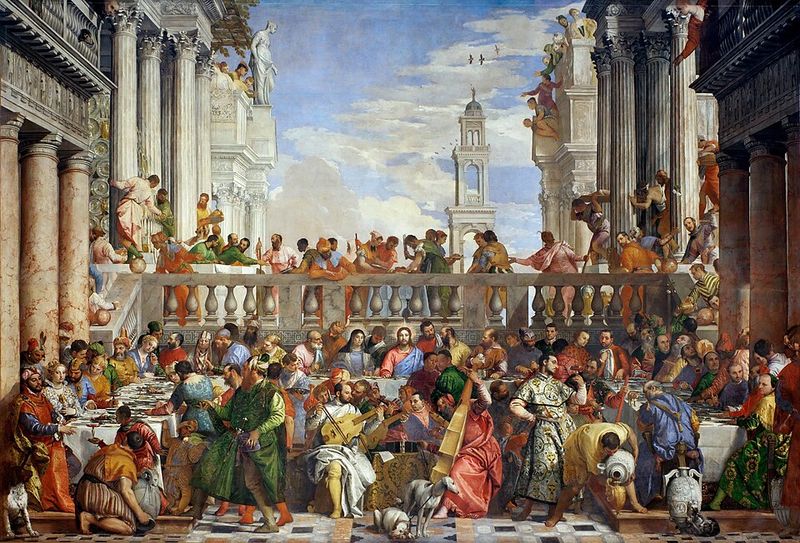
Why Did Jesus Call His Mother 'Woman'?
Jesus addresses Mary as 'woman' at Cana and from the cross — a choice that puzzles modern readers. Here's what the Greek actually means and why it matters for understanding John's Gospel.
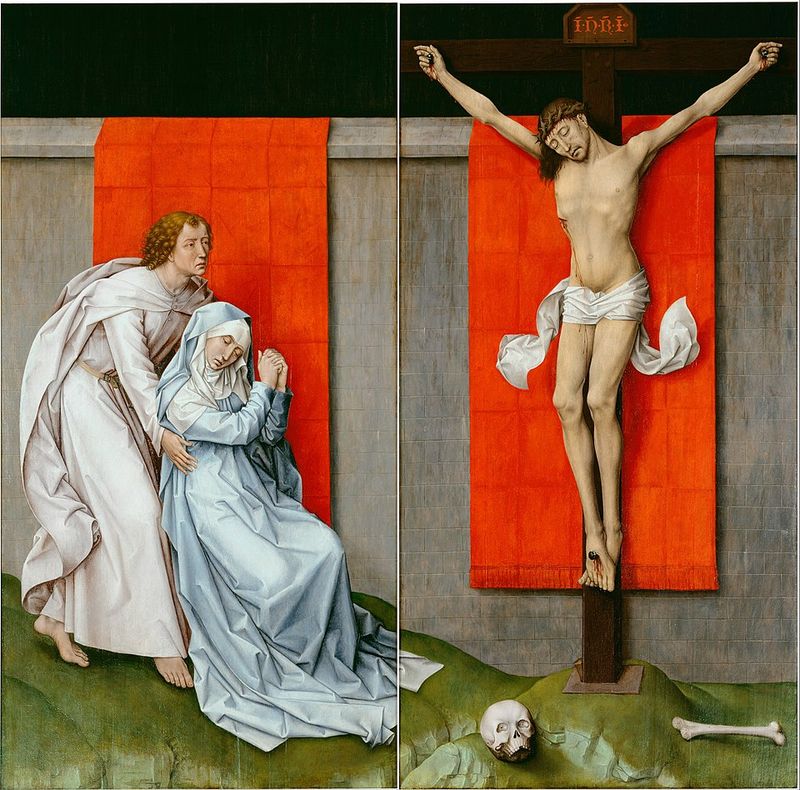
The Mother of Jesus as a Named Source in John
An analysis of John 19:26-27 arguing that Mary, the mother of Jesus, served as a named source for the Gospel of John. Based on a paper from Yale Divinity School.
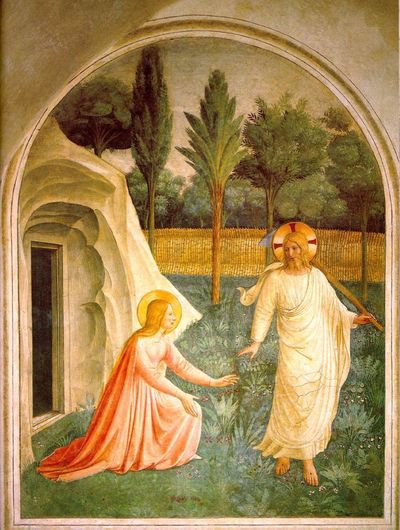
Women in the Gospel of John
From the mother of Jesus to Mary Magdalene, women play a more prominent role in John's Gospel than in any other. Here's a comprehensive analysis of every major female figure in the Fourth Gospel.
Stay Informed
Get new writing on faith, law, and service delivered to your inbox.
No spam. Unsubscribe anytime.