The Angel of the Lord: Divine Messenger, Theophany, or the Pre-Incarnate Son?
On This Page
Introduction
One of the strangest phenomena in the Hebrew Bible is a figure called the malʾak YHWH (מַלְאַךְ יְהוָה)—the Angel of the Lord, or more literally, “the messenger of Yahweh.” This figure appears repeatedly from Genesis to Zechariah, and what makes him so theologically charged is not simply that he delivers messages from God. Plenty of angels do that. What makes the malʾak YHWH unique is that he speaks as God in the first person, claims divine identity, receives worship that the human participants clearly believe is owed to God alone, exercises prerogatives like the forgiveness of sin—and yet is somehow sent by and even distinguished from the very God whose Name he bears.
This is not an occasional feature of a stray passage or two. It is a pattern that runs through the entire Old Testament, from Hagar’s encounter in the wilderness (Genesis 16) to the night visions of the prophet Zechariah. Scholars call it “the interchange” or “oscillation”—the narrator introduces the Angel, but then the figure speaks as YHWH, and the human interlocutor responds as though standing before God himself.1 The earliest Christian readers—Justin Martyr, Irenaeus, Tertullian—saw in this figure the pre-incarnate Son of God. Augustine famously challenged that consensus. Modern scholars have proposed everything from editorial interpolation to ancient Near Eastern diplomatic convention to divine hypostasis.
The question remains genuinely open, and the textual evidence is richer and stranger than most popular treatments suggest. What follows is a survey of what the Hebrew Bible actually says, how the major traditions have read it, and why this ancient question still matters for anyone who takes both Scripture and Christology seriously.
The Textual Phenomenon: What the Bible Actually Says
Before evaluating any theory, we need to see the data. The defining feature of malʾak YHWH passages is the seamless oscillation between “Angel” and “YHWH” within a single narrative. This is not occasional; it is the norm.
Genesis 16:7–13 (Hagar)
The malʾak YHWH finds Hagar fleeing Sarai and promises in the first person, “I will greatly increase your offspring” (v. 10)—a promise that only God can make. Hagar then names “YHWH who spoke to her” as El-roi (אֵל רֳאִי), “the God who sees me” (v. 13). The narrator confirms Hagar understood herself to have seen God, not merely an envoy. No distinction between the Angel and YHWH is drawn—the identification is seamless.2

Genesis 22:11–18 (The Akedah)
At the climax of the binding of Isaac, the malʾak YHWH calls from heaven to halt the sacrifice, saying, “Now I know that you fear God, since you have not withheld your son… from Me” (v. 12). The speaker claims to be the recipient of Abraham’s obedience—a divine prerogative. Abraham names the site “YHWH-yireh” (“Yahweh will provide”), indicating he understood the voice as Yahweh’s.3
Genesis 31:11–13 (Jacob’s Dream)
The malʾak ha-Elohim (מַלְאַךְ הָאֱלֹהִים, “angel of God”) speaks to Jacob in a dream and self-identifies: “I am the God of Bethel, where you anointed a pillar” (v. 13). This is the starkest identification in the entire tradition: the angelic figure flatly declares himself to be God.4
Exodus 3:2–6 (The Burning Bush)
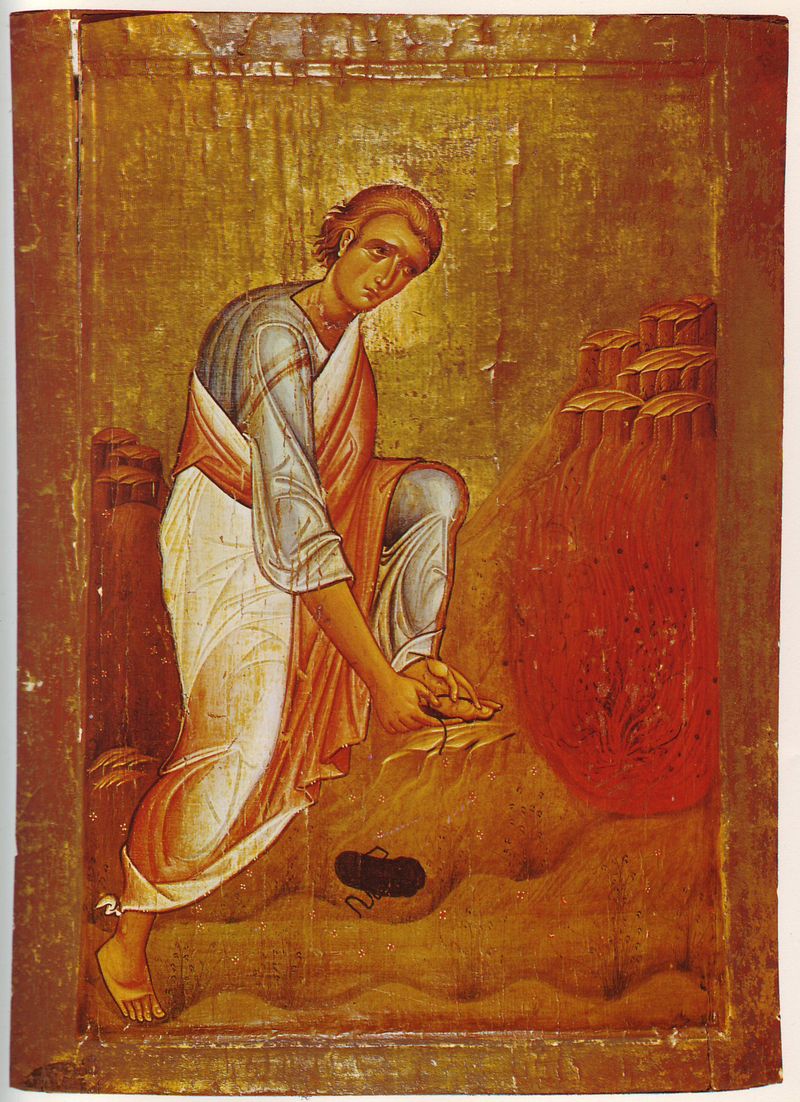
This is the decisive passage. Verse 2: “The malʾak YHWH appeared to him in a flame of fire from the midst of a bush.” Verse 4: “God called to him from the midst of the bush.” Verse 6: the speaker identifies himself as “the God of Abraham, the God of Isaac, and the God of Jacob,” and Moses hides his face “because he was afraid to look upon God.”5 The oscillation is total: Angel in the narrator’s voice, God in the speaker’s voice, theophanic fear in the recipient’s response. Nahum Sarna’s JPS commentary observes: “It is always God Himself who speaks. Most likely the messenger is mentioned only to avoid what would be the gross anthropomorphism of localizing God in a bush.”6 Strikingly, the Clementine Vulgate omits the Angel entirely at this verse, reading Apparuitque ei Dominus—“The Lord appeared to him”—an interpretive choice that effectively reads the Angel as Yahweh himself. (The Nova Vulgata restores the messenger, reading Apparuitque ei angelus Domini.)

Exodus 23:20–23 (The Name-Bearing Angel)
This passage is widely considered the canonical theological explanation for the entire phenomenon. God declares: “I am sending a messenger before you to guard you on the way… Pay attention to him and obey his voice. Do not rebel against him, because he will not forgive your transgressions, because my Name is in him (kî šěmî běqirbô, כִּי שְׁמִי בְּקִרְבּוֹ)” (vv. 20–21).7 The Angel bears the divine Name—and with it, the authority to forgive or withhold forgiveness of sin, a prerogative elsewhere reserved exclusively for YHWH. This verse is the anchor text for every major interpretation.
Judges 6:11–24 (Gideon)
The malʾak YHWH appears to Gideon (v. 12), but in v. 14 “YHWH turned to him” and commissioned him directly—the narrator switches mid-scene from “Angel” to “YHWH” without explanation. When the Angel ascends in the flame of Gideon’s offering (v. 21), Gideon exclaims: “I have seen the malʾak YHWH face to face” (v. 22) and fears death—yet it is YHWH who reassures him (v. 23). The fear-of-death motif makes sense only if Gideon believes he has seen God; the biblical text never states that seeing an ordinary angel is fatal.8
Judges 13:2–23 (Manoah)
The malʾak YHWH announces Samson’s birth. When Manoah asks his name, the Angel replies: “Why do you ask my name, seeing it is wonderful (pilʾî, פֶּלִאי)?” (v. 18)—a term some scholars connect to Isaiah 9:6’s messianic title. The Angel ascends in the flame of the altar (v. 20), and Manoah concludes: “We shall surely die, for we have seen God” (v. 22). His wife’s counter-argument (v. 23) does not challenge his identification of the figure as God, only his inference that death must follow.9
Zechariah 1:8–17 and 3:1–7 (The Night Visions)
These passages introduce a critical complication. In Zechariah 1:12, the malʾak YHWH intercedes with YHWH: “O LORD of hosts, how long will you have no mercy on Jerusalem?” The Angel prays to someone distinct from himself. In Zechariah 3:2, “YHWH said to Satan, ‘YHWH rebuke you’”—YHWH speaks of YHWH in the third person while the Angel mediates the scene.10 These are the strongest passages for distinguishing the Angel from YHWH, and they create the most difficulty for any simple identification.
The Grammar Beneath the Mystery
Several linguistic facts frame the debate. The Hebrew construct chain malʾak YHWH (מַלְאַךְ יְהוָה) is inherently definite: because YHWH is a proper noun and therefore intrinsically definite, the construct noun malʾak (מַלְאַךְ) receives definiteness automatically (Waltke and O’Connor, Introduction to Biblical Hebrew Syntax, §13.4a). This means the phrase is correctly rendered “the messenger of Yahweh,” not “a messenger of Yahweh.” The construction never appears in the plural (malʾakîm YHWH, מַלְאָכִים יְהוָה), underscoring that this is a singular, recurring figure rather than a generic category.11
How scholars parse the genitive relationship is decisive. If malʾak YHWH is a subjective genitive—“the messenger sent by Yahweh”—then the Angel is a distinct agent. If it is a genitive of identity or apposition—“the messenger who is Yahweh”—then the Angel is Yahweh appearing in communicable form. The Hebrew construct chain is formally ambiguous between these options, and as Carol Newsom has suggested, the texts themselves seem to exploit this ambiguity deliberately.12
The Hebrew word malʾak (מַלְאָךְ) itself derives from the root l-ʾ-k (ל-א-כ, “to send with a message”), preserved in Hebrew almost exclusively in the noun itself. Its Ugaritic cognate mlʾk designated messenger figures in the Canaanite divine council—envoys between the gods. (Akkadian, by contrast, generally uses the unrelated word šipru for “messenger”; the similar-sounding Akkadian root m-l-k belongs to a different semantic field meaning “to counsel” or “to rule.”) Comparative Semitics confirms that malʾak is fundamentally a functional title (“one who is sent”) rather than an ontological category—it describes what the figure does, not what it is.13 This is why the same word can designate human messengers (2 Samuel 11:19), prophets (Haggai 1:13; Malachi 2:7), and the mysterious divine figure of the theophanies without contradiction.
The Major Interpretive Positions
A Created Angel Acting as Divine Representative
The “agency model” draws on the ancient Near Eastern and later rabbinic šālîaḥ principle: an authorized agent speaks and acts with the full legal authority of the sender. The messenger of a king speaks in the first person as the king. On this reading, the Angel of Yahweh is a created angelic being who represents God so completely that the boundaries between representative and represented collapse linguistically without collapsing ontologically.
Scholars favoring this approach include René Lopez and Andrew S. Malone (Bulletin for Biblical Research, 2010 and 2011 respectively). The agency model handles the first-person divine speech naturally—envoys spoke as their principals throughout the ancient Near East. Its greatest weakness is the theophanic reaction: if this is simply an authorized angel, why does seeing him provoke the fear of death that Scripture elsewhere associates exclusively with seeing God’s face (Exodus 33:20)? Judges 13:22—“we have seen God”—is especially difficult, since Manoah does not say “we have seen God’s representative.”14
A Temporary Theophany of Yahweh Himself
On this view, the Angel is simply Yahweh choosing to appear in a visible, communicable form. There is no distinct “person”—only Yahweh accommodating himself to human perception. Nahum Sarna represents this approach, and Gerhard von Rad frequently treated “the angel of the LORD” as a mode of Yahweh’s appearing.15 The “angel” language is a narrative device to avoid the anthropomorphism of directly localizing God in a bush or at a campsite.
This reading elegantly handles the identification passages (Genesis 16:13; Exodus 3:4–6; Judges 6:14) but struggles acutely with Zechariah 1:12, where the Angel intercedes with YHWH as a distinct party. If the Angel simply is Yahweh appearing visibly, who is the Angel praying to? Carol Newsom has suggested that the texts may be “deliberately ambiguous,” preserving divine mystery rather than resolving it into a system.16
The Pre-Incarnate Son: The Christophany Reading
This was the dominant interpretation of the first four centuries of Christianity. Justin Martyr (Dialogue with Trypho, chs. 56–62, 126–128) argued explicitly that “He who is called God and appeared to the patriarchs is called both Angel and Lord” and identified this figure as “the Word of God… minister to the Father of all things.” His reasoning was straightforward: the Father is invisible (John 1:18); someone divine was visibly seen; therefore the one seen was the Son.17
Irenaeus (Against Heresies III.6) made the same identification central to his anti-Gnostic theology: the Son who appeared to Moses is the same God who created the world—against Marcion’s claim that the Old Testament God was a different, inferior deity.
Tertullian (Against Praxeas, chs. 14–16) deployed the Angel-of-YHWH texts against Modalist Monarchianism, arguing that the theophanies proved a real distinction of persons: “God is invisible as the Father and visible as the Son.” Hilary of Poitiers sharpened the point: “Whose angel could the Father be?”—the term “messenger” implies being sent by another, which fits the Son’s eternal relation to the Father.18
The Christophany reading has been revived in modern evangelical scholarship, most notably by James Borland (Christ in the Old Testament, 1978/2010) and Michael Heiser (The Unseen Realm, 2015). Borland defined Christophanies as “unsought, intermittent and temporary, visible and audible manifestations of God the Son in human form” prior to the Incarnation.19
The strongest objection is the anachronism charge: categories like “the second person of the Trinity” are not Old Testament categories, and reading them back into the text risks imposing later theology on earlier texts. A reviewer at The Gospel Coalition concluded that Borland “failed to convince me,” faulting him in particular for “presupposing a full-blown Trinitarian theology” in his readings of texts that do not yet operate within those categories.20
Augustine’s Break: Theophanies as Created Effects
Augustine (De Trinitate, Books II–IV) represents the most consequential break in the tradition. He argued that Old Testament theophanies were not specific appearances of the Son but manifestations of the one God (Father, Son, and Spirit jointly) through created intermediaries—either created physical forms or created angels speaking “in the person of God.” His reasoning was driven by anti-Arian concern: if only the Son was visible in OT theophanies, the Arians could argue the Son has a different (inferior, more material) nature than the invisible Father. Since all three persons share the same invisible divine essence, no person is intrinsically more visible than another.21
Thomas Aquinas (Summa Theologiae I, QQ. 50–51) broadly followed Augustine, holding that angels are entirely created incorporeal beings who can assume bodies for the purpose of ministry. When Aquinas treats the “Angel of the Sacrifice” in the Roman Canon’s Supplices te rogamus prayer (ST III, Q. 83, A. 4, ad 9), his primary reading is that the angel is a created angel who presents the Church’s prayers and offerings before the heavenly altar; only as a secondary alternative (“Or else…”) does he allow that the angel may be understood to signify Christ himself, the great Angel of God’s Counsel. Even his openness to a Christological reading is therefore framed as a fallback rather than his preferred interpretation.22
The Augustinian-Thomistic position remains influential in the Latin West but represents a departure from the earlier and broader patristic consensus. The Eastern Orthodox tradition generally maintained the older Christophany identification, and it remains more characteristic of Eastern theology to this day.
A Divine Hypostasis: More Than an Angel, Not Yet the Trinity
A growing body of modern scholarship sees the Angel of Yahweh as a hypostasis—a semi-independent divine entity that is an extension of YHWH’s own being, reflecting an early stage of Israelite theological reflection about how the one God can be present in multiple ways simultaneously.
Benjamin Sommer (The Bodies of God and the World of Ancient Israel, 2009) argues that the Hebrew Bible reflects a broader ancient Near Eastern concept of “divine fluidity”—the idea that a deity’s presence could manifest in multiple bodies or locations simultaneously. The malʾak YHWH is not a separate being, nor a scribal error, but an authentic “self” of YHWH that could appear on earth while YHWH remained in heaven.
In Mesopotamian religion, cult images were simultaneously the deity and not the deity; similarly, the Angel could be simultaneously YHWH and not YHWH.23
Tryggve Mettinger (The Dethronement of Sabaoth, 1982) connected this to “Name theology”—the idea that YHWH’s Name (šēm, שֵׁם) functions as a personified, semi-independent vehicle of divine presence. Exodus 23:21 (“my Name is in him”) is the anchor text. The Deuteronomistic theologians chose šēm as their preferred way of talking about divine presence precisely because it was “already connected with the idea of God’s presence” through the angel figure.24
This view has the advantage of taking the textual phenomena at face value: the Angel really is identified with YHWH and distinguished from YHWH, because the concept of divine selfhood in ancient Israel was more fluid than later systematic theology assumed. Its weakness is that the term “hypostasis” itself is contested—Saul Olyan cautioned it is “best avoided on account of the history of its use and abuse in biblical scholarship.”25
The Jewish Interpretive Tradition
The Angel-of-YHWH tradition generated a rich afterlife in Jewish thought that deserves attention, particularly because it illuminates the conceptual world within which early Christianity developed its Christology.
The Aramaic Targums systematically employ the term Memra da-Yeya (“the Word of the Lord”) as a circumlocution where the Hebrew text has anthropomorphic descriptions of God or the Angel of YHWH. In Targum Pseudo-Jonathan on Genesis 16, the Angel who appeared to Hagar is identified as “the Memra of God.” In Genesis 19:24, where the Hebrew reads “YHWH rained fire from YHWH out of heaven,” Targum Pseudo-Jonathan reads “the Memra of the Lord sent down sulfur… from before the Lord”—preserving a distinction between two divine referents that mirrors the Angel/YHWH oscillation.26
Philo of Alexandria (c. 20 BCE–50 CE) identified the Angel of the Lord with his Logos doctrine. In De Confusione Linguarum 146 he called the Logos “God’s firstborn,” “the most ancient,” and “the archangel of many names”; in Quis Rerum Divinarum Heres 205–206 he described the Logos as the “archangel” standing between Creator and creature; and—most strikingly—he called the Logos the “second God” (deuteros theos, Quaestiones in Genesim II.62). The Logos is “neither uncreated as God, nor yet created as you”—a formulation that strikingly anticipates later Christological debates.27
Alan Segal (Two Powers in Heaven, 1977) demonstrated that this “two powers” theology—the belief that a principal angelic or hypostatic figure in heaven was equivalent to God—was widespread in Judaism by the first century CE and was not considered heretical until the second century, when early Christians identified Jesus with this “second power” and provoked rabbinic condemnation.
The Talmud’s reaction is revealing: in b. Sanhedrin 38b, a min (heretic) asks Rabbi Idith why Exodus 24:1 says “Come up to the LORD” rather than “Come up to Me.” R. Idith answers: “This is Metatron, whose name is like that of his Master, as it is written, ‘For my Name is in him.’” When the heretic suggests Metatron should therefore be worshiped, R. Idith retorts that “Do not rebel against him” actually means “Do not exchange Me for him.”28
These passages show rabbinic Judaism actively policing the boundary that the Angel-of-YHWH tradition constantly threatened to blur.

New Testament Connections
The New Testament does not offer a systematic treatise on the Angel of Yahweh, but multiple authors handle the tradition in ways that converge on a consistent conclusion: the divine figure who appeared to the patriarchs and led Israel was the pre-incarnate Son.
John 1:18 provides the theological foundation: “No one has ever seen God; the only-begotten God, who is at the Father’s side, has made him known.” If the Father has never been seen, yet God was repeatedly seen in the Old Testament—in Eden, at Mamre, in the bush, on Sinai—then the one seen was someone other than the Father. John’s Logos, who “was with God and was God” (1:1), who “became flesh” (1:14), is the one who has always mediated between the invisible Father and the visible world.
John 8:56–58 strengthens the connection. Jesus claims Abraham “rejoiced to see my day; he saw it and was glad”—and then makes the climactic declaration, “Before Abraham was, I AM” (egō eimi). The “I AM” echoes the divine self-identification of Exodus 3:14, spoken from the burning bush by the very figure introduced as the malʾak YHWH.
Acts 7:30–38 (Stephen’s speech) narrates the burning bush episode with the same oscillation as Exodus 3: “an angel appeared to him” (v. 30), but “the Lord” spoke, identifying himself as “the God of Abraham, Isaac, and Jacob” (vv. 31–32). Stephen then refers to “the angel who spoke to him on Mount Sinai” (v. 38)—making the angel the continuous divine agent throughout Israel’s wilderness experience. His speech culminates in a vision of “the Son of Man standing at the right hand of God” (7:56), rhetorically connecting the OT divine agent with the exalted Christ.
1 Corinthians 10:1–4, 9 is among the most explicit identifications. Paul declares that the Israelites in the wilderness “drank from the spiritual Rock that followed them, and the Rock was Christ” (v. 4). This places Christ with Israel during the very period when the Angel of YHWH led them (Exodus 14:19; 23:20–23). Paul intensifies the point in verse 9: “We must not put Christ to the test, as some of them did and were destroyed by serpents”—attributing to Christ an act of judgment elsewhere attributed to YHWH (Numbers 21:5–6). Verse 9 carries its own textual variant: Codex Sinaiticus (ℵ) and Codex Vaticanus (B) read κύριον (“the Lord”), and the Tyndale House GNT prints κύριον, while Codex Alexandrinus (A) and a wide swath of the manuscript tradition read θεόν (“God”); the reading Χριστόν (“Christ”) is preferred by NA28 and UBS5 on internal grounds. The textual question is genuinely debated, but on any of the three readings Paul is associating the wilderness judgment with the same divine figure he elsewhere identifies as Christ.
Jude 5 contains a remarkable textual variant. A significant body of witnesses—including Codex Alexandrinus (A), Codex Vaticanus (B), minuscules 33, 81, and 1739, plus the Vulgate, several Coptic witnesses, and the Ethiopic version—read Ἰησοῦς (“Jesus”) as the one who “saved a people out of the land of Egypt and afterward destroyed those who did not believe.” Other major witnesses read differently: Codex Sinaiticus (ℵ) reads κύριος (“Lord”), and the early third-century papyrus P72 reads θεὸς Χριστός (“God Christ”).
Recent critical editions (NA28, UBS5, Tyndale House GNT) have nevertheless judged “Jesus” the most likely original reading, in part because it is the more theologically difficult variant (and thus the harder to explain as a later alteration). If original, it is the most direct NT attribution of YHWH’s Exodus actions to Jesus by name—though the variation among the earliest witnesses underscores how unsettled this verse’s text was in the early centuries.29
Where the Catholic Tradition Stands
The Catholic Church has the unusual distinction of having strong patristic support for both the Christophany reading (Justin, Irenaeus, Tertullian, Hilary, Ambrose, the entire Eastern tradition) and the created-mediation reading (Augustine, Aquinas, the Latin scholastic tradition). The question has never been dogmatically settled. This is actually a strength: it allows Catholic readers to engage the full range of evidence without feeling bound to a single answer.
What Catholic theology does affirm is that the Old Testament genuinely prepares for and prefigures Christ (CCC §§128–130), that the theophanies “light up the way of the promise” (CCC §707), and that the Son is the eternal Word through whom all things were made (Nicaea, Chalcedon). Whether the malʾak YHWH texts are best read as literal appearances of the pre-incarnate Son or as divinely ordained prefigurations of the Incarnation mediated through created forms—both options remain within the bounds of orthodoxy.
Catholic interpretive principles encourage what the Pontifical Biblical Commission calls both historical-critical attention (what the texts are doing in their ancient Israelite contexts) and canonical-theological reading (how the Church reads the Old Testament in the light of Christ). Dei Verbum teaches that the Old Testament “acquire[s] and show[s] forth [its] full meaning in the New Testament” (§16). This two-step hermeneutic lets the Catholic reader honor patristic Christophany without presenting it as the only academically responsible reading, and engage modern scholarship without reducing Scripture to a merely historical artifact.30
Evaluating the Evidence: What Can Be Said with Confidence
For a thorough scholarly presentation of these themes, Dr. Michael Heiser’s lecture on the “Two Powers in Heaven” doctrine in ancient Judaism is well worth watching:
Each position explains some texts well and strains against others.
The agency model has the advantage of simplicity and ANE precedent. Its strongest text is Zechariah 1:12, where the Angel prays to YHWH as a separate party—natural if the Angel is a distinct being. Its hardest text is Judges 13:22, where Manoah says “we have seen God”—not “we have seen God’s agent.” The fear-of-death reaction across multiple passages consistently points beyond mere representation.
The theophany view handles the identification passages elegantly—the Angel simply is YHWH appearing visibly. Its strongest texts are Genesis 16:13 (Hagar names the Angel as YHWH) and Exodus 3:2–6 (the total interchange). Its hardest text is Zechariah 1:12—if the Angel simply is YHWH in another mode, the intercession scene makes no sense.
The Christophany reading uniquely handles both the identification and the distinction: the Angel is divine (hence identified with YHWH, receiving worship, speaking as God) but personally distinct (hence praying to the Father, being sent). Its strongest texts are Exodus 3 (the burning bush interchange), Exodus 23:20–21 (the Name-bearer), and the NT reception (John 1:18; 1 Corinthians 10:4; Jude 5).
Its hardest challenge is the anachronism objection—whether OT authors intended a Trinitarian reading. However, the patristic argument was never that OT authors understood the Trinity explicitly, but that the texts contain a genuine divine mystery whose full meaning is revealed only in Christ.
The hypostasis/divine-fluidity view (Sommer, Mettinger) is the most nuanced academic position and arguably the closest to what the OT authors themselves understood. It takes the textual oscillation at face value without forcing it into either pure identity or pure distinction. Its strongest argument is the comparative ANE evidence for “fluid” divine selfhood. Its hardest challenge is whether “hypostasis” is a genuinely illuminating category or merely a scholarly placeholder for mystery.
Remarkably, Sommer himself (who is Jewish) has noted that his “fluidity” concept maps remarkably well onto Christian Trinitarian categories, though he does not draw Christian conclusions from this.
Conclusion
The honest conclusion is that the biblical text itself does not fully resolve the question. The oscillation between Angel and YHWH, identification and distinction, is not a problem to be solved but a feature of the text—one that may have been deliberately preserved precisely because it reflects something genuine about how the one God makes himself present.
Whether one calls this a “hypostasis,” a “Christophany,” a “divine self-manifestation,” or a “Name-bearing agent” may depend as much on one’s theological starting point as on the exegetical evidence. What no honest reading can deny is that the text presents something far more than an ordinary angel—a figure who bears the divine Name, speaks as God, receives worship, exercises divine prerogatives, and is yet somehow sent by and distinguishable from the God whose identity he shares.
That this figure would later be recognized as the eternal Son, the Word made flesh, is—for Christian readers—not an imposition on the text but its deepest fulfillment.
Frequently Asked Questions
Is the Angel of the Lord the same as other angels?
No. The malʾak YHWH (מַלְאַךְ יְהוָה) is a singular, recurring figure who is never pluralized in Scripture. Unlike other angels (Gabriel, Michael, the seraphim), this figure consistently speaks as God in the first person, receives worship, and exercises divine prerogatives like forgiving sin. The human recipients of these encounters consistently react with the fear of death associated with seeing God, not with the more measured response typical of angelic encounters elsewhere in Scripture.
Does the Catholic Church teach that the Angel of the Lord is Jesus?
The Catholic Church has never dogmatically defined the identity of the Angel of the Lord. The pre-Augustinian Fathers (Justin Martyr, Irenaeus, Tertullian, Hilary) overwhelmingly identified him as the pre-incarnate Son, and this remains the dominant view in the Eastern Orthodox tradition. Augustine and Aquinas argued instead for theophanies mediated through created forms. Both positions have genuine patristic warrant, and Catholic readers are free to engage the evidence without being bound to a single answer. The Catechism affirms that Old Testament theophanies “light up the way of the promise” (CCC §707) without specifying which interpretive model is correct.
What is the “two powers in heaven” tradition?
Alan Segal demonstrated in his 1977 study Two Powers in Heaven that the belief in a principal angelic or divine figure who was equivalent to God was widespread in Judaism by the first century CE. This belief drew on passages like Daniel 7:9–14 (two thrones), Exodus 23:20–23 (the Name-bearing angel), and the theophany passages with multiple YHWH referents. It was not considered heretical until Christians identified Jesus with this “second power,” prompting rabbinic condemnation. The tradition reveals that the conceptual space for a “divine mediator” figure already existed within Judaism well before Christianity emerged.
What is the strongest argument against the Christophany reading?
The strongest scholarly objection is the anachronism charge: the categories of Trinitarian theology (“second person,” “pre-incarnate Son”) were not available to the original Israelite authors, and importing them into earlier texts risks reading later theology back into the evidence. However, defenders of the Christophany position respond that the patristic argument never claimed the OT authors explicitly understood the Trinity—only that the texts contain a genuine divine mystery whose full meaning is revealed progressively, reaching completion in Christ.
1. For a comprehensive survey of the “oscillation” or “interchange” pattern, see the treatment at TheTorah.com, “The Angel of YHWH,” which catalogs the phenomenon across the entire Hebrew Bible. See also Wojciech Kosior, “The Angel of the Lord in the Hebrew Bible,” Polish Journal of Biblical Research 12 (2013).
2. Genesis 16:7–13. See the discussion in Nahum Sarna, Genesis, JPS Torah Commentary (Philadelphia: Jewish Publication Society, 1989), ad loc.
3. Genesis 22:11–18. The theophanic character of the Akedah is discussed in Sarna, Genesis, and in the broader tradition-history analysis at TheTorah.com.
4. Genesis 31:11–13. This represents the most explicit self-identification in the malʾak tradition.
5. Exodus 3:2–6. The passage is central to both scholarly source-critical debates (the “editorial seam” between the Elohist and Yahwist sources) and patristic Christological readings.
6. Nahum Sarna, Exodus, JPS Torah Commentary (Philadelphia: Jewish Publication Society, 1991), on Exodus 3:2.
7. Exodus 23:20–21. On the significance of the divine Name dwelling “in” the angel, see Tryggve Mettinger, The Dethronement of Sabaoth: Studies in the Shem and Kabod Theologies (Lund: CWK Gleerup, 1982), and Jarl Fossum, The Name of God and the Angel of the Lord (Tübingen: Mohr Siebeck, 1985).
8. Judges 6:11–24. The fear-of-death motif is theologically significant because the biblical text associates it exclusively with seeing God (cf. Exodus 33:20), not with ordinary angelic encounters.
9. Judges 13:2–23. On the connection between pilʾî (“wonderful”) and Isaiah 9:6, see Jonathan McLatchie, “The Angel of the Lord in the Old Testament,” and the discussion in Marquette University’s MAQOM materials.
10. Zechariah 1:8–17; 3:1–7. These passages create the most difficulty for any simple identification of the Angel with YHWH. See the analysis in Lena-Sofia Tiemeyer, “YHWH, the Divine Beings, and Zechariah 1–6,” Academia.edu.
11. On the definiteness of the construct chain, see Bruce K. Waltke and M. O’Connor, An Introduction to Biblical Hebrew Syntax (Winona Lake: Eisenbrauns, 1990), §13.4a. On the singularity of the figure, see the discussion at Answering Islam and Christian Thinktank.
12. Carol Newsom’s suggestion of deliberate ambiguity is discussed in the broader context of the malʾak YHWH debate in several scholarly treatments.
13. On the Semitic cognates of malʾak, see the relevant entry in the Theological Dictionary of the Old Testament and standard treatments of Ugaritic mlʾk. The Akkadian word for “messenger” is normally šipru; the Akkadian root m-l-k (“to counsel, to rule,” cf. māliku, “counselor”) is unrelated to the Hebrew root l-ʾ-k behind malʾak.
14. On the agency model, see René Lopez, “Identifying the ‘Angel of the Lord’ in the Book of Judges,” Bulletin for Biblical Research 20.1 (2010), and Andrew S. Malone, “Distinguishing the Angel of the Lord,” BBR 21.3 (2011). On the Jewish agency principle (šělûḥô šel ʾādām kěmôtô), see the article “Agency” in the Jewish Encyclopedia.
15. Gerhard von Rad is frequently cited for treating “the angel of the LORD” as a form of YHWH’s appearing. See also the overview in the Encyclopedia of Religion, s.v. “Angel, lord.”
16. Carol Newsom’s suggestion is cited in multiple scholarly treatments of the phenomenon.
17. Justin Martyr, Dialogue with Trypho, chs. 56–62, 126–128. Available at Logos Library, logoslibrary.org.
18. On the patristic tradition, see Irenaeus, Against Heresies III.6; Tertullian, Against Praxeas, chs. 14–16; Hilary of Poitiers, De Trinitate. See also Taylor Marshall, “The Angel of the Lord as Christ,” and Eusebius of Caesarea, Church History I.2.7–8.
19. James Borland, Christ in the Old Testament: Old Testament Appearances of Christ in Human Form (Ross-shire: Mentor, 1978; rev. ed. 2010). See also Michael Heiser, The Unseen Realm: Recovering the Supernatural Worldview of the Bible (Bellingham: Lexham Press, 2015).
20. See the review of Borland at The Gospel Coalition and the discussion by Phil Gons.
21. Augustine, De Trinitate, Books II–IV. Available at New Advent, newadvent.org.
22. Thomas Aquinas, Summa Theologiae I, QQ. 50–51 (on angels); III, Q. 83, A. 4, ad 9 (on the “Angel of the Sacrifice”). See Aquinas Online and The Human Jesus resources.
23. Benjamin D. Sommer, The Bodies of God and the World of Ancient Israel (Cambridge: Cambridge University Press, 2009). See also the discussion at Bible Odyssey, “Heavenly Beings.”
24. Tryggve N. D. Mettinger, The Dethronement of Sabaoth: Studies in the Shem and Kabod Theologies (Lund: CWK Gleerup, 1982). See also Jarl Fossum, The Name of God and the Angel of the Lord: Samaritan and Jewish Concepts of Intermediation and the Origin of Gnosticism (Tübingen: Mohr Siebeck, 1985), and the Marquette University MAQOM materials on Yahoelsinger.
25. Saul Olyan, quoted in the Marquette University MAQOM project discussion of the “hypostasis” terminology in biblical scholarship.
26. On the Targumic Memra tradition, see the article “Memra” in the Jewish Encyclopedia. On the connection to the Angel-of-YHWH tradition, see Jonathan McLatchie and the Targum Pseudo-Jonathan on Genesis 16 and 19:24.
27. Philo of Alexandria, De Confusione Linguarum 146 (where the Logos is called “God’s firstborn,” “the most ancient,” and “the archangel of many names”); Quis Rerum Divinarum Heres 205–206 (the Logos as “archangel” mediating between Creator and creature); Quaestiones in Genesim II.62 (the Logos as deuteros theos). See the overview at the Internet Encyclopedia of Philosophy, “Philo of Alexandria.”
28. Alan F. Segal, Two Powers in Heaven: Early Rabbinic Reports about Christianity and Gnosticism (Leiden: Brill, 1977; repr. Waco, TX: Baylor University Press, 2012). On b. Sanhedrin 38b, see also TheTorah.com and The Gemara discussions.
29. On the Jude 5 textual variant, see the NET Bible textual note on Jude 5 and the apparatus of NA28/UBS5. The reading Ἰησοῦς is supported by A, B, 33, 81, 1739, the Vulgate, several Coptic witnesses, and the Ethiopic version; Codex Sinaiticus (ℵ) reads κύριος, and P72 reads θεὸς Χριστός. Patristic support for the “Jesus” reading comes from Origen, Cyril of Alexandria, and Jerome, among others.
30. Second Vatican Council, Dei Verbum §16. See also the Pontifical Biblical Commission, The Interpretation of the Bible in the Church (1993), available at catholic-resources.org.

Garrett Ham
Garrett Ham is an attorney, military veteran, and holds a Master of Divinity from Yale Divinity School. He writes from Northwest Arkansas on theology, law, and service.
More about Garrett →Related Posts

In the Beginning Was the Word: John 1:1 Explained
A deep dive into John 1:1 in the original Greek—the Logos, Colwell's rule, Nicene consubstantiality, and why this verse is the whole Gospel.
Is Jesus God? The Biblical and Catholic Case for the Deity of Christ
Is Jesus God? A biblical and theological examination of the deity of Christ, from New Testament texts through the Councils, addressing common objections and theological implications.
The Holy Trinity Explained: A Catholic Guide to the Central Mystery of Faith
What is the Holy Trinity? A Catholic explanation of one God in three persons — the scriptural foundations, Nicene doctrine, and why it matters for the Christian life.
Stay Informed
Get new writing on faith, law, and service delivered to your inbox.
No spam. Unsubscribe anytime.