1 Peter — The Apostle’s Letter of Hope in Suffering

On This Page
Part of the series: The New Testament Canon—How 27 Books Survived the Ancient Gauntlet
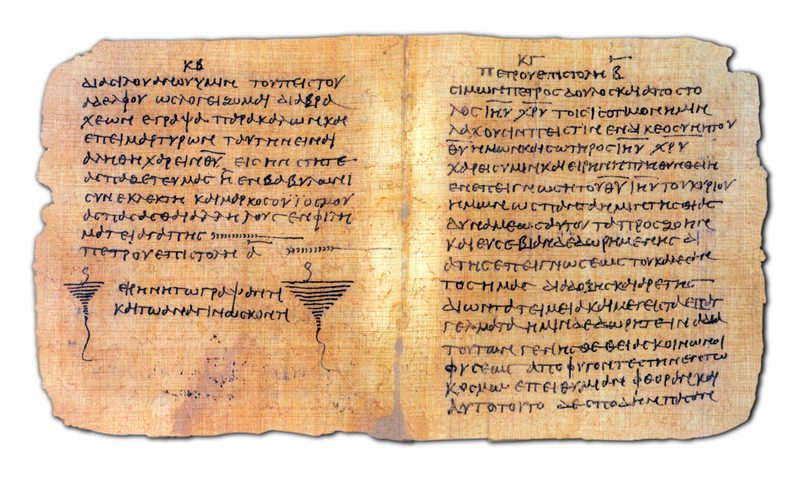
Every other letter in this series earned its place by surviving doubt. The Letter of James was nearly silent in the record before Origen; Jude quoted a book no one would canonize; 2 and 3 John were too short and too anonymous to be sure of; 2 Peter is, by common reckoning, the most contested book in the New Testament. The First Letter of Peter is the exception that proves the rule. It is the one catholic epistle the early Church never seriously doubted—quoted within a generation of the apostolic age, named by the earliest witnesses, and set down by Eusebius, without hesitation, among the books “acknowledged as genuine.”1
That makes 1 Peter the control case for the whole series. If we want to know what robust early attestation actually looks like—against which the disputed books can be measured—this is the letter to study. And it is worth studying for more than its pedigree. Into a short compass it packs the New Testament’s richest meditation on suffering, a theology of baptism and the priesthood of the baptized, a window onto Peter’s Rome, and one of the most argued-over sentences in all of Scripture: the claim that the crucified Christ “went to preach to the spirits in prison.”2
This post reads 1 Peter the way the series has read its harder neighbors: the letter first, and its world; then its unusually strong reception in the early Church; then the genuine puzzle of its authorship; then the meaning of its dateline, “Babylon”; then its theology of suffering and hope, which is its beating heart; then the riddle of the spirits in prison and the Catholic doctrine of Christ’s descent; and finally what the Church gained by receiving a letter that, almost alone among the catholic epistles, it never had cause to doubt.
A letter to exiles in five provinces
Begin with the address, because it sets the key. “Peter, an apostle of Jesus Christ, to the chosen sojourners of the dispersion in Pontus, Galatia, Cappadocia, Asia, and Bithynia.”3 The five names are Roman provinces covering most of Asia Minor—modern Turkey—and they are listed, as the Catholic study Bible notes, in a rough clockwise circuit, perhaps the route a courier would travel delivering the letter from church to church.4 The recipients are not one congregation but a scattered network of them, and the writer addresses them with a word loaded with meaning: they are parepidēmoi of the diaspora, resident strangers of the dispersion.
That language of displacement runs through the whole letter. The readers are “sojourners” passing “the time of your sojourning” (1:17); they are “aliens and sojourners” urged to keep themselves from the desires that war against the soul (2:11).5 A long tradition read these terms spiritually, as a metaphor for the Christian’s pilgrimage through a world that is not finally home, and the Catholic Scriptures lean that way.6 The sociologist of the New Testament John H. Elliott pressed the other possibility—that the words name a real social and legal status, that these were literally displaced people, resident aliens and visiting strangers on the margins of provincial society, to whom the letter offers a true home in the household of God.7 The readings are not exclusive; the power of the letter is that it speaks to both at once, to anyone who has ever felt like a stranger where they live.
The body of the letter unfolds that situation into a structure of remarkable warmth. After the address comes a great opening benediction, one of the finest sentences in the New Testament: “Blessed be the God and Father of our Lord Jesus Christ, who in his great mercy gave us a new birth to a living hope through the resurrection of Jesus Christ from the dead.”8 That phrase—a living hope—is the keynote of everything that follows. The readers will “rejoice” even while “for a little while” they “suffer through various trials,” so that the genuineness of their faith, “more precious than gold that is perishable even though tested by fire,” may be found to praise and glory at the revelation of Christ.9 Hope, faith tested by fire, suffering that is real but temporary and meaningful—the letter announces its themes in its first paragraph.
From there 1 Peter moves through a call to holiness (1:13–25), a vision of the Church as a spiritual house and “a chosen race, a royal priesthood, a holy nation” (2:4–10), a long section of practical counsel on living honorably within the structures of the ancient world (2:11–3:12), and then to the heart of the matter: how to suffer as a Christian (3:13–4:19), closing with counsel to the community’s elders and a final word of greeting (5:1–14).10 The famous declaration that the Church is “a chosen race, a royal priesthood, a holy nation, a people of his own” gathers up titles that Israel once bore at Sinai and lays them on this scattered, suffering, mostly Gentile people—telling exiles who feel they belong nowhere that they are, in fact, the people of God.11 It is a letter that confers dignity on the displaced.
“Acknowledged as genuine”: the one catholic epistle no one doubted
The thing to grasp about 1 Peter’s place in the canon is how early, and how thoroughly, it was received. The contrast with its neighbors is stark, and it is the whole point.
The earliest witness is also one of the earliest Christian writings outside the New Testament. Polycarp of Smyrna, a bishop who had known the apostolic generation, wrote to the Philippians somewhere around the year 110 to 135, and his short letter is saturated with the language of 1 Peter.12 He never names Peter—early Christian writers quoted by absorption more often than by citation—but the borrowings are unmistakable. “In whom, though now you see Him not, you believe, and believing, rejoice with joy unspeakable and full of glory,” he writes, lifting 1 Peter 1:8 nearly word for word.13 A few lines later he strings together two clauses from the same letter—Christ “who bore our sins in His own body on the tree,” “who did no sin, neither was guile found in His mouth”—quoting 1 Peter 2:24 and 2:22 in a single breath.14 No first-generation Christian writer leans on 1 Peter the way Polycarp does. The letter was authoritative Scripture in Asia Minor within living memory of the apostles.
By the early second century the attributions begin to appear by name. Papias of Hierapolis, whose lost work survives only in fragments quoted by later writers, “used testimonies from the first epistle of John and from that of Peter likewise,” according to Eusebius.15 Around 180 Irenaeus of Lyons quotes the letter explicitly: “Peter says in his Epistle,” he writes, before reciting the same verse Polycarp had used, that Christians love a Lord whom they have not seen.16 Elsewhere Irenaeus reaches for the letter again—“Peter says”—to warn against using liberty “as a cloak of maliciousness.”17 By the time Eusebius of Caesarea took stock of the whole question in the early fourth century, sorting the Christian writings into the acknowledged, the disputed, and the spurious, 1 Peter sat at the very top of the first list. “One epistle of Peter, that called the first, is acknowledged as genuine,” he wrote. “And this the ancient elders used freely in their own writings as an undisputed work.”18
There is one famous wrinkle, and it cuts the other way. The Muratorian Fragment—the oldest surviving list of New Testament books, usually dated to around 170—does not mention 1 Peter at all.19 For a letter this universally received, the silence is so odd that most scholars treat it as a problem of the document rather than of the letter. The fragment is a battered Latin translation, mutilated at the beginning and the end, “full of barbarisms,” and surviving in a single careless seventh- or eighth-century manuscript; the likeliest explanation, the one Bruce Metzger favored in his standard study of the canon, is that a line naming Peter’s epistle dropped out somewhere in its damaged transmission.20 A single corrupt list weighs little against Polycarp, Papias, Irenaeus, and the settled judgment of the ancient elders.
When the canon was formally enumerated, 1 Peter was simply there. Athanasius of Alexandria, in the Festal Letter of 367 that gives us the first surviving list of exactly our twenty-seven books, named “of Peter, two” among the seven catholic epistles.21 The North African councils of Hippo (393) and Carthage (397) listed “two Epistles of the Apostle Peter” for the Latin West.22 The Council of Florence repeated the list in 1442, and the Council of Trent defined it with the Church’s full authority in 1546, naming “two of Peter the apostle” among the canonical Scriptures and attaching its anathema to anyone who would not receive them.23
The irony is worth savoring. Peter’s two letters travel together in every canon list, joined by his name—and yet they could hardly be more different in their fortunes. The second letter is the most doubted book in the New Testament, with no certain citation before the third century and a place, in Eusebius’s reckoning, among the disputed books that “do not belong to the canon” even as they were “used with the other Scriptures.”24 The first letter is the opposite: the gold standard of early attestation, the letter against which doubt about the others can be measured. To read 2 Peter and 1 Peter side by side is to see, in two documents bearing one apostle’s name, the entire spectrum of how the early Church received its Scriptures.
Could a Galilean fisherman write this Greek?
If the letter’s reception is the easy part of its history, its authorship is the hard part. The letter names its writer in its first word: “Peter, an apostle of Jesus Christ.”25 The difficulty is not that anyone in the early Church doubted this—they did not—but that the letter itself raises a question the ancients did not press and the moderns cannot ignore.
The question is the Greek. First Peter is written in cultivated, literary Koine, with a respectable vocabulary, careful rhetorical rhythm, and an Old Testament quoted consistently from the Septuagint, the Greek translation, rather than the Hebrew.26 This is not the artless Greek of a man writing in his second or third language. And the traditional author is precisely such a man: Simon Peter, a fisherman from Galilee, of whom the Acts of the Apostles records that the Jerusalem authorities, “observing the boldness of Peter and John and perceiving them to be uneducated, ordinary men, were amazed.”27 How does the unlettered fisherman of Acts 4 become the polished stylist of 1 Peter? Critical scholars from J. N. D. Kelly to Paul Achtemeier and John Elliott have found the gap hard to close, and many conclude that the historical Peter did not, with his own hand, compose this Greek.28
The letter itself seems to offer an answer, and the tradition has leaned on it heavily. Near the close Peter writes, “I write you this briefly through Silvanus, whom I consider a faithful brother.”29 Silvanus is almost certainly the Silas of Acts, the Greek-speaking companion of Paul, and the traditional solution is that he served as Peter’s secretary, an amanuensis who gave Peter’s thoughts their literary Greek form.30 The Catholic study Bible records this defense plainly: such secretaries “often gave literary expression to the author’s thoughts in their own style and language,” so that “there is nothing in the document incompatible with Petrine authorship in the 60s.”31
Honesty requires admitting that the secretary solution is weaker than it is usually made to sound. The Greek phrase Peter uses—to write “through” someone, dia Silouanou—is, in the ordinary epistolary idiom of the ancient world, the language for naming the person who carries a letter, not the person who drafts it.32 The closest parallel is the council letter of Acts 15, sent “through” its bearers—one of whom was Silas himself.33 Both Elliott and Achtemeier, the two great modern commentators, judge that 5:12 names Silvanus as the courier of 1 Peter, not its ghostwriter, and that making him the secretary “introduces more problems than it solves.”34 The amanuensis remains possible; the grammar does not require him, and a careful writer should not present the secretary as a settled fact.
This is why many critical scholars take the further step and read 1 Peter as written after the apostle’s death—not as a forgery in the modern pejorative sense, but as a work composed in Peter’s name and spirit by a disciple or a “Petrine circle” in Rome, sometime around 70 to 90.35 The arguments are cumulative: the polished Greek and the Septuagint citations; a church situation that looks settled and organized; the use of “Babylon” for Rome, a cipher that gained currency after Rome destroyed the Temple in the year 70; and the address to Gentile churches in territory that had been Paul’s mission field. The Catholic Scriptures themselves register the force of this, noting that “it is unlikely that Peter addressed a letter to the Gentile churches of Asia Minor while Paul was still alive,” and tilting toward a date of 70 to 90 and an author who was “a disciple of Peter in Rome.”36
There is a worthwhile counter-current, and a Catholic reader should know it. The whole “uneducated fisherman could not write Greek” argument may lean on a caricature. The word Acts uses, agrammatos, means “without letters” in the sense of lacking formal scribal or rabbinic training—a layman, not necessarily an illiterate.37 First-century Galilee was substantially bilingual; the fishing trade was a commercial business that touched a Greek-speaking world, and Peter ministered for three decades after Pentecost in increasingly Greek environments, ending in Rome. Karen Jobes, in her commentary, makes a precise version of the point: analyzing the syntax of 1 Peter for the tell-tale traces of an author thinking in a Semitic language, she finds exactly the kind of “bilingual interference” one would expect from a competent second-language writer—Greek that is good but not native, which is consistent with, rather than against, an author like Peter.38
For the Catholic, the decisive point is the one the study Bible models: the canonicity and inspiration of 1 Peter are matters the Church has defined, while its precise human authorship is a matter she has left open to honest inquiry.39 One may hold that Peter wrote through Silvanus in the early 60s, or that a disciple wrote in his master’s name and authority a generation later, without touching the letter’s standing as the inspired word of God. What the letter unmistakably carries is the apostolic faith of Peter—and on the question of where that faith was being preached when the letter was sent, the text drops a single, telling clue.
“She who is at Babylon”: Peter in Rome
The clue is the dateline. “The chosen one at Babylon sends you greeting,” Peter writes near the end, “as does Mark, my son.”40 Taken flat, the line would place the writer in Mesopotamia, on the Euphrates, in the ruins of the ancient city of Babylon. Almost no one, ancient or modern, has read it that way.
“Babylon” in first-century Jewish and Christian usage was a cipher for Rome. The logic was typological and bitter: Babylon was the empire that had destroyed the First Temple in 587 B.C. and dragged Israel into exile; when Rome destroyed the Second Temple in A.D. 70, “Babylon” became the natural code name for the new imperial destroyer, and it is used exactly so in the Book of Revelation—“Babylon the great, the mother of harlots”—and in the Jewish apocalypses written after 70.41 The Catholic study Bible states it without hedging: the “chosen one…at Babylon” is the Christian community at Rome, “the code name for Rome.”42
The reading is not a modern inference. Eusebius reports that the ancients understood Peter to have written his first epistle from Rome, “and that he indicates this himself, referring to the city figuratively as Babylon.”43 In the same passage Eusebius preserves the testimony, drawn from Clement of Alexandria and from Papias, that the Gospel of Mark arose from Peter’s preaching at Rome—which is why the “Mark, my son” of the greeting fits so neatly, since the same Mark stood beside Peter in the same city.44 A few interpreters, beginning with Erasmus, have argued for a literal Babylon, whether the depopulated Mesopotamian city or a minor Roman garrison of that name in Egypt; but neither had any Petrine tradition attached to it, and the figurative reading of Rome held essentially uncontested for fifteen centuries.45
The payoff reaches beyond the letter. If “Babylon” is Rome, then 1 Peter is itself a New Testament witness—alongside the unbroken patristic chain from Clement of Rome and Ignatius to Irenaeus and Eusebius—to Peter’s presence in the imperial capital, where the tradition has him leading the Roman church and dying a martyr under Nero.46 That historical substrate—Peter in Rome—is the ground on which the claim of the Roman primacy and the first pope is built; I have told that larger story elsewhere, and 1 Peter 5:13 is one of its quiet cornerstones. For our purposes here it is enough to notice that the letter’s last lines locate the prince of the apostles exactly where the Church has always said he was.
The theology of suffering and hope
All of this—the address to exiles, the dateline from a hostile capital—serves the letter’s central concern, which is the one thing every reader of 1 Peter remembers: it is the New Testament’s great letter on suffering. From its first paragraph to its last, it is written to Christians who are suffering, and it sets out to tell them what their suffering means.
The model is Christ himself, and the letter draws the portrait from the Suffering Servant of Isaiah 53. In a passage addressed first to Christian slaves enduring unjust treatment, Peter sets the crucified Lord before them as the pattern: “Christ also suffered for you, leaving you an example that you should follow in his footsteps.” “He committed no sin, and no deceit was found in his mouth”; “he himself bore our sins in his body upon the cross, so that, free from sin, we might live for righteousness. By his wounds you have been healed.”47 The suffering of Christ is not merely an example to imitate; it is the redemptive act that makes the readers’ own suffering bearable and even meaningful. They follow in the footsteps of one who has gone before them, and whose wounds have already healed them.
On that foundation the letter builds its counsel. “Even if you should suffer because of righteousness, blessed are you,” Peter writes, echoing the Beatitudes; “it is better to suffer for doing good, if that be the will of God, than for doing evil.”48 Between those two lines sits the single most quoted verse of the letter, and one especially dear to anyone who has tried to give a public account of the faith: “Always be ready to give an explanation to anyone who asks you for a reason for your hope, but do it with gentleness and reverence.”49 The Greek for “explanation” is apologia, a defense—the root of the word apologetics—and it is striking that the New Testament’s charter for defending the faith is set precisely in the context of suffering, and immediately qualified by gentleness. The Christian answer to hostility is neither silence nor belligerence, but a reasoned, gentle account of hope.
As the letter nears its close the language of suffering intensifies. “Beloved, do not be surprised that a trial by fire is occurring among you, as if something strange were happening to you,” Peter writes; rather, “rejoice to the extent that you share in the sufferings of Christ.”50 “Whoever is made to suffer as a Christian should not be ashamed but glorify God because of the name.”51 And against the source of it all, the letter issues its famous warning: “Be sober and vigilant. Your opponent the devil is prowling around like a roaring lion looking for someone to devour. Resist him, steadfast in faith, knowing that your fellow believers throughout the world undergo the same sufferings.”52
What was the suffering? Here is a point where careful reading matters, and where popular summaries tend to overreach. It is tempting to picture a systematic, empire-wide persecution—Christians dragged before magistrates and executed—and the traditional dating under Nero, or the later dating under Domitian or Trajan, can be made to fit such a picture. But the letter’s own descriptions point mostly to something more diffuse and more familiar: slander, social ostracism, the contempt and abuse of neighbors for whom the Christians’ refusal to join in the old way of life was an offense.53 The Catholic study Bible captures the dominant scholarly reading exactly: the problem in view “would not be official persecution but the difficulty of living the Christian life in a hostile, secular environment that espoused different values and subjected the Christian minority to ridicule and oppression.”54 This does not make the suffering trivial—the letter calls it a trial by fire—but it locates it where most Christians have always met it: not on a scaffold, but in the daily friction of being different.
The letter’s answer to all of it is hope, and the whole structure is held together by that opening word: the “living hope” given through the resurrection. Even the much-debated counsel of the household codes—the instructions to citizens, slaves, wives, and husbands in 2:13 through 3:7—serves this hope, not by endorsing the social arrangements of the first century as eternal law, but by urging a conduct so visibly good that it disarms the slander: “Maintain good conduct among the Gentiles, so that…they may observe your good works and glorify God.”55 The suffering exiles are to answer contempt with holiness, and let the contrast speak.
“He went and preached to the spirits in prison”
We come, finally, to the passage that has done more than any other to make 1 Peter both memorable and difficult. In the middle of his teaching on suffering, Peter writes that Christ, “put to death in the flesh,” was “brought to life in the spirit. In it he also went to preach to the spirits in prison, who had once been disobedient while God patiently waited in the days of Noah during the building of the ark.”56 A chapter later he adds an equally cryptic line: “For this is why the gospel was preached even to the dead.”57 These two sentences are among the most disputed in the entire New Testament, and the Catholic Scriptures concede the difficulty openly: of the spirits in prison, the note says simply, “it is not clear just who these spirits are.”58
Three serious readings have contended across the centuries. The first, and the oldest in Christian piety, is the descent to the dead—the “harrowing of hell.” On this reading the crucified Christ, in the interval between his death and resurrection, descended to the realm of the dead and proclaimed his victory to the souls held there, above all the righteous of the Old Covenant who had died awaiting redemption. This is the reading enshrined in the Apostles’ Creed—“he descended into hell”—and it is the one the Catechism names as “the first meaning given in the apostolic preaching to Christ’s descent into hell.”59
The second reading now dominates critical scholarship, and it is the work largely of a Catholic exegete. The “spirits”, on this view, are not human dead at all but the disobedient angels of Genesis 6—the “sons of God” who sinned “in the days of Noah”—imprisoned, as the Book of Enoch elaborates, in a place of confinement. The risen and ascending Christ does not offer them salvation; he proclaims to them his triumph, the verb in Greek being the language of a herald announcing victory, and the passage ends precisely on that note, with “angels, authorities, and powers subject to him.”60 This is the reading the Jesuit scholar William Joseph Dalton argued in his influential monograph, published by the Pontifical Biblical Institute, and it has carried much of the field; the Catholic study Bible itself notes it as one of the two live options, cross-referencing Genesis 6 and the Enoch literature.61
The third reading is Augustine’s, and it is the most ingenious. Pressed by a correspondent to explain the passage, Augustine proposed that the “spirits in prison” were the living men and women of Noah’s generation, imprisoned not in the underworld but in the darkness of their own unbelief, to whom the pre-existent Christ preached “in the spirit” through the building of the ark—a preaching of repentance that they refused.62 Augustine offered this tentatively, as a man genuinely perplexed—he confessed the question “is wont to perplex me most seriously”—and he was careful to insist that whatever 1 Peter 3:19 means, the reality of Christ’s descent to the dead is not in doubt.63
What grounds the passage—and what every reading must reckon with—is the turn Peter makes next, from the spirits to the flood to baptism. The eight souls saved “through water” in Noah’s ark, he writes, “prefigured baptism, which saves you now…an appeal to God for a clear conscience, through the resurrection of Jesus Christ.”64 The flood is a type, a foreshadowing, of the waters of baptism; as Noah’s family was carried safely through the water that drowned a sinful world, so the Christian is carried through the water of the font.65 This is one of the New Testament’s strongest statements of baptismal regeneration—“baptism…now saves you”—and it is no accident that the whole difficult passage sits inside a meditation on suffering, for baptism unites the Christian to the death and resurrection of the Christ whose footsteps he follows.
Here the Catholic reader needs one clarifying distinction, and it dissolves most of the difficulty. The Church’s dogmatic commitment is to the reality of Christ’s descent to the dead, confessed in the creed and taught in the Catechism, which uses 1 Peter 3:18–19 and 4:6 as supports.66 The Church does not bind the faithful to any single exegesis of “the spirits in prison.” A Catholic may hold the descent reading, or Dalton’s fallen-angels reading, or even Augustine’s preaching-through-Noah—and remain entirely orthodox. What a Catholic may not do is deny that Christ truly died and truly entered the realm of the dead, or imagine that the descent emptied hell of the damned; the Catechism is explicit that Christ descended “not to deliver the damned, nor to destroy the hell of damnation, but to free the just who had gone before him.”67 The doctrine is fixed; the exegesis of the verse remains a field for honest study. That is exactly the posture a serious reader should want: certainty where the Church has spoken, and freedom where she has not.
What the Church received from 1 Peter
It would be possible to treat 1 Peter as the easy case in this series—the letter that needs no defending—and move on. That would miss what the letter gives.
It gives, first, a theology. Into five short chapters 1 Peter compresses a doctrine of hope grounded in the resurrection, a portrait of redemptive suffering drawn from Isaiah’s Servant, a vision of the baptized as “a royal priesthood,” a witness to baptism as the antitype of the flood that “now saves you,” and a contribution to the creed’s confession of Christ’s descent. For a letter so often read only at funerals and in the Easter season, it carries a startling amount of the Church’s faith. And it carries it pastorally, for people under pressure—which is why it has never stopped being one of the most consoling books in the canon for Christians who suffer for the name.
It gives, second, a lesson about the canon, and it is the mirror image of the lesson taught by its disputed neighbors. The other letters in this series show the Church discerning Scripture through doubt—weighing, hesitating, and finally recognizing the apostolic voice in books that some had set aside. First Peter shows the same process from the side of consensus: a book received so early, so widely, and so unanimously that there was never a serious question to resolve. No council made it Scripture; the churches read it as Scripture from the beginning, and the councils ratified what use and the apostolic Tradition had long since made plain. That is the Catholic account of the canon in a single example. As the Second Vatican Council put it, “Through the same tradition the Church’s full canon of the sacred books is known.”68
Fittingly, the Church reads 1 Peter often. Where the shortest catholic epistles surface in the liturgy once a year or not at all, 1 Peter supplies the Second Readings for the Sundays of Easter in Year A—so that, in the season of resurrection, the Church hears week after week the letter’s own keynote: that God “in his great mercy gave us a new birth to a living hope through the resurrection of Jesus Christ from the dead.”69 It is the right setting. A letter written to exiles in a hostile world, teaching them to suffer in hope because their Lord had suffered and risen, belongs to Easter. The early Church doubted a great deal on its way to the canon. It never doubted this.
Key scholarly works on 1 Peter
The two indispensable critical commentaries are Paul J. Achtemeier, 1 Peter, in the Hermeneia series (Minneapolis: Fortress Press, 1996), and John H. Elliott, 1 Peter: A New Translation with Introduction and Commentary, Anchor Bible 37B (New York: Doubleday, 2000; now reissued in the Anchor Yale Bible). Elliott’s earlier A Home for the Homeless: A Sociological Exegesis of 1 Peter, Its Situation and Strategy (Philadelphia: Fortress Press, 1981; rev. ed. 1990) reframed a generation of scholarship around the social situation of the addressees. J. N. D. Kelly, A Commentary on the Epistles of Peter and of Jude, Black’s New Testament Commentaries (London: A. & C. Black, 1969), remains a lucid mid-century standard. For a reading that defends the plausibility of Petrine authorship on linguistic grounds, see Karen H. Jobes, 1 Peter, Baker Exegetical Commentary on the New Testament (Grand Rapids: Baker Academic, 2005). On the disputed passage, the essential study is William J. Dalton, S.J., Christ’s Proclamation to the Spirits: A Study of 1 Peter 3:18–4:6, Analecta Biblica 23 (Rome: Pontifical Biblical Institute, 1965; 2nd ed. 1989), with the older but still valuable treatment in Edward Gordon Selwyn, The First Epistle of St. Peter (London: Macmillan, 1946). The German Catholic case for pseudonymous authorship is argued by Norbert Brox, Der erste Petrusbrief, Evangelisch-katholischer Kommentar 21 (Zürich: Benziger / Neukirchen-Vluyn: Neukirchener Verlag, 1979).
Frequently Asked Questions
Who wrote the First Letter of Peter?
The letter names its author as “Peter, an apostle of Jesus Christ” (1:1), and the early Church received it as the work of Simon Peter without dispute. The modern question concerns its polished Greek, which is difficult to attribute to a Galilean fisherman whom Acts calls “uneducated, ordinary” (Acts 4:13). The traditional answer is that Peter used a secretary, Silvanus, named in 5:12; many critical scholars instead read the letter as written around A.D. 70–90 by a disciple or “Petrine circle” in Rome, in the apostle’s name and spirit. The Catholic Church defines the letter’s inspiration and canonicity, not its precise human authorship, which remains genuinely open.
Where is “Babylon” in 1 Peter, and what does it mean?
At the end of the letter Peter sends greetings from “the chosen one at Babylon” (5:13). “Babylon” here is a coded name for Rome—the same usage found in the Book of Revelation (17:5; 18:2) and in Jewish writings after Rome destroyed the Temple in A.D. 70. Eusebius records that the ancients understood Peter to be writing from Rome and calling it Babylon “figuratively.” The reading places Peter in the imperial capital, where tradition has him martyred under Nero, and the line is one of the New Testament’s quiet supports for Peter’s presence in Rome.
What does “he preached to the spirits in prison” mean (1 Peter 3:19)?
This is one of the most disputed verses in the New Testament; the Catholic study Bible itself says “it is not clear just who these spirits are.” Three main readings exist: that the crucified Christ descended to the realm of the dead and proclaimed his victory there (the “harrowing of hell,” behind the creed’s “he descended into hell”); that the “spirits” are the fallen angels of Genesis 6, to whom the risen Christ proclaims his triumph (the dominant modern view, argued by the Catholic scholar William Dalton); and Augustine’s view that they were Noah’s living contemporaries, imprisoned in unbelief, to whom Christ preached through Noah. The Church binds the faithful to the reality of Christ’s descent, not to any single reading of the verse.
Why is 1 Peter important for the New Testament canon?
Because it is the best-attested of the catholic (general) epistles and the opposite of the disputed books. Polycarp was quoting it within a generation of the apostles, Papias and Irenaeus name it, and Eusebius classed it among the books “acknowledged as genuine” and used by the ancient elders “as an undisputed work.” It appears in every formal canon list from the late fourth century on—Athanasius (367), Hippo and Carthage, Florence, and Trent. In a series about books that nearly did not make the cut, 1 Peter is the control case: a book received so early and so universally that there was never a serious question to resolve.
What is 1 Peter about?
It is a letter of hope written to suffering Christians—“sojourners of the dispersion” scattered across Asia Minor and facing slander and social hostility. Its central message is that Christian suffering, joined to the suffering of Christ, is temporary, meaningful, and crowned by a “living hope” grounded in the resurrection. Along the way it teaches the dignity of the baptized as “a royal priesthood,” gives the classic charge to be “ready to give an explanation…for a reason for your hope” (3:15), presents baptism as the antitype of Noah’s flood, and contributes to the creed’s confession that Christ “descended into hell.”
Footnotes
1. Eusebius, Ecclesiastical History 3.3.1, in Nicene and Post-Nicene Fathers (NPNF), 2nd ser., 1, trans. Arthur Cushman McGiffert; newadvent.org. On the catholic epistles’ varied reception, see the New Testament canon series.
2. 1 Peter 3:19 (NABRE), bible.usccb.org/bible/1peter/3.
3. 1 Peter 1:1 (NABRE), bible.usccb.org/bible/1peter/1. The Greek parepidēmois diasporas renders “sojourners of the dispersion.”
4. NABRE note on 1 Peter 1:1: “Pontus…Bithynia: five provinces in Asia Minor, listed in clockwise order from the north, perhaps in the sequence in which a messenger might deliver the letter”; bible.usccb.org/bible/1peter/1. The note on 1:1–2 adds that the author “addresses himself to the Gentile converts of Asia Minor.”
5. 1 Peter 1:17; 2:11 (NABRE). 2:11 reads: “Beloved, I urge you as aliens and sojourners to keep away from worldly desires that wage war against the soul”; bible.usccb.org/bible/1peter/2.
6. NABRE note on 2:11: “Aliens and sojourners: no longer signifying absence from one’s native land (Gn 23:4), this image denotes rather their estrangement from the world during their earthly pilgrimage”; bible.usccb.org/bible/1peter/2.
7. John H. Elliott, A Home for the Homeless: A Sociological Exegesis of 1 Peter, Its Situation and Strategy (Philadelphia: Fortress Press, 1981; rev. ed. 1990). Elliott argues that paroikoi (2:11) and parepidēmoi (1:1; 2:11) denote the addressees’ actual status as displaced resident aliens, not merely a metaphor for heavenly pilgrimage.
8. 1 Peter 1:3 (NABRE), bible.usccb.org/bible/1peter/1. The NABRE note on 1:3–5 calls it “a prayer of praise and thanksgiving to God who bestows the gift of new life and hope in baptism.”
9. 1 Peter 1:6–7 (NABRE).
10. The structure follows the standard divisions in the commentaries; see Paul J. Achtemeier, 1 Peter, Hermeneia (Minneapolis: Fortress Press, 1996), and John H. Elliott, 1 Peter, Anchor Bible 37B (New York: Doubleday, 2000).
11. 1 Peter 2:9 (NABRE): “But you are ‘a chosen race, a royal priesthood, a holy nation, a people of his own.’” The NABRE note traces the titles to Is 43:20–21; Ex 19:6; and Hos 1:9; 2:23; bible.usccb.org/bible/1peter/2.
12. Polycarp of Smyrna, Epistle to the Philippians, in Ante-Nicene Fathers (ANF) 1, trans. Alexander Roberts and James Donaldson; newadvent.org. The letter is usually dated c. 110–135.
13. Polycarp, Phil. 1, quoting 1 Peter 1:8 (ANF 1); newadvent.org.
14. Polycarp, Phil. 8, quoting 1 Peter 2:24 and 2:22 (ANF 1); newadvent.org. Polycarp draws on 1 Peter more than on any other New Testament letter.
15. Papias of Hierapolis, quoted in Eusebius, Ecclesiastical History 3.39.17 (NPNF, 2nd ser., 1): “the same writer uses testimonies from the first Epistle of John and from that of Peter likewise”; ccel.org.
16. Irenaeus, Against Heresies 4.9.2, quoting 1 Peter 1:8 (ANF 1): “and Peter says in his Epistle: ‘Whom, not seeing, you love; in whom, though now you see Him not, you have believed, you shall rejoice with joy unspeakable.’” newadvent.org.
17. Irenaeus, Against Heresies 4.16.5, quoting 1 Peter 2:16 (ANF 1); newadvent.org.
18. Eusebius, Ecclesiastical History 3.3.1 (NPNF, 2nd ser., 1); newadvent.org. The same passage adds that 2 Peter “does not belong to the canon; yet, as it has appeared profitable to many, it has been used with the other Scriptures.” Eusebius lists 1 Peter among the accepted books again at 3.25.2, and places 2 Peter among the disputed at 3.25.3.
19. The Muratorian Fragment names the four Gospels, Acts, thirteen letters of Paul, Jude, two of John, and the Wisdom of Solomon, and the apocalypses of John and Peter—but not 1 Peter. Text and discussion in Bruce M. Metzger, The Canon of the New Testament (Oxford: Clarendon Press, 1987), 191–201 and (translation) 305–307; the fragment at bible-researcher.com. The list is usually dated c. 170, though a minority argues for a fourth-century date.
20. On the corrupt state of the single surviving manuscript and the likelihood that a reference to 1 Peter dropped out, see Metzger, Canon of the New Testament, 191–201; bible-researcher.com.
21. Athanasius of Alexandria, Thirty-Ninth Festal Letter (A.D. 367): “the seven epistles called Catholic: of James, one; of Peter, two, of John, three; after these, one of Jude.” Text at bible-researcher.com. This is the earliest surviving list of exactly the twenty-seven New Testament books.
22. Council of Carthage (397), with the Council of Hippo (393) behind it: “two Epistles of the Apostle Peter” (Latin Petri apostoli duae); bible-researcher.com. The received text of the African canon was edited c. 419, but the substance derives from Hippo 393.
23. Council of Florence, Bull of Union with the Copts (Cantate Domino), 4 February 1442, listing “two of Peter” among the canonical books; English in Norman P. Tanner, ed., Decrees of the Ecumenical Councils (Washington, DC: Georgetown University Press, 1990). Council of Trent, Session IV (8 April 1546), Decree Concerning the Canonical Scriptures, naming “two of Peter the apostle” (Latin Petri Apostoli duae) and attaching the anathema; trans. James Waterworth (London, 1848), bible-researcher.com; Denzinger–Hünermann 1502–1503.
24. Eusebius, Ecclesiastical History 3.3.1 and 3.25.3 (NPNF, 2nd ser., 1); newadvent.org. On 2 Peter’s weak early attestation, see 2 Peter—The Most Contested Letter in the Canon.
25. 1 Peter 1:1 (NABRE). The NABRE note observes that “the introductory formula names Peter as the writer (but see Introduction)”; bible.usccb.org/bible/1peter/1.
26. On the literary quality of the Greek and the consistent use of the Septuagint, see Achtemeier, 1 Peter (Hermeneia), and the NABRE Introduction to 1 Peter, bible.usccb.org/bible/1peter/0.
27. Acts 4:13 (NABRE): “Observing the boldness of Peter and John and perceiving them to be uneducated, ordinary men, they were amazed”; bible.usccb.org/bible/acts/4. The Greek terms are agrammatoi (“unlettered”) and idiōtai (“untrained,” “laymen”).
28. J. N. D. Kelly, A Commentary on the Epistles of Peter and of Jude (London: A. & C. Black, 1969); Achtemeier, 1 Peter (Hermeneia, 1996); Elliott, 1 Peter (Anchor Bible 37B, 2000). All treat the Greek-style argument as weighing against direct composition by the historical Peter.
29. 1 Peter 5:12 (NABRE): “I write you this briefly through Silvanus, whom I consider a faithful brother”; bible.usccb.org/bible/1peter/5. The Greek is dia Silouanou…egrapsa.
30. NABRE note on 5:12: “Silvanus: the companion of Paul (see 2 Cor 1:19; 1 Thes 1:1; 2 Thes 1:1). Jews and Jewish Christians, like Paul, often had a Hebrew name (Saoul, Silas) and a Greek or Latin name (Paul, Silvanus)”; bible.usccb.org/bible/1peter/5.
31. NABRE Introduction to 1 Peter: “these objections can be met by appeal to use of a secretary, Silvanus…Such secretaries often gave literary expression to the author’s thoughts in their own style and language…Hence there is nothing in the document incompatible with Petrine authorship in the 60s”; bible.usccb.org/bible/1peter/0.
32. The construction “to write through” someone (graphein dia + genitive) is the conventional Greek idiom for naming the bearer or courier of a letter; see Elliott, 1 Peter (Anchor Bible 37B), and Achtemeier, 1 Peter (Hermeneia), on 5:12.
33. Acts 15:22–23 (NABRE): the Jerusalem council sends its letter to Antioch by the hand of chosen men, among them Silas; bible.usccb.org/bible/acts/15.
34. Elliott, 1 Peter (Anchor Bible 37B), and Achtemeier, 1 Peter (Hermeneia), both judge that 5:12 designates Silvanus as the carrier of the letter rather than its secretary, and that the amanuensis hypothesis raises more difficulties than it removes.
35. For the pseudonymous reading, see Achtemeier, 1 Peter (Hermeneia, 1996), who places composition by a Petrine group in Rome c. 80–100; Elliott, 1 Peter (Anchor Bible 37B, 2000), c. 73–92; and Norbert Brox, Der erste Petrusbrief, Evangelisch-katholischer Kommentar 21 (Zürich: Benziger / Neukirchen-Vluyn: Neukirchener Verlag, 1979). “Pseudonymous” here means written in the apostle’s name and authority, not a forgery in the modern pejorative sense.
36. NABRE Introduction to 1 Peter: “it is unlikely that Peter addressed a letter to the Gentile churches of Asia Minor while Paul was still alive. This suggests a period after the death of the two apostles, perhaps A.D. 70–90. The author would be a disciple of Peter in Rome”; bible.usccb.org/bible/1peter/0.
37. On agrammatos as “lacking formal scribal training” rather than “wholly illiterate,” and on the Hellenization of first-century Galilee, see Karen H. Jobes, 1 Peter, Baker Exegetical Commentary on the New Testament (Grand Rapids: Baker Academic, 2005), in her introduction on authorship.
38. Jobes, 1 Peter (BECNT, 2005). Applying the linguistic analysis of bilingual interference to the syntax of 1 Peter, Jobes argues that its Greek shows the kind of Semitic substratum expected of a competent second-language writer—consistent with, rather than against, an author such as Peter.
39. The NABRE Introduction lays out the traditional view, the critical objections, the secretary solution, and a middle position without dogmatically settling the question—modeling the distinction between defined canonicity and open authorship; bible.usccb.org/bible/1peter/0.
40. 1 Peter 5:13 (NABRE): “The chosen one at Babylon sends you greeting, as does Mark, my son”; bible.usccb.org/bible/1peter/5. “The chosen one” is feminine, referring to the church (ekklēsia) there.
41. Revelation 17:5; 18:2 (NABRE), bible.usccb.org/bible/revelation/17; the NABRE note on Rev 17:1–6 identifies “Babylon…the symbolic name…of Rome.” The same cipher appears in the Jewish apocalypses 4 Ezra and 2 Baruch and in the Sibylline Oracles, all reflecting the period after the destruction of the Temple in A.D. 70.
42. NABRE note on 1 Peter 5:13: “The chosen one: feminine, referring to the Christian community (ekklēsia) at Babylon, the code name for Rome in Rev 14:8; 17:5; 18:2”; bible.usccb.org/bible/1peter/5.
43. Eusebius, Ecclesiastical History 2.15.2 (NPNF, 2nd ser., 1): Peter mentions Mark in his first epistle, “which they say that he wrote in Rome itself, as is indicated by him, when he calls the city, by a figure, Babylon”; newadvent.org. The Babylon-as-Rome identification is Eusebius’s own gloss.
44. Eusebius, Ecclesiastical History 2.15.1–2 (NPNF, 2nd ser., 1), citing Clement of Alexandria’s Hypotyposes (Book 8) and Papias of Hierapolis for the origin of Mark’s Gospel from Peter’s preaching at Rome; newadvent.org.
45. The literal candidates—Babylon on the Euphrates and a Roman garrison town called Babylon in Egypt—lack any Petrine tradition; the figurative reading of Rome was uncontested until Erasmus raised the literal alternative in the sixteenth century. See Karen H. Jobes, 1 Peter (BECNT, 2005), 320–22, surveying the consensus for Rome.
46. The tradition of Peter’s Roman ministry and martyrdom under Nero is attested by Clement of Rome (1 Clement 5), Ignatius (Romans 4.3), Irenaeus (Against Heresies 3.3.2–3), and Eusebius (Ecclesiastical History 2.25). For the full account and its bearing on the Roman primacy, see Simon Peter—The Fisherman Who Became the Rock.
47. 1 Peter 2:21–24 (NABRE), bible.usccb.org/bible/1peter/2. The NABRE note on 2:22–25 identifies the passage as drawing on the Suffering Servant of Isaiah 53 (Is 53:4–12), “perhaps as employed in an early Christian confession of faith.”
48. 1 Peter 3:14, 17 (NABRE), bible.usccb.org/bible/1peter/3. Cf. Matthew 5:10.
49. 1 Peter 3:15–16 (NABRE): “Always be ready to give an explanation to anyone who asks you for a reason for your hope, but do it with gentleness and reverence”; bible.usccb.org/bible/1peter/3. The Greek for “explanation” is apologia; the NABRE note links the verse to Isaiah 8:12–13.
50. 1 Peter 4:12–13 (NABRE), bible.usccb.org/bible/1peter/4. The NABRE renders the “fiery ordeal” as “a trial by fire.”
51. 1 Peter 4:16 (NABRE), bible.usccb.org/bible/1peter/4.
52. 1 Peter 5:8–9 (NABRE), bible.usccb.org/bible/1peter/5.
53. On the predominantly social character of the suffering—slander, ostracism, and discrimination rather than systematic state execution—see Elliott, 1 Peter (Anchor Bible 37B), and Achtemeier, 1 Peter (Hermeneia). The NABRE note on 4:12–19 records that some scholars read these verses as an actual persecution while others see “the heightening of the language as only a rhetorical device…to emphasize the suffering motif”; bible.usccb.org/bible/1peter/4.
54. NABRE Introduction to 1 Peter: “The problem addressed would not be official persecution but the difficulty of living the Christian life in a hostile, secular environment that espoused different values and subjected the Christian minority to ridicule and oppression”; bible.usccb.org/bible/1peter/0.
55. 1 Peter 2:12 (NABRE), bible.usccb.org/bible/1peter/2; cf. 2:15, “by doing good you may silence the ignorance of foolish people.” On the household code (2:13–3:7) as a strategy for disarming slander, see Achtemeier, 1 Peter (Hermeneia).
56. 1 Peter 3:18–20 (NABRE), bible.usccb.org/bible/1peter/3.
57. 1 Peter 4:6 (NABRE): “For this is why the gospel was preached even to the dead that, though condemned in the flesh in human estimation, they might live in the spirit in the estimation of God”; bible.usccb.org/bible/1peter/4.
58. NABRE note on 1 Peter 3:19: “The spirits in prison: it is not clear just who these spirits are. They may be the spirits of the sinners who died in the flood, or angelic powers, hostile to God, who have been overcome by Christ (cf. 1 Pt 3:22; Gn 6:4; Enoch 6–36, especially 21:6; 2 Enoch 7:1–5)”; bible.usccb.org/bible/1peter/3.
59. Catechism of the Catholic Church 632: “This was the first meaning given in the apostolic preaching to Christ’s descent into hell: that Jesus, like all men, experienced death and in his soul joined the others in the realm of the dead. But he descended there as Saviour, proclaiming the Good News to the spirits imprisoned there” (footnote citing “Cf. 1 Pet 3:18–19”); vatican.va.
60. 1 Peter 3:22 (NABRE): Christ “has gone into heaven and is at the right hand of God, with angels, authorities, and powers subject to him”; bible.usccb.org/bible/1peter/3. The verb in 3:19 (ekēryxen, “heralded/proclaimed”) is distinguished from the “preaching of good news” (euangelizō) in 4:6.
61. William J. Dalton, S.J., Christ’s Proclamation to the Spirits: A Study of 1 Peter 3:18–4:6, Analecta Biblica 23 (Rome: Pontifical Biblical Institute, 1965; 2nd ed. 1989). See also the NABRE note on 3:19 (n. 58 above), which cross-references Gn 6:4 and the Enoch literature. An earlier influential treatment is Edward Gordon Selwyn, The First Epistle of St. Peter (London: Macmillan, 1946).
62. Augustine, Letter 164 (to Evodius), A.D. 414, in NPNF, 1st ser., 1, trans. J. G. Cunningham; newadvent.org. Augustine reads the “spirits in prison” as the living unbelievers of Noah’s day, imprisoned in the darkness of ignorance, to whom the pre-existent Christ preached “in the spirit” while the ark was being built.
63. Augustine, Letter 164.15–22 (NPNF, 1st ser., 1): he calls the question one “wont to perplex me most seriously,” offers his reading tentatively, and affirms separately (164.3) the reality of Christ’s descent (“Who…will deny that Christ was in hell?”); newadvent.org.
64. 1 Peter 3:20–21 (NABRE), bible.usccb.org/bible/1peter/3.
65. NABRE note on 3:13–22: “As Noah’s family was saved through water, so Christians are saved through the waters of baptism”; bible.usccb.org/bible/1peter/3. The flood is read as the antitype of baptism; cf. Catechism of the Catholic Church 1219.
66. Catechism of the Catholic Church 632–635, “Christ Descended into Hell,” which cites 1 Peter 3:18–19 (at 632) and 1 Peter 4:6 (at 634); vatican.va.
67. Catechism of the Catholic Church 633: “Jesus did not descend into hell to deliver the damned, nor to destroy the hell of damnation, but to free the just who had gone before him”; vatican.va. “Hell” here translates the abode of the dead (Sheol/Hades), not the hell of the damned.
68. Second Vatican Council, Dei Verbum 8: “Through the same tradition the Church’s full canon of the sacred books is known”; vatican.va.
69. 1 Peter supplies the Second Readings for the Sundays of Easter in Year A of the Roman Lectionary; see the index of readings compiled by Felix Just, S.J., catholic-resources.org. The quotation is 1 Peter 1:3 (NABRE).

Garrett Ham
Garrett Ham is an attorney, military veteran, and holds a Master of Divinity from Yale Divinity School. He writes from Northwest Arkansas on theology, law, and service.
Related Posts

3 John — The Elder, Gaius, and the Man Who Loved to Be First
The Third Letter of John is the shortest book in the Bible, never names Jesus, and records a real first-century church quarrel over hospitality. A Catholic reads Gaius, Diotrephes, and its long road into the canon.

The First Letter to the Thessalonians — The Earliest Christian Writing and Its Journey to Canon
1 Thessalonians is most likely the oldest surviving Christian writing. A Catholic examines its date, the parousia, the misread “rapture,” and its path into the New Testament canon.
2 Peter — The Most Contested Letter in the Canon
Few New Testament books faced more persistent doubt than 2 Peter. Its disputed authorship, weak patristic attestation, and long road to the canon.
Stay Informed
Get new writing on faith, law, and service delivered to your inbox.
No spam. Unsubscribe anytime.